


Showing posts with label wave. Show all posts

10 May 2017

Jones (1.1.2) Music Theory, “Vibrating Strings”


by Corry Shores

 
[Search Blog Here. Index-tags are found on the bottom of the left column.]

[Central Entry Directory]
[Music and Sound, Entry Directory]
[Jones, Music Theory, Entry Directory]


[The following is summary. Boldface and bracketed notes are my own.]


George Thaddeus Jones


Music Theory


Part I
Notation, Terminology, and Basic Theory


Chapter 1
Elementary Acoustics and the Properties of Sound


1.1.2
Vibrating Strings


Brief Summary:
A stringed instrument is one whose sound is produced primarily by vibrating strings. They are further classified according to the action setting the string in motion: {1} bowed instruments (including violin) {2} plucked instruments (including harp and guitar); and {3} struck string instruments (including piano). The string vibrates on the whole by swinging back and forth. Throughout this main swing are smaller ones, dividing the string into halves, thirds, fourths, and so on, providing the overtone series. The way that an instrument accentuates certain overtones gives it its timbre.


Summary


1.1.2.1

[Stringed instruments produce their sounds with vibrating strings. The means of setting the strings in motion subclassifies them into: {1} bowed instruments (including violin) {2} plucked instruments (including harp and guitar); and {3} struck string instruments (including piano)]


In stringed instruments, the tones are made by making strings vibrate. There are different ways the strings can be set in motion, and the stringed instruments can be classified accordingly: {1} bowed instruments (including “violin, viola, cello, bass, and the obsolete family of viols”); {2} plucked instruments (including harp, harpsichord, guitar, lute, mandolin, and banjo); and {3} struck string instruments (piano, clavichord, and cimbalom). But “Whatever the method of setting the string in vibration, it reacts acoustically in substantially the same way for all of these instruments” (4).


1.1.2.2

[The string moves by making cycles from the resting position to a displaced position some distance away, rebounding to the opposite displaced position, and continuing back and forth. The ends of the string are the nodes of the wave, and the center is the loop. One cycle from the resting position through both opposite positions and back to the resting position is one wave or vibration.]


Jones will now explain how the physical motion of the string is involved in the physical properties of the sound waves it produces. We first consider an “elastic material” tied to two ends [perhaps we think of an elastic material generally so that these principles can apply to other sorts of things like drum heads. But it seems in this application we need to think of the elastic material as being shaped like a string.] It is relatively taut, and so it occupies the horizontal position shown in the diagram.

c1f1 string node

[Figure 1]

We then suppose that we displace it from that base-line position, drawing the center up to point A. As a result, it will rebound down to point B: “If it is moved out of its position of rest to point A by being struck, plucked, or bowed, the elasticity of the string and its momentum will carry it to point B, a distance past the point of rest approximately equal to the original displacement (A)” (4). Then the resistance from the air will gradually dampen the motion: “If it is then left free to vibrate, it will eventually be brought again to a state of rest by the friction of the medium, in this case air” (4). If the string is pulled back more, its own motions will have a greater amplitude, and the sound waves it produces will too: “The degree of displacement, which is the amplitude, determines the loudness of the sound” (4).  So the string begins at rest, moves to A, rebounds to B, then in its rebounding back toward A, will pass through its rest position, thereby making one cycle, also called one vibration or wave: “One entire cycle, from point of rest to A, then to B, and back to point of rest, is considered one vibration or wave; the ends of the string are the nodes of the wave, the center point is called the loop” (4). Certain physical properties can have some influence on the pitch of the string, like its material, thickness, and tension. However, what primarily determines the pitch is the string length (5).


1.1.2.3

[The full back and forth motion motion is the fundamental frequency. All the while, a series of additional motions moves through the same string. These are partials or overtones, and they bear frequencies increasing with the natural numbers.]


[First I will quote, then comment.]

The vibration of the entire length of the string as shown in figure 1 produces the fundamental, that is, the basic pitch we assign to this string length. However, being flexible the string vibrates also in parts of halves, thirds, quarters, and so on, and each of these segments produces a sound. These sounds are called partials, or overtones.

(5)

c1f2 overtone string.modified.2.mrg.4

[There is a lot that is interesting about wave movement and overtones. See this entry where the physics of it is discussed at greater length. I will share some comments, but please consult a more reliable source on this topic. The image at the bottom of the above figure looks a lot more like what we actually see when viewing a vibrating string, and as the diagram suggests, what we normally see in all that blurry, dynamic motion is the combination of the main wave with its harmonic partial waves. All of them move through the string simultaneously, but with decreasing influence, normally, as we go down the series of partials. Were we to take an instantaneous snapshot of the string, however, it would not look like that blurry one on the bottom and most likely not like any of the ones pictured above it. It would rather be a deformation with no regularity, probably. The diagram below shows this. (Please contact me if you know the print source.)

3737606643_6bd522b131_o

(Image obtained from: http://nexusilluminati.blogspot.com. Many thanks to this source, and seeking the original print source.)

I am not sure of this however. But as far as I understand, at any one instant, the string takes on a deformation which expresses all the wave forces moving through it, but only over time, as those forces have periodic effect, are we able to discern the distinct wave frequencies.]


1.1.2.4

[The set of partial vibrations accompanying the fundamental is called the overtone series.]


The composite sound of the additional frequencies accompanying the fundamental constitutes the overtone series. For C, we obtain the “following series of pitches” resulting “from the partial vibrations” (5):

c1f3 overtone series


1.1.2.5

[The way that an instrument accentuates certain overtones determines its timbre (characteristic tone color).]


[I do not follow the next point about the tempered scale, but we return to it later anyway. The point might be that the notes as they have been assigned in the tempered scale have frequencies that are not precisely the doublings, triplings and so on of the original tone, but are rather approximations. As we noted above, the fundamental has the greatest intensity, with the next partials generally speaking decreasing in intensity with each one. However, that is not how it works really, because different instruments accentuate certain overtones. Let me quote:]

The pitches are shown in our “tempered scale” notation, and are only approximate; the space between the partials decreases proportionately as the series ascends. The series does not stop at the sixteenth partial, but this segment is, for practical purposes, all that we need be concerned with. The fundamental and the lower partials have greater intensity and are therefore easier to | hear than some of the more remote overtones, but it would be an oversimplification to say that the series gradually diminishes in intensity as it ascends. In the timbre or characteristic tone color, of some instruments certain of the upper partials are stronger than certain others, and it is due partly to this fact that we are able to distinguish one instrument from another – an oboe from a flute, for example.

(5-6)


1.1.2.6

[The fundamental is numbered as 1 and the first overtone as 2.]


We give the fundamental the number 1, and the first overtone is numbered 2. (6)


From:


Jones, George Thaddeus. Music Theory. New York: Barnes & Noble Books / Harper & Row, 1974.


Other images sources:

String wave overtone synthesis:

http://nexusilluminati.blogspot.com.tr/2011/06/philosophers-stone-how-to-transmute.html

7 Aug 2015

Jones. (1.1.1) Music Theory, [basic terminology of sound and music: introductory material]

Corry Shores
[
Search Blog Here. Index-tags are found on the bottom of the left column.]

[Central Entry Directory]
[Music and Sound, Entry Directory]
[Jones, Music Theory, Entry Directory]


[The following is summary. Boldface and bracketed notes are my own.]


George Thaddeus Jones


Music Theory


Part I
Notation, Terminology, and Basic Theory


Chapter 1
Elementary Acoustics and the Properties of Sound


1.1 
[Introductory material]


Brief Summary:
Music is made out of sounds, which are air vibrations produced by vibrating material parts of musical instruments. If these vibrations are irregularly patterned and complex, they make noise. But if the vibrations are regular in their periodicities, they produce tones. A tone is characterized by four variable properties: {1} pitch (highness or lowness, depending on the wave frequency), {2} duration (the temporal extent of the tone), {3} Intensity (the volume or loudness of the tone, depending on the wave’s amplitude), and {4} timbre (the tone’s distinctive quality, depending on its overtone signature). Instruments can be classified by the primary material they are made of. But since our concern here is more acoustical, we distinguish them by whether they have vibrating strings, vibrating air columns, or vibrating bars, plates, or membranes.


Summary


We hear sound when vibrations traveling through the air strike and stimulate the eardrum. When these vibrations are irregular and complex, we normally classify them as noise. Regular vibrations, however, produce tones with a discernible pitch. (3) [Tone is not defined here, but from wikipedia: “A musical tone is a steady periodic sound”. For more on the periodicity of waves, see this entry on sine waves, and also see this entry on the physics of waves.]


The sound vibration “is produced by the oscillation of some elastic material, such as a stretched string” (3). These vibrations [of the solid material] are transmitted through the air by “forming areas of compression and rarefaction. One vibration in the air consists of one cycle or wave of high- and low-pressure  areas” (3). [See this entry for more on compression and rarefaction waves.]


“The number of these vibrations per second is called the frequency of the sound wave; the greater the frequency, the higher the pitch” (3). [A wave in water can be larger or smaller, that is, have a greater or lesser amplitude. In the air, the compression wave can also be more or less “massive” or pronounced.] “The strength or amplitude of the vibration controls the volume or intensity of the sound; the greater the amplitude the louder the sound” (3).


There are four main properties that characterize the tone:

1) Pitch: the relative sense of “high” or “low” [depending on the frequency of the sound wave’s oscillations]
2) Duration: the [temporal] length of the sound or rhythm
3) Intensity: the volume or degree of loudness [depending on the amplitude of the wave]
4) Timbre: the distinctive quality of the sound [depending on the “overtone” wave signature. Again see
this entry on the physics of waves.]
(3)


There are other musical concepts that are of more interest for performance, for example “how the tone is attacked and released, how one tone is connected with another, and how a combination of tones produces a sense of density or texture” (3d).


“Musical instruments are mechanisms that produce, resonate, | amplify, and otherwise control vibrations” (3-4). Instruments can be classified in different ways. One way is to classify them according to the principal material they are made from, for example, brass and woodwind. “However, from an acoustical point of view, it is better to discuss the common musical instruments under the headings of vibrating strings, vibrating air columns, and vibrating bars, plates, or membranes” (4).


Jones, George Thaddeus. Music Theory. New York: Barnes & Noble Books / Harper & Row, 1974.


7 Jan 2011

Dancing with the Waves: Deleuze's Concept of Spinozistic Rhythm

by Corry Shores
[Search Blog Here. Index-tags are found on the bottom of the left column.]

[Central Entry Directory]
[Deleuze Entry Directory]
[Spinoza Entry Directory]
[Deleuze on Bacon Entry Directory]


[Let me please sincerely thank the sources of the images used in this entry:
wiki
Fayetteville State University Department of Mathematics and Computer Science
physics.cornel
mediacollege.com
jimloy.com
Paul Falstad
acoustics.salford.ac.uk
Note: some images are uncredited, because I obtained them very long ago. If they are recognized, please let me know so I may obtain permissions or be asked to take them down.
corrymshores@gmail.com
Thanks!]


Dancing with the Waves:
Deleuze's Concept of Spinozistic Rhythm
Sliding tangent curve
(Thanks wiki)


What does Spinozistic rhythm got to do with you?

Our lives are filled with our relations with the world and other people. We are continually responding and reacting to what goes on around us, and these events might change us profoundly. And often we need to change ourselves even if slightly to adjust to the conditions of each situation. Our changing relations have a sort of rhythm to them. How well we learn to dance with this rhythm determines how well we will thrive in life.


Brief Summary:

Bodies are made fundamentally of differences, and bodies combine with each other to the degree that their differences maintain in their coexistence. Something's own inner differences is a matter of the differential relations between the speeds of its parts. The sum total of these differential relations determines the power of the body. This power is its capacity to affect other bodies and to withstand the affections of other bodies. When two bodies encounter, they affect one another. Each one sends a shock-wave of differential variation through the other. It survives if its parts maintain differentially relating with one another despite the new differences that were introduced. And if the colliding bodies themselves continue differentially relating together, they form a third body. The way that bodies relate is a matter of their speeds and slownesses differentially relating to one another, and this manner of relating Deleuze calls rhythm.


Points Relative to Deleuze:

In his Francis Bacon: The Logic of Sensation, Deleuze writes of the rhythms involved when Bacon's paintings give us sensations. We might understand this rhythm as our body's differential interaction with the variations in the painting.


Spinoza's Rhythm

We will look at Deleuze's use of the term 'rythme' in a couple of his Spinoza courses. When we find him using the term in
Francis Bacon: The Logic of Sensation, he seems not to not always mean it in the conventional sense. He refers us to Messiaen's and Boulez' meaning of the term, which we find to be something more like continual variation in the patterns of temporal divisions. Yet there still might be more to understand. Let's look at rhythm and Spinoza.

We first will need to review some calculus ideas Deleuze teaches us. We first think of a curve as a point in motion. Imagine that we are spinning around a ball tied to a string. It makes a circle. If we cut the string while it is spinning, it does not fly off in a spiral. Rather, it shoots-off in a straight line. This is because it is constantly tending to move at a ninety degree angle to the string.

forces acting on a ball rotating in circle centrifugal centripetal forcesforces acting on a ball rotating in circle centrifugal centripetal forces
(Image attributions sought. Thanks so much sources.)

Now consider just the circle that the ball's motion makes. Curves like on a circle can have something called a tangent line. It is angled against the curve so that it just touches in that one place. It also depicts the direction that the curve is tending at that place, too. So the ball was tending to fly outward at a ninety degree angle from the string. Likewise, on a circle, the tangent line lies at a ninety degree angle to the radius. It depicts for us the conflict of powers (centrifugal and centripetal) that cause it to be aimed in its particular direction. Consider more complex curves.

derivative curve
(Image attribution sought. Thank you very much, source)

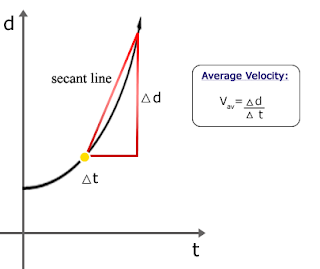
We can sort of feel the direction the points are headed. But there is a more precise way of determining which way the point is tending to fly-off at a certain place along the curve. Consider first when we examine a region of the curving variation, to determine the average change. Imagine we are representing the motion of a ball, distance per time.
average velocity graph
(Image attribution sought. Again, thank you, source)

The diagonal line tells us where the curve was generally tending during that region of variation. But it does not tell us where it was tending at any point. In other words, it does not give us what speed the object was tending at a particular place and time in its motion. To do so, we use a technique that diminishes both the change-in-time and the change-in-distance down to an infinitely small magnitude. Each value by itself no longer has a magnitude in comparison to the finite magnitude it began as. However, these two infinitely small magnitudes can still maintain their ratio value to one another. And this value in a sense has a quantity. Deleuze explains this by referring us to Leibniz' doubled triangle demonstration. Two right triangles, whose diagonal (hypotenuse) line is mutually constructed, maintain the same proportions as one is reduced while the other increases. So as the lines of the small one diminish to the infinitely small (but not yet completely zero), they still maintain the same ratio as the lines of the larger triangle. Hence we can still conceive of a finite value holding between two non-finite (infinitesimal) magnitudes.

leibniz calculus triangles from Justification of the Infinitesimal Calculus by that of Ordinary Geometry
(Image my own, made with OpenOffice Draw and GIMP)

Leibniz Justification of the Infinitesimal Calculus by that of Ordinary Algebra diagram animation
(Animation above is my own, made with Open Office Draw and Unfreeze.)

So watch as we reduce the two magnitudes of the axis. See how it alters the angle of the diagonal, until it seems to depict the way the curve is tending at the given point.


instantaneous velocity graph
(Image attribution sought. Thank you very much, source)

This animation shows how the tangent is angled at each place along the curve, and we can see how it depicts the way the curve is tending at each point. [When it turns black, it hits points of inflection. Some day we will turn to this concept that Deleuze discusses in The Fold.]

Sliding tangent curve
(Thanks wiki)

So we are deriving the tangent on a curve. Our curves can be described by functions. What we find is that in order to find the derivative, we need the x and the y values to be at different powers, that is, having different exponents. Deleuze refers us to a concept of depotentialization, which he very well might have drawn from Hegel's calculus writings in the Science of Logic (especially§§569-570). Consider the graph below. If we just have y = x, then we just have a straight line, and not a curve.
graph of y = x^2 x squared and y = x^-2 square root of x
(Image my own, made with Geogebra, OpenOffice Draw and GIMP)

But when we have y = x squared or y = the square root of x, then we have curves. What seems to allow for the function's line to curve is that there is a difference of power between them. In the case of y = x, they both tug on each other about the same amount throughout their variations. But in y = x squared, it is as though y pulls more-and-more on x as x increases, which is why the curve rapidly tilts upwards. So we might think of y having an increasing power, or having power of a higher order. For each standard unit of increase of y, it has an increased influence on x, and the magnitude of that influence itself increases with each unit. Deleuze refers to this as an acceleration. We will need to use this metaphorically to extract an idea we later use: we can only find the power relations on a curve if our line is curved, and we can only have a curved line if x and y have different powers in relation to one another.


Spinoza's Body Differentials

So we turn now to Deleuze's Spinozistic theory of affection and the body. At any moment, we are affected more-or-less by something [see Deleuze Cours Vincennes 20-01-1981]. This gives us more-or-less power to survive, and it indicates our capacity to endure such influences. As well, it tells us our power to influence other things. Our level of affection is always in continuous variation, like a curve. So at any moment, there is an instantaneous affection. It is the degree to which our level of affection is trying to change. It is the intensity of the change, stripped from the actual transition, and this transition requires duration to express itself fully. So if someone poisons us with arsenic, we lose power to survive, act, withstand influences and cause influences. Too much, and we die.

Deleuze further incorporates the differential calculus to explain this in physical terms. He finds implicit in Spinoza's thinking the idea of "simple bodies" [see Spinoza's Letter 32, Deleuze's Cours Vincennes 10-03-1981, and Deleuze's Expressionism in Philosophy, Chapter 13.] Spinoza discusses the composition and coherent relations of parts in the world in his Letter 32 to Oldenburg. Spinoza says that parts cohere when "the laws or nature of one part adapts itself to the laws or nature of another part in such wise that there is the least possible opposition between them" (Spinoza
Letters 192d). So he is taking into consideration
things as parts of a whole to the extent that their natures adapt themselves to one another so that they are in the closest possible agreement. In so far as they are different from one another, to that extent each one forms in our mind a separate idea and is therefore considered as a whole, not a part. (Spinoza Letters 192-193)
Spinoza offers an example "the motions of particles of lymph, chyle, etc.," which he regards as the parts of the blood. The particles
adapt themselves to one another in accordance with size and shape so as to be fully in agreement with one another and to form all together one single fluid, to that extent only are the chyle, lymph, etc. regarded as parts of the blood. But in so far as we conceive the particles of lymph as different from the particles of chyle in respect of shape and motion, to that extent we regard them each as a whole, not a part. (193a)
We will find that Deleuze will emphasize not so much the principle that allows the parts to accord with one another, but rather the difference which makes them different and thus relatable to begin with. We will first note how Deleuze conceives these parts which differentially relate to one another. Bodies, including our own, extend in space. This means they are made of smaller extending parts. We can keep dividing parts and only find more extensive pieces. But if we were to infinitely divide an extending part, we would have something that no longer extends, because it is infinitely small. So blood is made of lymph and chyle. We can divide chyle up into infinitely small pieces. They do not actually exist, because they are no longer extending bodies. But they are virtually there. Consider how we looked at an infinitely small part of time and an infinitely small part of space when finding the instantaneous velocity. We cannot have speed without an extent of time or space, because there is no motion. However, the instantaneous velocity is real. So it is real but not actual. This is Deleuze's virtual. We will try to apply this to extending bodies. There are not really infinitely small bodies making up our larger bodies. However, they are there virtually, and they can be explicated by means of our differential analysis. Deleuze will explain more.

So we consider that we may find some infinitely small reduction of a part of chyle. It is not really there, but when we place that tiny value in relation to another one, we can find the differential value holding between them. So note first the following. Our blood has a certain quantity of power (and so does the arsenic). What does this value come from? Deleuze says that the particles relate according to differences in speed and slowness. It could be that an infinitely small part of chyle moves at a different speed than an infinitely small part of lymph. I would suggest another conception. We might say that the lymph and chyle affect one another, but the one being of a greater power, like the x squared. So the difference in power would be like different speeds, one pulling harder and faster than another, causing the acceleration of the line's change in our graphs. Let's try this interpretation. So chyle and lymph are made of infinite sets of infinitely small parts. There is a power struggle between the sets, and this produces a value, indicating the blood's power. So if there are violent forces of variation in a body, it will be more powerful. It will be able to undergo the influence of very strong other differential values. So consider then if arsenic enters our blood. Our blood already has a differential value, so too does the arsenic. The bodies of our blood and those of the arsenic collide. If we can somehow be beings with arsenic in our blood, and still survive, then we are incorporating more differential variation within us. We evidently are strong, because it can survive even when poisoned. But if our blood decomposes, causing our body to decompose with it, then the arsenic decreased our power. This is power based on constitutive difference, on variation.

When the arsenic enters our blood, it will differentially relate to the blood's parts, and in that way affect the blood's relations. This will affect the way the other parts of our bodies differentially relate, in a chain reaction ending in the decomposition of our bodies. So the arsenic caused waves of affection to flow through our bodies, and this happens on the basis of a differential encounter. Later when discussing Deleuze's aesthetic affection, we will return to this notion.


One Body, One Blood?

The reason we consider blood to be one thing with parts is only because the parts have differentially related. If they assimilated, there would be no composition of parts, just a heterogeneous composition, whose parts are only spatially different. In other words, consider when the arsenic enters the blood. The two differentially relate in such a way that blood decomposes. We might rather say that it deforms. The blood is already a deformation of lymph and chyle. So when lymph bodies meet chyle bodies, one has more power than the other, but the two benefit from each other's differences and continue relating until new bodies like arsenic disrupt the differential relations. So blood is one body not in the sense that it consists of assimilated parts, quite the opposite: we call it a body because conditions allow its parts to persist in their differentially affecting one another, until something causes alteration.


Bodies of Rhythm

Let's now clarify then Deleuze's Spinozistic concept of body, by turning to his
Spinoza: Practical Philosophy. In Spinoza: Practical Philosophy, he will associate two somewhat parallel distinctions:

Kinetic / Dynamic
Longitude / Latitude

When we define a body kinetically, we regard their being infinitely small parts that differentially relate to one another in terms of differences in speeds and slownesses.
How does Spinoza define a body? A body, or whatever kind, is defined by Spinoza in two simultaneous ways. In the first place, a body, however small it may be, is composed of an infinite number of particles; it is the relations of motion and rest, of speed and slownesses between particles, that define a body, the individuality of a body. (Practical Philosophy, 123a)
He writes in a footnote that these particles whose speeds and slownesses differentially relate are 'simplest bodies,' which are the infinitely small divisions of extensive bodies [for more on simplest bodies as infinitely small divisions of extensive bodies, see Cours Vincennes 10-03-1981, and Deleuze's Expressionism in Philosophy, Chapter 13.] This kinetic dimension is also what Deleuze calls the longitude of the body:
We call longitude of a body the set of relations of speed and slowness, of motion and rest, between particles that compose it from this point of view, that is, between unformed elements. (Practical Philosophy 127c) [ft.3: Cf. what Spinoza calls "the simplest bodies." They have neither number nor form nor figure, but are infinitely small and always exist as infinities. The only bodies having a form are the composite bodies, to which the simple bodies belong according to a particular relation. (Practical Philosophy 127d)]
In a course lecture, he explains how according to this kinetic sense of the body that: "L’individualité du corps, pour lui, de chaque corps, c’est un rapport de vitesses et de lenteurs entre éléments" (Cours 02/12/1980 - 1). Since we are dealing with relations between speeds, and because speeds are quantities, perhaps we might translate 'rapport' as 'ratio,' at least in certain cases like this. So when we speak of the 'relations' of speeds and slownesses, perhaps we could also think of them as the 'ratios of speeds and slownesses.'

We might find ourselves interested at times in form and at other times in the changes that forms undergo. Yet both the form of something and its mutations are both grounded on the differential relations of speeds and slownesses of the parts. Blood is composed by the differential relations between infinitely small parts of chyle's speed and infinitely small parts of lymph's speed (that is, all the one's tendencies-toward-change and all the other's). The sum integrated total of all these differential relations, at a given time, between the infinitely small parts under differential relations between the sets, might be the form. The mutation of forms might then come from the differential relations between the elements of one moment with those of another moment. This would look at how one body relates to itself over time as it continually alters. So while we might find form and alteration to be interesting, Deleuze says:

The important thing is to understand life, each living individuality, not as a form, or a development of form, but as a complex relation between differential velocities, between deceleration and accelerations of particles. (Practical Philosophy 123bc)

That fact that things change, or that they 'become' can be quite interesting. But what might interest us more are what underlies those becomings, which are the differential relations. These perhaps are more matters of logic than metaphysics. They are the source of the power that secondarily gets expressed as change.

Deleuze also defines these differential relations of speeds and slownesses in musical terms, and we will return to this metaphor of music later.

Now, however, we define a body dynamically when we take into account the way it affects other bodies and is capable itself of withstanding affections.
Secondly, a body affects other bodies, or is affected by other bodies; it is this capacity for affecting and being affected that also defines a body in its individuality. (Practical Philosophy 123a)
Deleuze points-out that we will understand the things in our world differently when we comprehend them in terms of their capacity for giving and enduring affections instead of in terms of their formal relations. He has us consider the way we understand plow horses, racing horses, and oxen. Normally we would think that the horses are more akin to each other than is either horse to the ox. But let's consider these animals in terms of their affective capacities.
Take any animal and make a list of affects, in any order. Children know how to do this: Little Hans, in the case reported by Freud, makes a list of affects of a draft horse pulling a cart in a city (to be proud, to have blinders, to go fast, to pull a heavy load, to collapse, to be whipped, to kick up a racket, etc.) (Practical Philosophy 124a)
A draft horse has much the same capabilities as an ox. A race horse might struggle too much under the burden, respond wickedly to the whip, fear the situation rather than respond with pride in its abilities. But even capabilities might vary according to circumstances. If we were meditating in the dark, and someone turns on the light, this will dazzle our eyes and decrease our powers. But if we were looking for our glasses in the dark and then someone turns on the light, it increases our powers. These increases and decreases are always instantaneous and infinitesimal. [Deleuze Cours Vincennes 20-01-1981].

Deleuze also refers to the dynamic sense of body as latitude.

We call latitude the set of affects that occupy a body at each moment, that is, the intensive states of an anonymous force (force for existing, capacity for | being affected). (Practical Philosophy 127-128)

We turn now to Deleuze's using the metaphor of music to illustrate the kinetic view of the body:
The important thing is to understand life, each living individuality, not as a form, or a development of form, but as a complex relation between differential velocities, between deceleration and accelerations of particles. A composition of speeds and slownesses on a plane of immanence. In the same way, a musical form will depend on a complex relation between speeds and slownesses of sound particles. It is not just a matter of music but how to live: it is by speed and slowness that one slips in among things, that one connects with something else. (Practical Philosophy 123c)
Deleuze will develop this music metaphor further. He will also use the example of a wave. So let's take a look at what he might mean by taking a look at what could be the differential relations in sound waves.

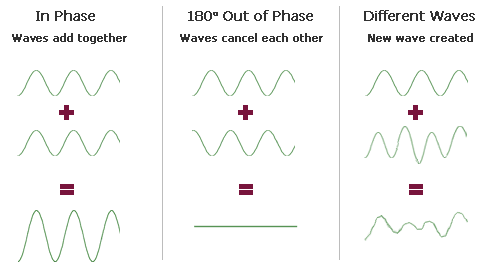
When waves intersect, the can either add or subtract from one another, depending on how the waves are lining up.

So you can see the different possibilities.


So when two waves intersect, they push and pull on each other, and thereby create a co-composed deformation. Even a harmonic combination is still a deformation of the original waves:

harmonic sound wave combination
(Thanks jimloy.com)

We might see this better with a three dimensional animation of waves differentially deforming one another. [This animation comes from one of Paul Falstad's absolutely amazing simulators].


(Thanks Paul Falstad)

Now consider also this animation from the University of Salford, showing how the overtones of a string combine. These are additional smaller waves that accompany all real waves in the world around us. [See this entry on Pythagoras for a detailed explanation.]


So we see that these wave-combinations, even when harmonic, produce deformed waves. But such deformations perhaps would only come about if the parts were differentially related, each one communicating its differences to the other.

Deleuze uses the musical metaphor to describe Spinoza's vision of the world's composition. Bodies are made of these differential relations between the infinitely small parts of infinite sets. The values of those relations determine the combined differential body's affective power. Again, this affective power is its capacity to sustain a differential relation to another body without disintegrating apart or becoming assimilated into the other body. We saw in the three-dimensional animation how the smaller wave can still be seen in the larger one, and the larger one still discerned despite the smaller one's cutting through it.

three dimensional waves smaller flowing through larger
(Thanks Paul Falstad)

But even for the more complex wave forms, like the guitar string one above, we may still extract the component overtone values by means of Fourier analysis [discussed in this entry]. This means that no matter how much the component waves seem to have been swallowed-up and assimilated, they are still implied in the composite wave. So if we could see the sound waves in the air while a symphony plays, we would notice the effects of all the differential variations affecting one another as they come into contact. In other words, we would see the composition in the air as a network of differential relations that are the affections between different speeds and slownesses.
we are concerned [...] with a symphony of Nature, the composition of a world that is increasingly wide and intense. In what order and in what manner will the powers, speeds, and slownesses be composed? A plane of musical composition, a plane of Nature, insofar as the latter is the fullest and most intense Individual, with parts that vary in an infinity of ways. [126d]
In his seminars on Spinoza, Deleuze better explains the differential and compositional relations of affective speed. He begins with the idea of the simplest bodies, the infinitely small parts of a body [The following is from Cours 12 du 17/03/81]. They have no internal composition, because they are like the infinitely small values of vanishing terms. So they can only have external relations. When another body impacts us, that is, when our differentially related parts shockingly impact the other body's parts, both sets will differentially relate, causing changes in the relations of our internal parts, like a wave moving through us, changing all the other waves as it passes. We might know then how we were changed by that external wave. This is the first kind of knowledge. But we might also something about our own differential relations and how they differentially relate to other differential relations. Deleuze gives the example of swimming through a wave. The second kind of knowledge is 'know-how', which involves knowing how our body differentially relates to others and also our knowing how to change our own inner differential relations so that we sustain our differential relation with the thing we encounter.

When we jump into the water to swim, our simplest bodies and the wave's simplest bodies shockingly contact one another and send through each other waves of affective variations. This impact registers on our body, and the imprint is like the first kind of knowledge. This is the effect of the shock. But that does not mean we know anything about our own relations or the wave's relations.

But if we adjust our body so that we swim through the wave, then we have more than just a knowledge of the immediate shocking impact that the wave has on us. Deleuze calls it a sense of rhythm. This is a knowledge of how our differential relations differentially relate to other differential relations.
Alors, au contraire je sais nager, ça veut pas dire forcément que j’ai une connaissance mathématique ou physique, scientifique du mouvement de la vague, ça veut dire que j’ai un savoir faire. Un savoir faire étonnant, c’est à dire qui une espèce de sens du rythme. La rythmicité. Qu’est-ce que ça veut dire le rythme ? Ca veut dire que mes rapports caractéristiques je sais les composer directement avec les rapports de la vague. ça se passe plus entre la vague et moi, c’est à dire ça se passe plus entre les parties extensives, les parties mouillées de la vague, et les parties de mon corps, ça se passe entre les rapports. Les rapports qui composent la vague, bon, les rapports qui composent mon corps, et mon habileté, lorsque je sais nager, à présenter mon corps sous des rapports qui se composent directement avec les rapports de la vague. Alors c’est : Je plonge au bon moment, je ressort au bon moment, j’évite la vague qui approche ou au contraire je m’en sers, etc. Tout cet art de la composition des rapports (Cours 12 du 17/03/81)
Recall also our reasoning for using the term 'ratio' instead of 'relation' when speaking of the differential relations of speeds and slowness between parts. This was because the speeds or slowness (or better, their instantaneous tendencies toward speed or slowness) are quantitative, so their relation could be one of a ratio. This also could help explain why our knowing how the speeds and slownesses relate is a matter of a sense of rhythm. We normally think of rhythms as a repeating pattern per some amount of time. And we might say that a rhythm has a certain relative speed to it, depending on how it divides temporal portions. But in this Deleuzean sense, rhythm is the way speeds differentially relate. When we jump in the water, knowing how to maintain ourselves within the water, despite our continual differences with the wave, is a sense of rhythm. So rhythm in this sense is something immediate, and it is not so much like a pattern repeating through time. Specifically, rhythm is the way the different speeds of bodies affect themselves and one another in response to each other.

Deleuze uses both the swimming example and a dancing example in another seminar. He says when we encounter the wave or enter the dance floor, we are living in the rhythm of our interaction, where we are continually anticipating how the wave or dance-body will affect us, and then also we adjust ourselves so that we survive through it. He notes that those who do not know how to dance might anger everyone by dancing however they can so to disrupt the overall flow. (
Cours - 03/02/81 - 2) This would be a case where one body fails to cause itself to self-differentiate in such a way that it sustains its differential relation with another body. The bad dancer causes the dance to break-down, and hence there becomes no point for him to be dancing anymore. And he himself, by angering everyone, has lowered his own social powers of affection.

Deleuze also uses the metaphor of musical instruments playing together to illustrate the rhythmic combination of a third body. He says that rhythm is something like the shared interaction at the boundary of two meeting bodies. Rhythm is not so much to be found in the violin or the piano alone, rather rhythm is to be found in violin responding and reacting to the piano all while the piano at the same time responds and reacts to the violin. This is sort of like them dancing. The third body then is the musical work that their shared rhythmic interaction produces. [Le rythme c’est une notion commune à deux bords au moins. Le rythme il est fondamentalement commun à au moins deux bords. Il n’y a pas le rythme du violon, il y a le rythme du violon qui répond au piano et le rythme du piano qui répond au violon. Ça c’est une notion commune à ce moment là. Vous savez la notion commune de deux corps, le corps du piano et le corps du violon, sous l’aspect, sous tel ou tel aspect, c’est-à-dire, sous l’aspect du rapport... du rapport qui constituera telle œuvre musicale et qui forme le troisième corps.] (
Cours 31/03/81 - 14_- 2)


Sources:

Deleuze, Gilles. Spinoza: Practical Philosophy. Transl. Robert Hurely. San Francisco: City Lights Books, 1988.

Deleuze's Spinoza Course Classes:

Cours 20/01/1981
webdeleuze.com
French and English

Cours 03/02/81 - 2
http://www2.univ-paris8.fr/deleuze/article.php3?id_article=221

Cours 10/03/1981
(webdeleuze.com)
French and English

Cours 17/03/81
http://www2.univ-paris8.fr/deleuze/article.php3?id_article=151

Cours 31/03/81 - 14_- 2
http://www2.univ-paris8.fr/deleuze/article.php3?id_article=46

Cours 02/12/1980 - 1
http://www2.univ-paris8.fr/deleuze/article.php3?id_article=91
http://www.webdeleuze.com/php/texte.php?cle=209&groupe=Spinoza&langue=1


Spinoza. The Letters. Transl Samuel Shirley. Cambridge: Hackett Publishing Company, Inc., 1995.


Image and animation sources.

Derivative animation
http://faculty.uncfsu.edu/msiddiqu/Maple_Animations.htm
(Thanks Fayetteville State University Department of Mathematics and Computer Science)

Wikipedia sliding tangent
http://en.wikipedia.org/wiki/File:Graph_of_sliding_derivative_line.gif
(Thanks wiki)

3-D Wave animation made using:
http://www.falstad.com/mathphysics.html
(Thanks Paul Falstad)

Phase sound wave image:
http://www.mediacollege.com/audio/images/wave-interaction.gif
(Thanks mediacollege.com)


Combining wave animation:
http://pages.physics.cornell.edu/courses/p101/6/demo2.html
(Thanks physics.cornel)

String combination animation from:
http://www.acoustics.salford.ac.uk/feschools/waves/string.htm
(Thanks acoustics.salford.ac.uk)

Harmonic wave combination image:
http://www.jimloy.com/physics/harmony.htm
(Thanks jimloy.com)


19 Sept 2010

The Cycles of Our Life-Sines. Trigonometric Functions in Edwards & Penney's Calculus (Section 1.4)


presentation of Edwards & Penney's work,
by
Corry Shores

[
Search Blog Here. Index-tags are found on the bottom of the left column.]

[Central Entry Directory]
[Mathematics, Calculus, Geometry, Entry Directory]
[Calculus Entry Directory]
[Edwards & Penney, Entry Directory]

Edwards & Penney's Calculus is an incredibly-impressive, comprehensive, and understandable book. I highly recommend it.


[I am not a mathematician; I am merely an admirer of Edwards & Penney's wonderful calculus book. Please consult the text or other references to be certain about anything in the summary below. I mean this emphatically.

The material here is from Edwards & Penney. Whenever it is not, I will indicate the source. Thanks:
Edwards & Penney
eugeneleeslover.com
mathworld.wolfram.coml
wikipedia
zonalandeducation.com
sparknotes.com
blog.ssis.edu.vn
elegantgirls.w-ru.com
mathforblondes.com
cliffsnotes.com
theroswellcode.com
mathimage.com
acoustics.salford.ac.uk
Math Demos
]


The Cycles of Our Life-Sines
Sine wave circle animation
Review and philosophical application of
Edwards & Penney's
Calculus

Trigonometric Functions
in
Section 1: Functions, Graphs, and Models
Subsection 4: Transcendental Functions


What Do Trigonometric Functions Got to Do with You?

Our lives course-by to many wave-like periodic patterns. Each day the sun rises-and-falls, increasing-and-decreasing light like a wave, with noon as the peak, and the middle of the night is the wave's bottom trough. And those of us living away from the equator experience another sort of waving of the light. Days get longer as we near summer solstice, and shorter as we head toward winter solstice. This can affect our moods, and as well the ways we feel about ourselves, the way we behave, the thoughts we have, and the way we relate and interact with others, loved-ones especially. On winter solstice, the darkness might feel heavy, like we are trapped under a blanket of black. Here we are at the bottom arc of the periodic curve. It might feel as if we are stuck forever in the winter darkness. Now consider more closely that exact moment of winter solstice when the earth enters its magic place along its revolution around the sun. We come upon the limit of the darkening trend. For a moment-out-of time, we no longer tend toward shorter days. And it is not yet until the next moment that the trend will change us toward longer days. Then as we near spring equinox, we can sense the tendency-toward-light increase. We can actually feel these tendencies immediately, as we witness the earth come alive again, erupting from its frozen slumber. And perhaps we too feel forces pushing our moods to the lighter and freer feelings of the summer.

There is something quite remarkable about these wave-like periodic patterns that we find in so many ways in our everyday experiences. They can be described by trigonometry and circles. At any moment in the cycle, a circle is being implicitly expressed. In a way, repetition is there from the beginning, and it is there at every instant. The wave patterns in the world and in our lives express circles in motion. There is an eternal recurrence in our lives, but it is not just the cycles repeating over-and-over seemingly without the intention of ending. Rather, recurrence is already there from the beginning, because the whole circle is implied at the start and it is implied in any instant. In a sense, the eternal form of the circle, and especially its internal structural relationships between its parts, is like a mythical eternal ground for our world and for our lives. It is eternal not because it happens infinitely, but because it is outside of time. All particular recurrences that we see in cyclical patterns happening through time were made possible on the grounds of an eternal recurrence that is outside of time and yet is implicitly immediate to every real moment of its expression in our lives.

Now, the circle just by itself is an expression of eternal repetition. The circle as it begins its motion implies already its return to its beginning. So consider the wave-like patterns which express a circle. The circle they express is eternal, because at any point along the waving change, the circle as a closed shape is already implied. In other words, the circle has returned upon itself even as its wave-expression begins. But this repetition is not possible on the basis of some sameness. The eternal is not a line that goes on forever. It is continually bending away from where it is, but back toward where it began. But when it returns back to where it began, it does not stop there. When it returns, the tendencies toward change are just as strong then as they were at every other place in the circle. And at every point along its changing course, the path is differing from itself already. The change is continuous because the motion always differs from itself. In other words, it is only because self-difference is always in the circle that there is the potential for it to return to itself. So we might think that the circle is everywhere the same. But we see that it is also everywhere tending away from itself, even while tending back toward itself in the same motion, like the snake biting its tail. In our own lives, we go from summer to summer. And it seems like each summer is similar to the rest. But what we experience is not a continual summer. What we experience is a continual self-differing as the changes proceed. We keep having summers only because they never stay the same. It would be one eternal summer if the circle's repetition were based on sameness. Rather, it is a matter of difference already there immediate to us that allows summer to tend away from itself, and welcome itself once again immediately upon itself. We only experience something again if we experience a different instance. We might find ourselves acting out a habitual action that makes us relate to ourselves in the past. But we can only encounter our past selves by meeting ourselves as other to ourselves. The identification is secondary, a matter of recognition. What is primary is that we are firstly different from ourselves.

So consider if we go from experience a to experience b; we can afterward say they are different. But we could not have arrived at b unless first difference paved the way. And we could not have begun at a unless a's way was already paved by difference. Difference is what is most immediate. The things that come to be called different are a secondary derived form of difference. But when we note that we go from summer to summer, from a to a, we should realize again that the second summer, the second a, first needed difference before it could arise. The same for the circle. We cannot say that it arrives back upon its beginning unless the beginning is already different from itself. A circle can begin and end at the same point, but only if that same point is different from itself, so it can serve on the one hand as the beginning, and on the other hand as the end. Now consider how the geometrical form of the circle implies this motion, but itself is not rotating. Any point along the circle is already a beginning and end, a self-different point, a point that treats of itself as being different from itself. Now, what the cycles of our life and world imply is a geometrical circle. Such circles might express themselves in durational wave-like patterns, but as a formal element to that pattern, the circles are outside duration; they are eternal. The circle then should hardly evoke in us the idea of eternal sameness. It is eternal difference, an always and everywhere self-difference.

So as we notice cycles in our lives, we could on the one hand think about how things are somehow both same and different, how there are always ambiguities. We can in addition consider that when we for example lie down to sleep, we are not just sleeping again, or having a different sleep, but that we are immediately experiencing an eternal repetition of difference. Sure, each sleep is unique. But it expresses a difference more profound than its uniqueness. Each sleep is an expression of the difference which made it possible. The eternal substance of all our experience, of everything in our world, is difference.

So if there is one thing that is always repeated eternally, it is difference. The eternal circles implied in the many waves in the world and in our lives are testiments to a more profound eternity, the eternal difference, the eternal return of difference.


Brief Summary

The relations between the sides and angles of a right triangle can be described through the science of trigonometry. We may then apply these relations to angles in circular variation. By doing so, we are able to describe the wave-like periodic patterns in the natural world.


Points Relative to Deleuze
[Under Ongoing Revision]

For Deleuze, our sensations are matters of continuously varying waves. Affection in general is a matter of such a continuous variation. We wonder, why a wave? Is there not continuity to a wave, and thus not complete difference and heterogeneity? Or is there something heterogeneous and discontinuous in the series of tendency-changes along a wave? We should try to be specific about why Deleuze speaks of these waves of sensation, especially considering that sensation is a matter of difference and a discontinuity in our experiences. I currently suspect that the wave is a useful image, because on the one hand there is a continuity in the series; each point or limit is immediately near its neighbor. However, on the other hand there is a discontinuity in the series of tendencies (differentials), moving from one limit to the next along the wave's curves.


Edwards & Penney

Appendix C: Review of Trigonometry

We begin looking at a right triangle.

Edwards Penney Right Triangle adjacent opposite hypoteneuse

We see the right angle in the bottom right corner. The other two must then total 90 degrees, so they both must be acute (less then 90 degrees). The trigonometric functions will be ratios between sides of angles, relative to the acute angle in question. We may arbitrarily pick which of the two acute angles to be θ (theta). Then, the side opposite to theta will be considered the "opposite" side. There are two lines that will come out of theta. One will be opposite to the right angle. This is always the "hypotenuse". The other line extending alongside theta is called the "adjacent" side. We now make ratios of the lengths of the sides. For example, we might take the ratio of the opposite angle over the hypotenuse. By doing so, we have defined the "sine" of theta. When we instead take the ratio of the adjacent line over the hypotenuse, we have then determined the "cosine" of theta. We will use the following abbreviations:
cos = cosign
sin = sine
tan = tangent
sec = secant
csc = cosecant
cot = cotangent
There are six primary trigonometric functions:

edwards penney trigonometric functions secent cosecent tangent cotangent sine cosine

Here by the way is a table calculating the values for our approximations [click to enlarge]

We might also consider these angles more dynamically. They could be formed by a rotation of sorts.

edwards penney circle sine

An angle created by rotation is called a directed angle. Using the image above, we imagine that first the two lines extending from the angle both begin together along the right side of the x axis. Then, one of the lines rotates away while the other remains on the x axis. If the rotation of the line moves counterclockwise, we consider the angle to be a positive angle. But if it goes clockwise, we instead consider it to be a negative angle. We consider P(x,y) to be the point where the moving (terminal) side of theta intersects with the circle. This circle we define as


Let's break from Edwards & Penney to give more background on the circle. Its formula is:


The center-point is (a, b), and r is the radius. To make things easier, we will just make the center-point (0, 0). This way we simplify the formula to.

circle formula

To form a 'unit circle', we make the radius one unit, that is, equal to 1.

unit circle formula diagram

We can construct the circle from this formula. See how the points plotted above fulfill it.


unit circle formula diagram

Now let's pick some point (x, y) on the circle.

unit circle formula diagram

We could then drop a line down from this point to the x-axis.

unit circle formula diagram

It will have the value y, because it extends directly up the y axis. Then we can get the x value by extending the line from that new corner to the origin.

unit circle formula diagram

Then finally the radius line going out to our point on the circle will be 1, because we have defined the radius that way.

unit circle formula diagram

Using the Pythagorean theorem, we see that we return again to our circle formula:

unit circle formula

So let's consider angle theta.


unit circle formula diagram

And recall the formulations for cosine and sine.

formula cosine sine

We see that they are both set over the hypotenuse. But the hypotenuse is 1. The adjacent angle is x. And the opposite angle is y. Hence we can define the following [and we return now to Edwards & Penney]:

We make some assumptions in the above. For tan θ and sec θ, we assume that x ≠ 0 [so that we do not have a number divided by zero]. And for cot θ and csc θ, we assume that y ≠ 0.

If we make substitutions in the above equations, we can use sine and cosine to define the others.


Edwards & Penney then have us compare the angles θ and -θ in this figure:


Notice that the x and y lines will be the same length. Hence:

cos(–θ) = cosθ

and

sin(–θ) = –sinθ

Then, by working on the values, they give us the following formulas.

The Fundamental Identity of Trigonometry:

cos2θ + sin2θ = 1

thus

1+ tan2θ = sec2θ

thus also

1 + cot2θ = csc2θ

The Addition Formulas:

sin(α + β) = sin α cos β + cos α sin β

cos(α + β) = cos α cos β – sin α sin


The Double-Angle Formulas:

sin 2θ = 2sinθ cosθ

cos 2θ = cos2θ – sin2θ

= 2cos2θ – 1

= 1 – 2sin2θ


The Half-Angle Formulas
(These, they say, are particularly important in integral calculus):

cos2θ = ½(1 + cos2θ)

sin2θ = ½(1 – cos2θ)


Radian Measure

Normally we measure measure angles in degrees, like 360°, 90°, etc. However, there is another means called radian measure. It is often more convenient, and even at times essential, to use radian measure in calculus. So consider this image below [first one from wikipedia]


arc length radius radian
[Thanks wikipedia.org]

arc radius radian circle edwards penney

Here we see that the radius has a certain length, and it equals the circle's arc created by the angle. We say that the angle 'subtends' in the arc. And the length of the arc equals the length of the radius. This wonderful animation from zonalandeducation.com shows how the lengths are equal.


Now consider this animation. It shows that when the diameter of circle is 1 unit, the circumference is pi (π) units.

circumference diameter pi radian animation rolling circle wheel
[Thanks wikipedia.org]

So the diameter multiplied times π will tell us the circumference. This means also that the formula for the circumference could be rendered, when in terms of the radius:

C = 2πr

So the radius measure, times , will give us the circumference. But we are also dividing that circumference up into radius length arcs. Each one corresponds to a fixed angle measure, which we can convert into degrees if we wish. So we know that the circumference is times the radius measure. That corresponds to the total of all the internal angle-measure, which is 360°. If times the radius gives us 360°, then π times radius gives us 180°.


On this basis, we can calculate conversions between radians and degrees.


Here are some conversion charts [The second one is from Edwards & Penney]:

degree radian conversion chart
[Thanks sparknotes.com]

degree radian conversion chart

degree radian conversion circle diagram
[Thanks blog.ssis.edu.vn]


degree radian conversion circle diagram
[Thanks wikimedia.org]

Recall also the formula for the area of a circle:

formula area circle

From this we can obtain the following formulas


Section 1: Functions, Graphs, and Models
Subsection 4: Transcendental Functions

Trigonometric Functions

Now first consider this 30-60-90 degree triangle.
30-60-90 degree triangle
[Thanks wikimedia.org]

We see that the sine for the 30 degree angle will be a/2a, or 1/2. And using our conversion methods, we see that this is equal to π/6 radians.


So we see for example these equivalences charted on tables such as these:


trigonometry trigonometric conversion chart degree radian sine cosine tangent
[Thanks cliffsnotes.com]

Now consider this diagram:


Here it is in radian measures:

unit circle to sine wave conversion diagram
[Thanks mathimage.com]

See how the 30 degrees (π/6) on the sine of the circle corresponds to the 0.5, or half-way up the sine wave to the right? A great animation for how the sine wave is formed from the circle values can be seen here.

I tried to capture it, but the quality is much better at the source. [Also it is a wonderful source for many other acoustic related things ideas].

Here is another great animation from Math Demos [Also much better seen at its source]:


And this one is from wikipedia.

circle to sine wave animation
[Thanks wikipedia.org]

And here is one for cosine:


For tangent,


circle to tangent wave animation
[Thanks wikipedia.org]

And for cosecant:

circle to cosecant wave animation
[Thanks wikipedia.org]

Let's return to Edwards & Penney. Using our radians to degree conversions, we obtain:


Now let's also consider when we let the sine wave continue. It repeats its regular oscillation
.


This is called the periodicity of the trigonometric functions. Every the unit circle rotation returns to where it began. So too does the sine wave pattern repeat its period with each return. Hence

sin(x + 2π) = sin x and cos(x + 2π) = cos x

When we shift ('translate') the cosine graph by π/2, we get the sine graph.


Example 2:
Consider this graph.


It charts the average daily temperatures in Athens, Georgia, USA. It begins in the middle of July, and returns to the next middle of July. As we would expect, the temperatures are higher in the summer, and lower in the winter. They swing like a wave. In this case, the pattern resembles a cosine wave. The formulation that describes this wave is [where average temperature is T in °F, and the number of months after July 15 are t]:


So let's consider October 15, which is three months after July 14. We will then substitute 3 for t. What we obtain is 61.3°F. Note first that the substitution gives us cos(3π/6 ). This is the same as π/2. Recall from the chart that this cos (π/2) = 0.


So now working out the equation is easier:


And of course, this pattern is periodic, which means that in 12 months it returns to where it began.


Let's look again at the graph for y = tan x.

graph for y = tan x

Photobucket
[Thanks wikipedia.org]


The tangent is the blue segment's length divided by the green segment's length. When we near the π/2 part, we have a number divided by an increasingly small number. So 1/ 0.000001 is 1,000,000. As the smaller number nears zero, the quotient of the two nears infinity, hence the tangent lines flying-off to infinite heights. This also means, however, that unlike the sine and cosine graphs, the tangent graph has 'infinite' gaps. Where the top part leaves-off is infinitely high, and where the bottom part picks-up immediately after is infinitely low. Such gaps are called discontinuities. We will later discuss them in more depth.


from Edwards & Penney: Calculus
. New Jersey: Prentice Hall, 2002, pp. A13-15; 33-36.


Image Credits:
Nearly all from Edwards & Penney, except,

Table of Natural Trigonometric Functions:
http://www.eugeneleeslover.com/USNAVY/TRIG-FUNCTIONS.html

Triangle in the circle:
http://mathworld.wolfram.com/Trigonometry.html

Large radian:
http://en.wikipedia.org/wiki/File:Radian_cropped_color.svg

Radian animation:
http://zonalandeducation.com/mmts/trigonometryRealms/radianDemo1/RadianDemo1.html

Diameter wheel:
http://en.wikipedia.org/wiki/File:Pi-unrolled-720.gif

Radian table:
http://www.sparknotes.com/math/trigonometry/angles/section2.rhtml

1st radian conversion circle:
http://blog.ssis.edu.vn/chrischoi/2010/04/08/precal-unit-circle/

2nd radian conversion circle:
http://commons.wikimedia.org/wiki/File:Degree-Radian_Conversion.svg

30-60-90 degree triangle:
http://commons.wikimedia.org/wiki/File:30-60-90_triangle.jpg

Radian trigonometry conversion chart 1:
http://elegantgirls.w-ru.com/inf_trig.html

Radian trigonometry conversion chart 2:
http://www.mathforblondes.com/2010/07/trigonometric-table.html

Radian trigonometry conversion chart 3:
http://www.cliffsnotes.com/study_guide/Trigonometric-Functions.topicArticleId-39909,articleId-39868.html

Sine and Cosine with Circle:
http://www.theroswellcode.com/ArticleDNA.html

Unit circle to sine wave:
http://www.mathimage.com/see_mi_UnitCircleToSineWave.jsp

3D sine wave animation:
http://www.acoustics.salford.ac.uk/feschools/waves/shm2.htm#sine

Math Demos animations all from:
http://mathdemos.gcsu.edu/mathdemos/family_of_functions/trig_gallery.html

Wiki animations from:
http://en.wikipedia.org/wiki/Trigonometry