

Showing posts with label relativity. Show all posts

2 Jan 2010

Simultaneity is Absolute. §81. Ch.4.One or Many Durations? Bergsonism. Deleuze

[The following summarizes parts of Deleuze's Bergsonism. My commentary is in brackets. Paragraph subheadings are my own.]


Gilles Deleuze

Le bergsonisme
Bergsonism

Ch.4.
Une ou plusieurs durées ?
One or Many Durations?


Previously Deleuze discussed Bergson's reaction to Einstein's theory of broken-up simultaneities. Bergson shows that the theory presupposes simultaneities which are absolute. One of these absolute simultaneities is the flow of all flows (which is concurrent with our own consciousness), and hence simultaneities cannot break apart.


§81 Time is One, Because It's a Special Kind of Many

[Recall Bergson's distinction between virtual and actual multiplicities (see §78 of Bergsonism). There is one flow of all flows. Only secondarily may we divide it up into discrete numerically different constituent flows. Because it requires a second act to extract the constituent flows, the universal flow of duration is a virtual multiplicity. But after our mental acts of division, it becomes an actual multiplicity. Einstein's relativity performs such a division, and looks at other flows from the perspective of a particular one out of the group. As a result, we might come to conclude that there is a plurality of times. But these other times are not real lived times. All lived times are concurrent with each other, with the ultimate flow, and with our conscious duration. Einstein wants it both ways. He would like to assign other flows a different temporality, which would not be livable, while in the same stroke call them 'times', as though they were in the same category as lived time. This lived time is only found in the virtual multiplicity. So by trying to have it both ways,] Einstein confuses the virtual with the actual (85a). [Recall also Bergson's distinction between image and symbol from §79. Physicists use math to produce a symbolic representation of the time in other moving systems. But they are not so much imagining the people in the other systems as much as they fictionalize or merely symbolize them. For if the physicists really imagined the other people, they would also take-on their conscious perspective, and thereby find their own system to be the system of reference.] Relativity physicists regard their symbolic tokens, which stand for fictionalized observers, as being in another sense real conscious beings. This explains how they also confuse the virtual with the actual.

So we began with the question, is duration one or multiple? We found that in one sense it is multiple. But this is a virtual multiplicity, which means it is primarily united and only secondarily divided into spatially-distinct actual fluxes. Hence "Only the hypothesis of a single time can, according to Bergson, account for the nature of virtual multiplicities" (85b). Scientists normally spatialize time by representing successive moments along a drawn time-line. But then we see the line all at once. The moments are no longer successive, but rather simultaneous and instantaneous. This deprives them of their real durational character. Einstein spatializes time in yet a new and different way. At different places in space are objects moving at different speeds. The object in one place, moving at its speed, will have a different time-flow than another object moving a different speed through its place. Deleuze writes: "By confusing the two types - actual spatial multiplicity and virtual temporal multiplicity - Einstein has merely invented a new way of spatializing time" (85bc). However, this spatialization of time has advanced the sciences profoundly. [In footnote 24, or the one on p.87 of the French, Deleuze cites two parts of Duration and Simultaneity (reference to be added later). The first one could be: "We have just seen how the notation of a fourth dimension is introduced automatically, so to speak, into the theory of relativity. This undoubtedly accounts for the often expressed opinion that we are indebted to this theory for the earliest suggestion of a four-dimensional environment merging time and space" (Bergson 103a). The second one, regarding the advantages of assuming a space-time manifold, could be: "And much is gained, for the expression with which we provide him is that of a new physical truth: it points out how the 'transmission' of light behaves with regard to the 'translation' of bodies" (119c).]

And yet, the mathematics involved in these four-dimensional calculations does not tell us something about the real nature of time. Although it is beneficial to science, it only produces symbols for a temporality that no one could possibly experience.

this achievement is that of a symbol for expressing composites, not that of something experienced that is capable, as Proust would say, of expressing "a little time in the pure state." (85c)

cette conquête est celle d'un symbole pour exprimer les mixtes, non pas celle d'un vécu capable d'exprimer, comme dirait Proust, « un peu de temps à l'état pur ». (87c)

And as we noted, time, as a virtual multiplicity, is more fundamentally a unity. Deleuze writes:

Being, or Time, is a multiplicity. But it is precisely not "multiple"; it is One, in conformity with its type of multiplicity. (85cd)

L'Être, ou le Temps, est une multiplicité ; mais précisément il n'est pas «multiple », il est Un, conformément à son type de multiplicité. (87cd)


Deleuze, Gilles. Bergsonism. Transl. Hugh Tomlinson and Barbara Habberjam. New York: Zone Books, 1991.Deleuze, Gilles.

Deleuze, Gilles. Le bergsonisme. Paris : Presses Universitaires de France, 1966.


Simultaneity is Absolute. §80. Ch.4.One or Many Durations? Bergsonism. Deleuze

[The following summarizes parts of Deleuze's Bergsonism. My commentary is in brackets. Paragraph subheadings are my own.]


Gilles Deleuze

Le bergsonisme
Bergsonism

Ch.4.
Une ou plusieurs durées ?
One or Many Durations?


Previously Deleuze showed how relativity theory is Bergson's best way to demonstrate his thesis that there is a universal duration that we all share. Bergson takes strictly the premise that there is no absolute reference frame. This means we should not just take one perspective and determine from it the temporalities for all other moving things. Rather, as philosophers interested in the reality of time and not in making accordant physics calculations, we take all perspectives equally and simultaneously. What we find then is that there is no grounds to say the time flow of one is different from another.


§80 Simultaneity is Absolute

Hence, notes Deleuze, Bergson himself claims that relativity theory "demonstrates the opposite of what it asserts about the plurality of time" (Deleuze 84bc). [In footnote 21, the first on p.86 of the French, Deleuze cites §§81-82 of Duration and Simultaneity]

[Recall the previous paragraph. Deleuze explained Bergson's distinction between image and symbol. We might rightly form an image to better grasp the relations between our fluxes. But note that these relations are ones that we are actually living and experiencing. Compare this image to when a physicist determines the temporality for a system moving relative to his chosen point-of-reference. Perhaps he might imagine himself living that other person's life, and sharing her consciousness. But then he would also consider that other location to be the point-of-reference. This would disrupt the physicist's calculations. So he picks one and remains with it for the purpose of his figures. All the while, he is computing the temporal distortions that the other observer would have to be experiencing, in order for all the calculations to come-out accordantly. Would we say still that the physicist imagines this other person? If so, it is not in the same way as in the previous case. We know that the figures he finds for the other observer are the same that the other observer would find for the first physicist. So what he forms are not images of the other observer, but rather a mathematical symbol for them. And this symbol does not even represent the actual time that the other observer experiences. Rather, it represents merely the fact that we are taking one person's perspective instead of the other.]

Bergson also critiques Einstein's conclusion that what seem to be distant simultaneous events in a person's own moving system are not simultaneous from the perspective of the reference-frame.

[In footnote 22, Deleuze will reference §§84-87 of Duration and Simultaneity. In these passages, Bergson discusses relativity's break-up of simultaneities. He has us consider system S and system S'. They are duplicates of each other. S' breaks off and travels at a constant speed. On S there are a group of distant events which are simultaneous, events A, B, C, D, and E. On S' there are the corresponding events A', B', C', D', and E'. Bergson already demonstrated from the twin paradox that observers on both systems experienced the same flow of time. So what is simultaneous in S should in fact be simultaneous in S' as well.] Bergson does not reject the idea that there is temporal variance in the simultaneities of moving systems. What he argues, according to Deleuze, is that the variance is limited to the symbolic representations which are a product of choosing one perspective over another. The temporal distortion is not something that the moving observer could possibly live [for it leads to impossibilities like the twin paradox].

[In the text and continuing into footnote 23 (the third on p.86 of the French), Deleuze goes on to distinguish four sorts of simultaneities that Bergson deals with.
1) Relativist simultaneity. This is the simultaneity between distant clocks. (See §45 and §§83-85 of Duration and Simultaneity)
2) The two simultaneities in the instant. This is the simultaneity between the event and the nearby clock that marks the moment of the event in that location. (See §44)
3) The simultaneity of event and conscious duration. This is the simultaneity between the exterior event and the contemporaneous moment of our consciousness. (See §44-46)
4) The simultaneity of fluxes. This is the simultaneity of all flows together. Our mind can consider all flows flowing together. All the while, our mind itself is flowing. This exhibits the unity of all flows. Our mind's flow, then, would be no different from the flow that unites all flows. (See §42)

Deleuze continues the footnote by referring to Merleau-Ponty's In Praise of Philosophy. Here Merleau-Ponty speaks of our mind's coexistence of all flows. It allows us to extend ourselves into the multiplicious world around us. In fact, doing so, he thinks, is the proper activity of the philosopher. Deleuze writes "Merleau-Ponty clearly shows how the theme of simultaneity, according to Bergson, confirms a genuine philosophy of 'coexistence' " (Deleuze 131).]

Einstein says that the simultaneity between distant clocks varies according to the speed of the system. Yet, Bergson shows that this relative simultaneity presupposes other simultaneities which are not variable but are rather absolute:
1) The simultaneity between two nearby events: "the simultaneity between two instants, taken from external movements (a nearby phenomenon and a moment of the clock)" (84d).
2) The simultaneity between these instants and a moment of our conscious duration.
These two simultaneities presupposes another one,
3) The simultaneity of all fluxes together (it is presupposed, as we saw in §78 of Bergsonism, because in order for us to distinguish simultaneities, they must already have been together in a greater flow).

Hence we see that "The Bergsonian theory of simultaneity thus tends to confirm the conception of duration as the virtual coexistence of all the degrees of a single and identical time" (85a).


Deleuze, Gilles. Bergsonism. Transl. Hugh Tomlinson and Barbara Habberjam. New York: Zone Books, 1991.Deleuze, Gilles.

Deleuze, Gilles. Le bergsonisme. Paris : Presses Universitaires de France, 1966.


Paradox Regained: The Twin Paradox and Thomas Smid's Critique of Special Relativity


Paradox Regained:
The Twin Paradox and Thomas Smid's Critique of Special Relativity


According to Gilles Deleuze, Einstein's relativity theory, taken strictly, is Bergson's best means to demonstrate that there is only one duration rather than a plurality of them. [Bergson's argumentation is found in his book Duration and Simultaneity]

This insight runs contrary to what many physicists conclude regarding relativity. There seems to be consensus that time slows down for things as their speed increases, relative to an observer. One conclusion from this is the following. Suppose a twin departs on a space-ship, leaving his brother on earth. He travels long and far into outerspace before finally returning much later. Many physicists predict that the traveling twin will actually be younger than his earth-bound sibling. In an interview with NOVA, for example, Carl Sagan narrates this same scenario:

time, as measured by the speeding space traveler, slows down compared to time as measured by a friend left home on Earth. This is sometimes described as the "twin paradox": two identical twins, one of whom goes off on a voyage close to the speed of light, and the other one stays home. When the space-traveling twin returns home, he or she has aged only a little, while the twin who has remained at home has aged at the regular pace. So we have two identical twins who may be decades apart in age. Or maybe the traveling twin returns in the far future, if you go close enough to the speed of light, and everybody he knows, everybody he ever heard of has died, and it's a very different civilization. ("Sagan on Time Travel.")

The twin on earth experiences time flowing at one rate. The traveling twin experiences time flowing at another rate. Bergson, for example, uses this paradox to argue that there is only one flow of time and not a plurality [see this section of Duration and Simultaneity for his account]. He strictly adopts special relativity's premise that there is no absolute frame of reference. As the space-bound twin flies-off (at a constant speed), he feels stationary, while it appears to him that the earth flies-away into the distance. So according to his calculations, he predicts that his earth-bound brother will be younger than him. On what grounds have we to say that one is really younger than the other?

In their book, Inside Relativity, Mook & Vargish explain the paradox this way:

Let the twins move apart for some time so that the difference in aging measured by each is substantial; then bring the twins back together and let them stand side by side and compare their appearances. Each will say that his sibling is younger than he, but both cannot be right. Which twin is, in fact, older, or is there any age difference seen at all? (Mook & Vargish 110c)

There is a solution that is commonly given to resolve the paradox. It deals with how acceleration affects time. Mook & Vargish continue [and they use the example of trains rather than space-ships]:

The resolution of the "paradox" depends upon a careful analysis of how the experiment actually can be carried out. When the twins separate on the tracks it is true that each will claim the other is aging more slowly than he, but notice that this is a conclusion based on measurements made of the other twin. Unless we change the direction of motion of at least one twin (that is, accelerate the twin), the two twins will continue to separate forever, and we cannot directly compare their two ages (this is like bringing two events to the same point in space so that simultaneity can be determined directly). But since we do want to compare the twins' ages directly by comparing their simultaneous appearance, suppose that we accelerate twin #1 and bring him back to stand at rest with respect to twin #2. Notice that now the two twins no longer have identical histories. One twin has undergone an acceleration (and the twins can tell which has been accelerated because the accelerated twin moved in a non-inertial frame for a time and so experienced some sort of force, as described in section 2.4). As we will see in the following chapter, in accelerating, twin #1's clock will be slowed relative to twin #2. When the twins are standing at rest with respect to one another, the twin who suffered the acceleration will have aged less than the other. (Mook & Vargish 110b-111).

For more elaboration, note how the wikipedia entry on the twin paradox explains the solution this way as well:

The standard textbook approach treats the twin paradox as a straightforward application of special relativity. Here the Earth and the ship are not in a symmetrical relationship: the ship has a "turnaround" in which it undergoes non-inertial motion, while the Earth has no such turnaround. Since there is no symmetry, it is not paradoxical if one twin is younger than the other. Nevertheless it is still useful to show that special relativity is self-consistent, and how the calculation is done from the standpoint of the traveling twin.

Special relativity does not claim that all observers are equivalent, only that all observers at rest in inertial reference frames are equivalent. But the space ship jumps frames (accelerates) when it performs a U-turn. In contrast, the twin who stays home remains in the same inertial frame for the whole duration of his brother's flight. No accelerating or decelerating forces apply to the homebound twin.

There are indeed not two but three relevant inertial frames: the one in which the stay-at-home twin remains at rest, the one in which the traveling twin is at rest on his outward trip, and the one in which he is at rest on his way home. It is during the acceleration at the U-turn that the traveling twin switches frames. That is when he must adjust his calculated age of the twin at rest. (Twin Paradox)

I am not knowledgeable enough to understand how acceleration is supposed to affect temporality. Fortunately we do not need to even get into that matter, according to Thomas Smid. He devises a way to test special relativity's twin paradox in a way that keeps the systems moving at constant speed, and that involves mechanical means to communicate simultaneities rather than using light signals, for example.

Smid first observes the explanation based on changing inertial frames. He writes:

Some physicists claim that the situation would in practice not be symmetric as one observer has to turn around in order to compare the clocks (see for instance http://www.phys.vt.edu/~jhs/faq/twins.html), but it is clear that this argument does not hold water as the time dilation should already be apparent before one observer turns around. (Smid Time Dilation and Twin Paradox Debunked)

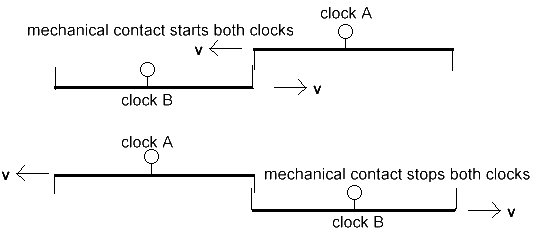
He then describes his own thought experiment. His image for it is here. There are two systems moving relative to each other, each one maintaining its speed. They have very long arms that allow stop-clocks to be mechanically started-and-stopped. Below is my animation.


Smid writes:

The clocks are started and stopped in each reference frame simultaneously (by definition, the contact starts each clock from zero) and both clocks will thus show identical times (for identical rods and clocks) after having been stopped (and after the clocks have been stopped, it is obviously irrelevant if A or B (or both) turn around to compare the clocks). (Smid Time Dilation and Twin Paradox Debunked)

Regarding the mechanisms, he continues:

It should also be pointed out that the signal propagation time from the trigger points to the clocks is actually irrelevant here (whatever way of transmitting the signal is used): if the corresponding distances are identical in both systems, then the delay times will also be identical and there won't be any difference in the clock readings afterwards (Time Dilation and Twin Paradox Debunked)

Hence for Smid, this is no solution to the paradox.

According to relativity, clock differences should arise solely due to a constant relative velocity, but as this leads to the twin paradox, a hand-waving argument is being made that one system has to turn around (i.e. accelerate) to compare the clock (which of course doesn't resolve the paradox, as a) you could in principle make the period of acceleration arbitrarily short, and b) it would violate causality as the clock difference would have to build up already before the acceleration occurs). (Smid Relativity Discussion Forum page 4)

[Smid, by the way, provides here a technical explanation for the inconsistencies he finds in Special Relativity.]

Then there is the question of experimental evidence which seems to demonstrate special relativity. What we wonder is if time itself actually changes, or if perhaps it only appears that way from a given perspective. Many physicists say that time really does change, and hence the traveling twin really would be younger. This is a profound claim. I would expect that before the scientific community accepts it as fact, they will first need to see a mountain of experimental evidence that clearly demonstrates time dilation. This site lists and describes four such experiments. There is one that uses clocks and seems to resemble somewhat a situation like with the space-bound twin. It is the Hafele-Keating experiment [wikipedia entry here]. Atomic clocks were placed in planes and compared to ground clocks. Their results accord with relativity theory.

Smid performs a logical analysis on the time dilation and twin paradox problem, and finds that they cannot exist. Hence his position is that "any alleged experimental evidence for the time dilation must therefore be due to actual physical effects (e.g. charged particles moving in electric and magnetic fields)." He offers alternative explanations which serve as suggestions for a genuine account of the observed results. [Although he has a strong sense that his suggestions are likely on the right tract, they may or may not in fact be correct. Even with access to all the experimental data, he explains, he still might not have enough information to pin down the right theoretical explanation. So his accounts are still somewhat speculative. He is certain nonetheless that a time dilation effect in the sense of Relativity (i.e. clocks in systems moving relatively to each other go at different rates) is a logical impossibility.] He provides here the mathematics for an alternate explanation for the planes' clock-discrepancies. He begins by writing: "In the case of the 'airplane-experiment' the slowdown of the atomic clock could for instance be explained by the Lorentz- Force in the earth's magnetic field" (Smid Relativity Discussion Forum page 1).

The 'muon experiment' also seems to support special relativity. Smid provides his alternate explanation at the top of this page.

My inabilities with math and science prevent me from assessing Smid's theories. I was very interested to see that someone had an alternate view that could lend support to Bergson's theory of unitary time. And I was impressed with his thought experiment involving the mechanically triggered clocks. I just ask that readers with abilities in math and science take Smid's ideas seriously, so that the truth of the matter can be better settled. Dr. Smid's homepage is here: http://www.physicsmyths.org.uk/


"Sagan on Time Travel." NOVA online. http://www.pbs.org/wgbh/nova/time/sagan.html


Mook, Delo E. & Thomas Vargish. Inside Relativity. Princeton: Princeton University Press, 1987.


Smid, Thomas. "Time Dilation and Twin Paradox Debunked."


1 Jan 2010

The Life of Time. §79. Ch.4.One or Many Durations? Bergsonism. Deleuze

[The following summarizes parts of Deleuze's Bergsonism. My commentary is in brackets. Paragraph subheadings are my own.]


Gilles Deleuze

Le bergsonisme
Bergsonism

Ch.4.
Une ou plusieurs durées ?
One or Many Durations?


Bergson says that there is one universal duration. He also says that there is a plurality of durations each differing in their nature. Previously Deleuze explained how Bergson's concepts of virtuality explain why this is not a contradiction. We used two senses of the term 'virtual.' In one sense, the past is virtual, because it presents itself in the present and helps shape this present moment that it actualizes in. This virtual past might be contracted down to the present moment, like when we perform some behavior over-and-over until it becomes automatic. In this case we do not reflect on the past, although it manifests fully in our present action. Or, we might sit-back and ruminate on these past repeated behaviors. This expands the virtualities out in front of our mind's eye. The extent to which we expand or contract our virtual past helps determine the way time feels to us at that moment. Most likely your level of contraction differs right now from mine. So in one sense we might be feeling time's passing in a different way right now. Hence it is on account of this first sense of virtual that we may say there are a multiplicity of time fluxes. However, there is another sense of the term virtual at work here. Bergson says that your and my conscious durations are simultaneous only because they are taken together. And they can only be taken together by another consciousness that regards them both at the same time. Now, we can consider a network of consciousness that take their neighbors' fluxes together. So long as all of them are linked into the network, there would then be one common time flow shared by all members. But note that no flux is simultaneous with another unless some mind takes them together. That means the one universal duration is partly responsible for there being all the constituent different ones. Now we will address the other sense of the term virtual. This one duration is a multiplicity of qualitatively different fluxes (differing according to the contraction or expansion of their virtual pasts). However, as the prerequisite for the simultaneity of all the other fluxes, the universal duration is firstly unified. Only by means of a secondary mental act may we divide it up into different parts. So in the first place, for example, Achilles and the tortoise are running together in one flowing race, because there is a consciousness that in the first place conceives them as running alongside each other simultaneously. But we may secondarily consider each one's own flux individually. So the common durational flux is potentially made-up of qualitatively different parts. But because it requires a secondary act, these parts are distinctly different only virtually. After we conceive them as apart, they make-up an actual multiplicity rather than their original virtual multiplicity. So this second sense of 'virtual' refers to the primarily undifferentiated fluxes flowing together in one durational flow. And it is on account of the second sense of 'virtual' that the parts of universal duration are all together as one flow. But it was on account of the first sense of 'virtual' that we are able to secondarily divide the one flow up into many parts.


§79 The Life of Time

Deleuze will now explain how Bergson needs relativity theory to give clear demonstration to why there is one duration shared by all of us. Given what we have discussed, the unity of duration seems to be the most plausible idea. But let's see how the assumptions of relativity theory, taken strictly, make Bergson's theory compelling.

We first place our concepts into the context of relativity. [In footnote 19, or the single footnote on p.84 of the French, Deleuze cites parts of Duration and Simultaneity where Bergson lays-out the way he places his ideas into the language of relativity. The first is from §§62-63. Here Bergson speaks of two identical systems, system S and S'. They begin by overlapping each other, and they are perfectly identical to one another. Then, they break apart from each other, and move relative to each other in reciprocal motion. This means that we can say S moves away from S' just as much as S' moves always from S. The second reference is from §§81-82. In this part, Bergson explains that according to relativity, we might take either the perspective of S or of S', or even in fact some other system S''. So relativity theory would say that from the perspective of S, the time in S' has dilated without the observers in S knowing it. But relativity theory also says the inverse: from the perspective of S', the time has dilated in S. In cannot be both. But the fact that we may not say that either one is an absolute frame of reference means that they both are equally valid frames of reference. This also means then that their flows of time must coincide exactly, for otherwise we would be preferring one system over the other. Hence relativity theory demonstrates the unity of time rather than its plurality. The last reference is to §§123-125. In these passages, Bergson explains that when physicists choose one reference frame, they imagine the person in the other moving system, and then determine what their time flow must be from the physicist's perspective. But the physicist might instead consider this other observer as a conscious being who is conscious simultaneously. By doing so, he would conceive their consciousnesses as flowing simultaneously. Then, the physicist would realize that they share the same duration.]

Deleuze begins by assuming Einstein's hypothesis: systems S and S' do not share same time.
1) Even if they flowed at different speeds, the two times would differ only quantitatively. But that does not make them different in kind. [So we do not yet have grounds to say they exist separately. They could perhaps be different expressions of the same time-flow.]
2) If we take S as the system of reference, then the time of S' is slow. But if we take the perspective of S', then the time of S is slow. They cannot both be at the same faster and slower. So they both must be the same speed at the same time.

Deleuze then quotes a passage from §70. Here Bergson explains that the physicist in one system calculates a mathematical abstraction for the time of another's system. The difference in time is based on the physicist taking his own system as the reference-frame, and regarding the other system as being the one in motion. Consider if instead the physicist imagined being the observer in the other system. He would then consider his new self as being the reference-frame. Then his new self would see his original self on the previously stable system. Now from this new point of view, the transported physicist would then regard his original system as being the one in motion. And he would get the same calculations for time distortions in the other system. What we see then is that the calculations do not represent the reality of the time that flows in both systems. Rather, it is just expresses which system was taken as the reference-frame. Bergson writes [underlined is what Deleuze quotes]:

To be sure, Peter pastes a label on this time with Paul's name on it; but if he were picturing a conscious Paul, living his own duration and measuring it, he would by that very act see Paul as system of reference and therefore take his place within this single time, inside each system, to which we have just referred; by that very act, moreover, Peter would also take temporary leave of his system of reference, consequently, of his existence as a physicist, and consequently, of his consciousness as well; Peter would no longer see himself as anything but a vision of Paul's. But when Peter attributes a slowed time to Paul's system, he is no longer thinking of Paul as a physicist, nor even a conscious being. He is emptying Paul's visual image of its inner, living consciousness, retaining of the person only its outer envelope (it alone, in fact, is of interest to physics). Then, Peter takes the figures by which Paul would have designated the time intervals of his own system, were he conscious, and multiplies them by


so as to make these figures fit into a mathematical representation of the universe conceived from his own point of view and no longer from Paul's. To sum up, whereas the time attributed by Peter to his own system is a time he has lived, the time he attributes to Paul's is neither a time that either Peter or Paul has lived, nor a time that Peter conceives as lived or as capable of being lived by a living, conscious Paul. What is it, then, if not a mere mathematical expression meant to indicate that Peter's not Paul's system has been taken as the system of reference? (52b.d)

Sans doute Pierre colle sur ce Temps une étiquette au nom de Paul; mais s'il se représentait Paul conscient, vivant sa propre durée et la mesurant, par là même il verrait Paul prendre son propre système pour système de référence, et se placer alors dans ce Temps unique, intérieur à chaque système, dont nous venons déparier : par là même aussi, d'ailleurs, Pierre ferait provisoirement abandon de son système de référence, et par conséquent de son existence comme physicien, et par conséquent aussi de sa conscience ; Pierre ne se verrait plus lui-même que comme une vision de Paul. Mais quand Pierre attribue au système de Paul un Temps ralenti, il n'envisage plus dans Paul un physicien, ni même un être conscient, ni même un être : il vide de son intérieur conscient et vivant l'image visuelle de Paul, ne retenant du personnage que son enveloppe extérieure (elle seule en effet intéresse la physique) : alors, les nombres par lesquels Paul eût noté les intervalles de temps de son système s'il eût été conscient, Pierre les multiplie par


pour les faire entrer dans une représentation mathématique de l'univers prise de son point de vue à lui, et non plus de celui de Paul. Ainsi, en résumé, tandis que le temps attribué par Pierre à son propre système est le temps par lui vécu, le temps que Pierre attribue au système de Paul n'est ni le temps vécu par Pierre, ni le temps vécu par Paul, ni un temps que Pierre conçoive comme vécu ou pouvant être vécu par Paul vivant et conscient. Qu'est-il donc, sinon une simple expression mathématique destinée à marquer que ; c'est le système de Pierre, et non pas le système de Paul, qui est pris pour système de référence? (99-100)

Recall how in §50, Bergson defined time as being something that is livable or could possibly be experienced by some consciousness. If there is a time that could not possible be experienced by anyone, then it would not be a real time. What we found with Peter and Paul is that neither one could possible live the time that the other ascribes to them, because that leads to us concluding they live two times at once. But we do know that they live their own conscious durations. And these durations must be the same. Hence relativity theory demonstrates the unity of time. (84a)

In footnote 20 (the single one on p.85 of the French), Deleuze notes that we need to distinguish what Bergson means by image vs. a symbol (reference to be added later). Bergson does think it is legitimate to form an image to express the "various tensions and the relations between durations" (Deleuze 130). But this image represents something that we are living. However, the image that Peter forms for Paul's time does not represent a temporality that Paul could in fact live without also producing a contradiction. For, we saw that such an ascription of distorted time implies someone lives two different speeds of time at once. If we adhere to Bergson's terminology, we would not say that Peter forms an image of Paul's time (for that would mean to imagine his conscious experience of it as well), but instead that Peter forms a (numerical) symbol for it. Deleuze then quotes from the sixth chapter of Duration and Simultaneity (reference to be added later). Here Bergson is discussing how real physicists do not experience time and space permeating each other. It is only when a physicist imagines a fantasy observer in another system that time and space interpenetrate each other. Yet Bergson notes that the physicist does not imagine this other observer as being real (for, to do so would be to imagine someone like himself who does not experience time and space interpenetrate). Thus the imagined observer is more properly a symbol for an abstraction rather than an image of something real. Bergson writes [underlined is what Deleuze quotes]:

For this space and time which interpenetrate are not the space and time of any physicist, real or conceived as such. The real physicist makes his measurements in the system in which he finds himself, and which he immobilizes by adopting it as his system of reference; time and space there remain separate and mutually impenetrable. Space and time interpenetrate in moving systems in which the real physicist does not exist, in which there live only physicists imagined by him - imagined for the greater good of science. But these physicists are not imaged as real or able to be so; to suppose them real, to attribute a consciousness to them, would be to give; [sic] their system the status of a system of reference, to transport oneself there and become identical with them, to declare that their time and space have ceased to interpenetrate. (Bergson 119d)

Car cet Espace et ce Temps qui s'entrepénètrent ne sont l'Espace et le Temps d'aucun physicien réel ou conçu comme tel. Le physicien réel prend ses mesures dans le système où il se trouve, et qu'il immobilise en l'adoptant comme système de référence : Temps et Espace y restent distincts, impénétrables l'un à l'autre. Espace et Temps ne se pénètrent que dans les systèmes en mouvement où le physicien réel n'est pas, où n'habitent que des physiciens par lui imaginés, — imaginés pour le plus grand bien de la science. Mais ces physiciens ne sont pas imaginés comme réels ou comme pouvant l'être : les supposer réels, leur attribuer une conscience, serait ériger leur système en système de référence, se transporter là-bas soi-même et se confondre avec eux, de toute manière déclarer que leur Temps et leur Espace ont cessé de se compénétrer. (234c-235)


Bergson, Henri. Duration and Simultaneity. Ed. Robin Durie. Transl. Mark Lewis and Robin Durie. Manchester: Clinamen Press, 1999.

Bergson, Henri. Durée et simultanéité: A propos de la théorie d'Einstein. Paris: Librairie Félix Alcan, 1923. Available online at:http://www.archive.org/details/dureetsimultan00berguoft


Deleuze, Gilles. Bergsonism. Transl. Hugh Tomlinson and Barbara Habberjam. New York: Zone Books, 1991.Deleuze, Gilles.

Deleuze, Gilles. Le bergsonisme. Paris : Presses Universitaires de France, 1966.


31 Dec 2009

The Flux of Two in the Time of One. §77. Ch.4.One or Many Durations? Bergsonism. Deleuze

[The following summarizes parts of Deleuze's Bergsonism. My commentary is in brackets. Paragraph subheadings are my own.]


Gilles Deleuze

Le bergsonisme
Bergsonism

Ch.4.
Une ou plusieurs durées ?
One or Many Durations?


Previously Deleuze discusses what he calls Bergson's triplicity of fluxes. The flow of the bird's flight along with the flow of a river will only be simultaneous if another flow brings them together. A flowing consciousness which is aware of these other fluxes draws them into itself and in that way unites them, even while being aware of their qualitative differences. Conscious durations envelop other durations and themselves. We might imagine the whole of all durations as being enveloped together in one encompassing act of conscious duration. In this way, there is one single flow of duration that is made up of a multiplicity of fluxes.


§77 The Flux of Two in the Time of One

Bergson considers duration to be a virtual multiplicity [see §75] as well as a continuous multiplicity [see this entry on Riemann's and Bergson's notion of a continuous multiplicity].

When we divide duration, we obtain elements that are different in kind. [Now, recall that Bergson distinguishes numerical and non-numerical multiplicities. (See §33 of Deleuze's Bergsonism). A numerical multiplicity, like any number in general, may be divided without changing its nature. However a non-numerical multiplicity, like conscious duration, changes with each division. Yet, we may still extract numerical values from conscious states in a secondary and qualitative way. Bergson's example is the bell tolling the hour while he is engrossed in his writing. While taking a pause, he tries to recall the number of tolls. He did not originally set-out an image of each one in ideal space as they rung. However, by the final toll, the group has a certain feel to it. If for example there were four tolls, he would know so, because hearing four tolls feels a certain way, and hearing three or five tolls each feel their own unique ways. In this sense, numerical values begin as qualities. Only afterward may they be given a quantitative value. Numbers however already imply their divisions, because any quantity is divisible in any variety of ways. A numerical unit is already a multiplicity of fractions already combined to form the given value. Space itself is like this too. But conscious duration does not come pre-packed with its divisions. Bergson needed to commit an additional mental action to convert his feeling of four tolls into the numerical quantity four.] Deleuze parenthetically references Matter and Memory (reference to be added later) to explain how conscious duration requires an act of consciousness in order for it to be divided [underlined is Deleuze's quotation]:

Abstract space is, indeed, at bottom, nothing but the mental diagram of infinite divisibility. But with duration it is quite otherwise. The parts of our duration are one with the successive moments of the act which divides it; if we distinguish in it so many instants, so many parts it indeed possesses; and if our consciousness can only distinguish in a given interval a definite number of elementary acts, if it terminates the division at a given point, there also terminates the divisibility. (Bergson 273-274)
L'espace n'est d'ailleurs, au fond, que le schème de la divisibilité indéfinie. Mais il en est tout autrement delà durée. Les parties de notre durée coïncident avec les moments successifs de l'acte qui la divise ; autant nous y fixons d'instants, autant elle a de parties; et si notre conscience ne peut démêler dans un intervalle qu'un nombre déterminé d'actes élémentaires, si elle arrête quelque part la division, là s'arrête aussi la divisibilité. (230)

Hence Deleuze notes that the parts we divide from duration "only actually exist insofar as the division itself is effectively carried out" (Deleuze 81). [Also recall from §75 that duration is a continuous and non-numerical multiplicity. It is made-up of its qualitative multiplicity. But the numerical discreteness of these multiple elements only exists secondarily or potentially, after an act of consciousness divides them. So they are virtual multiplicities]. Before we divide the virtual multiplicity of duration, there would of course only be one single time (81c). [Now also recall Bergson's use of the Achilles and Tortoise paradox to explain the indivisibility of motion and hence also duration (see §70 of Time and Free Will). Achilles' movement involves longer steps than the tortoise's. And the movement and consciousness of each runner is qualitatively different from the other.] Deleuze notes that in Bergson's Achilles & tortoise illustration, we are decomposing one flowing event into two separate fluxes, the motions of Achilles and of the tortoise, each of which is qualitatively different from the other. [Deleuze now turns to a point Bergson makes in Duration and Simultaneity. In Chapter 3, §50, Bergson first defines duration as being something that is consciously experienceable. A temporality that cannot possibly be experienced is not one that exists. But if there are two conscious observers, that means neither one's time is less real. We would obtain imaginary time however if one observer were to use Lorentz' formulae to calculate what from his own perspective would be the temporality of the other person. Yet, as Bergson showed, this calculated temporality is not the one the other person experiences. Rather, they both experience the same flow of duration. See §§59 & 60, §§64-71, §§72-79, §§80-82, §§87-116, and §§121-125 in Bergson's Duration and Simultaneity.]

We might consider then Achilles and the tortoise as being observers moving relative to each other. Let's first take Achilles' perspective. He experiences a concrete flow of conscious duration while running. But from his point-of-view, he might calculate some figure that determines what from his perspective the temporality must be like for the tortoise. Physicists perform such calculations in order to be sure that no matter the reference-point, all figures can come into accord despite the problems light causes for their mathematics. [See §74 of Deleuze's Bergsonism for a brief overview of Einstein's relativity. Or see Chapter 1 of Duration and Simultaneity, or see this simplification of the theory]. Yet Bergson notes that for their scientific purposes, physicists always must arbitrarily take one point-of-view instead of any other one, even though they know it could have been some other one just as well. So in other words, to obtain the fruits of relativity theory, the absolute relativity of moving bodies must be suspended temporarily. But, says Bergson, philosophers are not interested in producing accordant calculations for cosmic computations. They are concerned rather with reality, in this case, the reality of time and also space. Bergson meticulously accounts for why both Achilles and the tortoise, for example, experience the same flow of duration. Their different movements might create the appearance of time distortions in the other flux, but in reality there is none. In a sense, Bergson is saying that scientists imagine fantasy times for mathematical purposes, and then confuse them with the real times that actual consciousnesses would experience.

Hence in regard to divergent fluxes, Deleuze notes that Bergson's "whole thesis consists in demonstrating that they can only be livable or lived in the perspective of a single time" (81d). If we want to say in the first place there are two time flows for different consciousnesses, we "are forced to introduce a strange factor: the image that A has of B, while nevertheless knowing that B cannot live in this way. This factor is completely 'symbolic'; in other words, it opposes and excludes the lived experience" (82a). Hence Bergson concludes that there is only one Time, no matter if we divide it into component fluxes or if we consider them all together at once. (82a)


Bergson, Henri. Duration and Simultaneity. Ed. Robin Durie. Transl. Mark Lewis and Robin Durie. Manchester: Clinamen Press, 1999.

Bergson, Henri. Durée et simultanéité: A propos de la théorie d'Einstein. Paris: Librairie Félix Alcan, 1923. Available online at:http://www.archive.org/details/dureetsimultan00berguoft


Bergson, Henri. Matière et mémoire: Essai sur la relation du corps à l'esprit. Ed. Félix Alcan. Paris: Ancienne Librairie Germer Bailliere et Cie, 1903. Available online at:http://www.archive.org/details/matireetmmoiree01berggoog


Bergson, Henri. Matter and Memory. Transl. Nancy Margaret Paul & W. Scott Palmer. Mineola, New York: Dover Publications, Inc., 2004; originally published by George Allen & Co., Ltd., London, 1912. Available online at:http://www.archive.org/details/mattermemory00berg


Deleuze, Gilles. Bergsonism. Transl. Hugh Tomlinson and Barbara Habberjam. New York: Zone Books, 1991.Deleuze, Gilles.

Deleuze, Gilles. Le bergsonisme. Paris : Presses Universitaires de France, 1966.