

Showing posts with label affirmation. Show all posts

7 Feb 2018

Goldschmidt (2.1.4.3.45) Le système stoïcien et l'idée de temps, “Coopération avec la causalité du Destin”, summary


[Search Blog Here. Index tabs are found at the bottom of the left column.]


[The following is summary. Bracketed commentary is my own, as is any boldface. Proofreading is incomplete, which means typos are present, especially in the quotations. So consult the original text. Also, I welcome corrections to my interpretations, because I am not good enough with French or Greek to make accurate translations of the texts.]


Summary of

Victor Goldschmidt

Le système stoïcien et l'idée de temps

Deuxième partie
(2)
Aspects temporels de la morale stoïcienne

A
(2.1)
La Connaissance

Chapitre IV
(2.1.4)
L’interprétation des événements

III
(2.1.4.3)
L’usage des représentations

45.
(2.1.4.3.45)
Coopération avec la causalité du Destin


Brief summary:
(2.1.4.3.45.1) Divination of the entirety of God’s providence by interpreting present event-signs is impossible. We turn now to a different kind of interpretation of event-signs that will involve matters of wisdom and conformity with nature. (2.1.4.3.45.2) Our human limitations make us unable to understand the whole of the cosmos and thereby to act exactly like God does. However, by accepting the present moment in a certain way, we can at least act and understand the world in the general way that God does. (2.1.4.3.45.3) Because causality is always active and rational, it is thereby always perfect, in that what happens always does so by necessity. We ourselves should cooperate with God in this divine causality. However, we are such a small part of that causality that we cannot cooperate with God on the cosmic scale. Nonetheless, insofar as we act in accordance with the necessarily causality acting upon us, we can play our small role in the divine causality. That is to say, our causality can partake in the perfection of the divine causality, because perfection here means being necessary. (2.1.4.3.45.4) God knows everything, so God knows how the causal nature of any situation will ultimately result. With that knowledge, God does not need time to deliberate while calculating outcomes of actions that God can decide to take. God knows it all already. There is thus not a delay between God first having an intention for how things happen and then secondly taking on the action that will lead to that end. Even though there is logical order, they transpire in the same instant, namely, the first instant of time. Humans, however, have limited knowledge, and we find ourselves in the middle of a chain of determinate efficient causal relations. This means that we cannot change what happens, and we cannot have acted otherwise, even though it felt like we were choosing one option or another (because in fact the whole decision-making process we underwent followed a course determined by antecedent causality), and we also cannot discern where current events are ultimately leading. As God did not consult us at the beginning of time, the course of events are not in any sense decided by us. That means that although we are the necessary efficient cause for the consequences of our actions, whatever happens does not really depend on us in the sense that it was our choice or intention that really played any role in how things transpire. This would seem to place us into a passive role where it does not matter how we live our lives. For, we have no free will anyway, and whatever happens does not depend on our choices. However, we do have one particular freedom that is not determined by fate, even though it also will have no influence on the course of events. While for God both the intention which comes first logically and the action that comes secondly and that will lead to fulfilling that intention in fact occur simultaneously for him (they are logically ordered but temporally simultaneous), for us, our action or our undergoing of action comes first and our intention, understood as what we want, hope, or intend to happen, comes second, both logically and temporally. Our action comes first logically, because it was determined long before we were even alive, and when it happens, it was really something provided by the antecedent causality. So first we act or undergo action, and only secondly can we decide whether or not we want it, that is, decide that it is something that we have been hoping for, wanting, intending, deem just, and so on. Yet despite this necessary interval, the Stoic sage strives to make their intentions be as simultaneous as possible with their actions and undergoings of actions. They try to keep themselves in a constant state of always wanting what is in fact happening and anticipating that they will want what must necessarily happen next. So, our only freedom is to choose what we want, that is, to choose our intentions. Now, since we cannot change the course of events anyway, and since we cannot know how any particular event must happen necessarily for the sake of the cosmic good, we are best to choose to want whatever is happening. For, it is both necessary and good, regardless of whether or not it is agreeable to our preferences. In that way, we can participate in the divine causality, namely, by placing our value-assigning activities into accord with the fundamental nature of reality, even though what transpires does not actually depend on our affirmational choices.


[Wisdom and Event-Sign Interpretation]

[Wisdom and Event-Sign Interpretation]

[Divine Necessary (Perfect) Causality and Our Necessary (Perfect) Causality Cooperating with It]
 
[Divine Necessary (Perfect) Causality and Our Necessary (Perfect) Causality Cooperating with It]


Summary


2.1.4.3
L’usage des représentations

2.1.4.3.45
Coopération avec la causalité du Destin


[Wisdom and Event-Sign Interpretation]

(p.99: “ A partir d’ici, il va se produire un revirement …”)

[In sum: Divination of the entirety of God’s providence by interpreting present event-signs is impossible. We turn now to a different kind of interpretation of event-signs that will involve matters of wisdom and conformity with nature.]

[(Please see the following quotation, as I will probably will get some of this wrong. It builds from sections I have not yet summarized.) Although the Stoics believe in divine providence, we will never be able to discern the whole of all causality in the cosmos. So we should not think of interpreting the present event-sign as being a matter of arriving at such humanly impossible knowledge. We turn now to another method of interpretation. We have certain given tendencies toward self-preservation that also direct us toward wisdom as well. But, wisdom will teach us a “good” for the sake of which the sage will accept the sacrifice of his own salvation without ceasing to conform with nature.]
45. A partir d’ici, il va se produire un revirement et un retour. Un passage va s’ouvrir vers une autre méthode d’interprétation. Ce passage, comme toujours, va du même au même, mais, ici encore, le terme finalement atteint va changer entièrement la signification du point de départ. Ainsi, on l’a vu1, les tendances initiales nous portent à nous conserver nous-mêmes, et c’est par elles que nous sommes « recommandés » à la  sagesse ; mais la sagesse nous enseignera un « bien », en faveur duquel le sage acceptera le sacrifice de son propre salut sans que, pour autant, il cesse d’agir « conformément à la nature ».
(99)
1. Cf. pp. 57-58.
(99)


[Wisdom and Event-Sign Interpretation]

(p.99: “1. L’effort pour comprendre tel événement …”)

[In sum: Our human limitations make us unable to understand the whole of the cosmos and thereby to act exactly like God does. However, by accepting the present moment in a certain way, we can at least act and understand the world in the general way that God does.]

Our efforts to understand events refer us back to God, who is the “the fountain of all things; from whom all things are ordered in a fixed series” (Marcus Aurelius 2014: 99. Meditations Book VIII, 23). From this common cause of all things, we are just scattered members. Our purpose in all of this is learn how to accept whatever happens, which is yet somehow an active acceptance, since it implies a cooperation (see section 2.1.4.1.39.1). But our faculties of understanding and acting are limited. Now, since our limitations can lead us to certain failures [for example, the failure to really understand why things are happening they way they do and to have a certain sense of how to react], we will need to look at our understanding and action in a different way. Understanding the event on a cosmic scale and wanting or willing it is not possible for us, given our limitations. We cannot imitate and act exactly like God does. But perhaps, by accepting the mutilated present [maybe, the present in terms of its current self-varying], which we cannot escape from anyway, we will succeed in understanding and acting at least the general way God does.
1. L’effort pour comprendre tel événement nous a renvoyés à Dieu, « source commune d’où dérivent, en s’enchevêtrant, tous les événements »2. De cette cause commune, nous ne sommes que des membres épars. Le but de cet effort était de nous apprendre à « accepter ce qui arrive », acceptation active, puisqu’elle implique « coopération »3. Il s’est montré que nos facultés de comprendre et d’agir étaient également limitées. A moins d’accepter l’échec où nous sommes conduits, il faudra, à cette double tâche, trouver un sens nouveau. Comprendre l’événement et le vouloir ne nous est pas possible à l’échelle cosmique. Nous ne parvenons pas à imiter Dieu et à faire comme lui. Mais peut-être, en acceptant le présent mutilé dont, décidément, nous ne pouvons sortir, réussirons-nous à comprendre et à agir à la manière de Dieu.
(99)
2. M. -Aurèle, VIII, 23 (p. 97, n. 6).
3. P. 90.
(99)


[Divine Necessary (Perfect) Causality and Our Necessary (Perfect) Causality Cooperating with It]

(p.99-100: “ La causalité est, tout ensemble …”)

[In sum: Because causality is always active and rational, it is thereby always perfect, in that what happens always does so by necessity. We ourselves should cooperate with God in this divine causality. However, we are such a small part of that causality that we cannot cooperate with God on the cosmic scale. Nonetheless, insofar as we act in accordance with the necessarily causality acting upon us, we can play our small role in the divine causality. That is to say, our causality can partake in the perfection of the divine causality, because perfection here means being necessary.]

Causality is active and rational (see the Seneca Letter 65 quotation in section 2.1.4.2.40.2). This constant coincidence [of its active and rational nature] is what makes causality always perfect, and it is what makes God’s action perfect, when taken in the entirety of a full cosmic period as well as in terms of each of its instant. [So the perfection is found in the full development of the causation throughout the cosmic period, spanning between conflagrations. But we, our lives, and our roles in the whole of the development of the cosmos are very small parts of this. So we cannot really “cooperate” with God on the cosmic scale. Nonetheless, this does not change the fact that we ourselves are causes, and we are “perfect causes” just like the divine causality is, even though our causal power is far less extensive. For, put in Cartesian terms, this perfection of causality consists only in acting “according to its own nature” (or “of their own nature”; see Cicero 1968, p.239); and “everything that come to be according to impulse depends on those who exercise the impulse” or “all that comes to be according to impulse depends on those who act thus” (Alexander of Aphrodisias 1983 p.85).] [I do not follow the idea here yet, but it might be that although we are only a small part of the cosmic causality, our small causal role is still a perfect causality, because we act according to our nature or impulse. We need to then understand what makes causality “perfect”. In de fato XVIII, 41, Cicero discusses “perfect and principle causes”. They seem be causes that in themselves necessarily bring about the outcome. See Cicero 1968, p.237. So if we act according to impulse or nature, we are acting I suppose according the necessary and efficient causality acting upon us, and we thereby participate in the overall causality of the cosmos.]
La causalité est, tout ensemble, agissante et rationnelle ; la cause se dé finit ratio.... faciens4. C’est précisément cette coïncidence constante qui la rend parfaite et qui rend parfaite l’action de Dieu, prise dans l’ensemble d’une période | cosmique et à chacun de ses instants. Parcelles détachées de la cause universelle, nous ne l’égalons ni en force ni en raison. Aussi l’entreprise est-elle chimérique, de vouloir « coopérer » avec Dieu à l’échelle cosmique. Mais nous aussi sommes des causes, des « causes parfaites », et dont la perfection, sans doute d’un pouvoir moins étendu, ne diffère cependant en rien de celle qui caractérise la causalité divine. Car, pour reprendre les termes de Descartes, « si je la considère formellement et précisément en elle-même »1, cette perfection consiste seulement à agir « selon sa nature propre »2 ; « tout ce qui se produit selon la tendance de l’agent, dépend entièrement de celui-ci »3.
(99-100)
4. P. 92, n. 5.
(99)
1. Médit., IV. Cf. Epict., Diss., I, XII, 26.
2. P. 96, n. 1 et le texte d’Alexandre cité p. 98, n. 4.
3 Alex., de fato, XXXIII, S.V.F., II, 1001.
(100)


[Divine Necessary (Perfect) Causality and Our Necessary (Perfect) Causality Cooperating with It]

(p.100-101: “ La causalité est, tout ensemble …”)

[In sum: God knows everything, so God knows how the causal nature of any situation will ultimately result. With that knowledge, God does not need time to deliberate while calculating outcomes of actions that God can decide to take. God knows it all already. There is thus not a delay between God first having an intention for how things happen and then secondly taking on the action that will lead to that end. Even though there is logical order, they transpire in the same instant, namely, the first instant of time. Humans, however, have limited knowledge, and we find ourselves in the middle of a chain of determinate efficient causal relations. This means that we cannot change what happens, and we cannot have acted otherwise, even though it felt like we were choosing one option or another (because in fact the whole decision-making process we underwent followed a course determined by antecedent causality), and we also cannot discern where current events are ultimately leading. As God did not consult us at the beginning of time, the course of events are not in any sense decided by us. That means that although we are the necessary efficient cause for the consequences of our actions, whatever happens does not really depend on us in the sense that it was our choice or intention that really played any role in how things transpire. This would seem to place us into a passive role where it does not matter how we live our lives. For, we have no free will anyway, and whatever happens does not depend on our choices. However, we do have one particular freedom that is not determined by fate, even though it also will have no influence on the course of events. While for God both the intention which comes first logically and the action that comes secondly and that will lead to fulfilling that intention in fact occur simultaneously for him (they are logically ordered but temporally simultaneous), for us, our action or our undergoing of action comes first and our intention, understood as what we want, hope, or intend to happen, comes second, both logically and temporally. Our action comes first logically, because it was determined long before we were even alive, and when it happens, it was really something provided by the antecedent causality. So first we act or undergo action, and only secondly can we decide whether or not we want it, that is, decide that it is something that we have been hoping for, wanting, intending, deem just, and so on. Yet despite this necessary interval, the Stoic sage strives to make their intentions be as simultaneous as possible with their actions and undergoings of actions. They try to keep themselves in a constant state of always wanting what is in fact happening and anticipating that they will want what must necessarily happen next. So, our only freedom is to choose what we want, that is, to choose our intentions. Now, since we cannot change the course of events anyway, and since we cannot know how any particular event must happen necessarily for the sake of the cosmic good, we are best to choose to want whatever is happening. For, it is both necessary and good, regardless of whether or not it is agreeable to our preferences. In that way, we can participate in the divine causality, namely, by placing our value-assigning activities into accord with the fundamental nature of reality, even though what transpires does not actually depend on our affirmational choices.]

[This paragraph is very tricky for me interpret. In the following, I will try to give the best summarization I can, little by little, with the best elaborations I can in brackets.] Now we will examine the singular event. [Perhaps the distinction is between the one whole cosmic unfolding and any particular present event, but I am not sure.] Because the singular event is caused by God, it is thus not dependent on us. And when something has been perfectly caused (that is, caused by something that necessarily has that particular effect), then the caused thing depends on whatever caused it. [Here “depends on” will not always seem to mean simply coming about as the effect of an efficient cause. I say that, because the effect is said to not depend on us, even though we are the efficient cause of it. Rather, here “depends on” seems to mean, be chosen to take place over some other option. So we might wonder, will I be in some far away place next week? That depends on whether I take a vacation or not. So there is dependence here not just on an action but on a decision and intention.] But we just said that particular events do not depend upon us. [That is to say, events that transpire are not chosen by us over some possible alternative, even though our actions may have brought them about.] Therefore, it seems, we have no causal influence in the world, which then makes it seem impossible for us to cooperate with God’s divine causality, given that it does not need us to transpire. [Here the idea might be that even though we have efficient causality, since whatever we do is predetermined by some antecedent efficient causality, whatever happens does not really depend on us ultimately but rather on decisions made at the beginning of time.] But recall from section 2.1.4.2.42.3 that perfect causality abolishes the distance between intention and act [that is to say, what is aimed toward in the future is expressed now in the causal nature of the current action, which sets the course of forthcoming causal development in a certain direction thus toward a certain target.] So, yes, we cannot be the brute causality of the future things that do not depend on us alone. However, we can become perfect causes, that is to say, we can commit actions that necessitate some future situation, and thus we can see ourselves as playing a causal role in bringing it about, so long as, when the causal event happens, we do everything that depends on our action, even though it happens regardless. [I may have that wrong, so please consult the text below. This is complicated, but I assess the idea as being the following. We are not “brute” causes in the sense of being like an initiating cause that sets things in motion in one direction rather than another. We can only cause what we are caused to cause. But by causing what we are caused to cause, we are still perfect causes. We are just not brute perfect causes, that is to say, future-deciding efficient causes. We should now address an important issue. Does it not feel like we are calculating possible courses of action and then taking one of them on the basis of a decision we are free to make one way or another way? We need to distinguish what it feels like is happening in these cases with what is ultimately happening. Our very decision-making process which seemingly leads us to decide between options was itself, as a deliberative cognitive process, caused to unfold the way it did. Thus, in reality, the world was not forking down two possible future paths, waiting for us to choose one, even though our cognitive process involved us assessing possible paths to take. So it may have felt that way in the critical moment of a consequential decision, but whatever we chose could not have been chosen otherwise anyway. Perhaps we get the feeling that we decide fate only because we are unable to see all the causal factors at work (like our brain chemistry at that moment, our unconsciousness thinking, and so on). So, it is still conceivable that we have no “free will” in terms of choosing the outcomes that happen, even though a significant part of life is engaging in activities that feel as if we do.] To do this, we simply need to reduce the difference between our intentions and our actions. [The next thing we should note is this idea of intention overlapping with action. Why is it that for God, intention and action are part of the same movement, where for us they are not? The idea might be the following. The world is headed in a certain direction, that is, toward an end that does not preexist the present efficient cause in such a way that it can cause (in the sense of final causality) current events to transpire, but rather the end here is the direction toward which current efficiently caused events are headed, being a sort of byproduct of that efficient causality’s directionality. Now, we might here want to imagine the first moment of the cosmos, after a conflagration. We might want to say, the first causal event must have involved God first seeing where he wanted everything to go, that is to say, initially having an intention, which then determined what the first causal event would have to be, so that we would reach that end, with this first causal action transpiring only after the intention was set up. In other words, we might assess a logical order. Before we can determine what action we are going to take, we need to know what it is supposed to accomplish, thus even for God there would need to be a distance between intention and action, at least at the very beginning. But as we saw in section 2.1.4.2.40, for the Stoics, primary causality is efficient and active. It is not final and Ideal/formal. And, because it is efficient, built into its causal nature is already the end it is setting subsequent actions up toward. In other words, from the very first moment of the world, God hits the ground running, in that the first action itself must, though its initial causality, make a decision about where it wants to be going. So God’s intention must always be built into his action. But, this is possible for God, because God can know everything. If God had limited human intellect, when he committed the first act, he would not actually know for sure where things would ultimately go. Humans would need to do a lot of calculating and figuring. But God does not need time to work it all out. He knows from the beginning the direct correlation between the efficient causal nature of an action and the specific final end that ultimately results. And, since God really does decide the first causation of the world, even though it is decided the same moment it is committed, everything else does really “depend” on God in the sense we are using here. But, things are different for us humans, who have limited knowledge of the causal whole and who, by finding ourselves in the middle of the chain of causes, cannot decide alternate paths. We can make decisions, but whatever we chose was really the only thing we could have chosen, despite all the drama of the deliberative process that preceded the “decision”. But God goes from intention to action in the same instant, because he can know the full consequences of any action, and he can decide the action and the intention simultaneously and without deliberation.] And since we cannot, like God can, go from intention to act in one singular instant, as our act is what is first given to us, it will suffice for us instead, in one instant, to take the opposite step and make the act (which does not depend on us) coincide with the intention (which does depend on us). [So we see here now why I am using this sense of “depend on”. The action we take, we would normally say, does depend on us. Why? Because we are the ones who decided to make it in the first place. But instead, we should see that it was never really our decision to take whatever action we are taking. That was decided from the beginning of time by the initial efficient causality. But the idea here in that sentence is still quite tricky. God goes from intention to act, in that order, but without a duration of time. So they are temporally equal but logically ordered. God “first” must decide where the world should go, and “secondly” determine the actions that would lead there, but here the “first” and “second” logically ordered steps do not have a temporal order, for reasons we tried to lay out previously. The next point here is that the order seems already to go the other way for us. First, temporally speaking, we are acting or undergoing action in a certain way, and that way was not ultimately decided by us. So it does not matter really what our intentions are. It is the intentions of God that have already decided everything. Goldschmidt is now saying that we still have a real, non-determined option in this situation. We can make ourselves “intend”, that is, want, decide, etc., whatever it is that is happening and will happen. So we find ourselves in a situation that we are reacting to, which causes a new situation. Whatever happens could not have happened otherwise. But we carry through our actions in either one of two ways. We can experience the world and react to it in a way where we accept whatever happens, no matter whether we like it or not, or we can deny things and wish things to have happened and to happen differently. This is a little like saying, we can either live in the real world as it is, and say that the way the world is is fundamentally good, even when it proves unpleasant or disturbing (even morally disturbing), or we can live in the world as if there is a better world that could have been, but unfortunately or tragically did not happen.] Thus we must “accept” the event and even want it. As Marcus Aurelius says in Book VIII, 23 of his Meditations:
Am I in action; I refer to it some benefit thence to accrue to mankind. Does anything befall me? I accept it, as referring it to the Gods, the fountain of all things; from whom all things are ordered in a fixed series.
(Marcus Aurelius 2014: 99)
Yet, to want what happens also involves being responsible for causing what happens. And it furthermore means that we try not to counteract or prevent what is happening. The way we would accomplish this is not by means of our actions (for, our actions cannot change what will happen, they can only participate in making happen what does happen); so that is to say, we take no additional actions to interfere with the course of fate and steer it in accordance with our wishes. Rather, what we “do” is we choose to want what happens, and we participate in its arrival by means of making our intentions (or expectations) for how things will go to line up with how in fact they do go. Thus, to cooperate with the event consists in working within ourselves to combat everything in us that can be opposed to the way things actually do go, namely, our passions and our preferences. [In other words, we do not let ourselves want something particular to happen. We instead allow things to happen, and, as a rule that we constantly follow each moment, we make ourselves want whatever does happen to transpire, even from the very first moment that it begins to occur. Put another way, we never wait to judge whether or not we like what is happening. We from its beginning want to happen whatever is in fact now happening, and we judge it as good and necessary no matter how unpleasant it is. We know in advance that it was fated, and thus could not be otherwise, and because it was fated, it is for the greater cosmic good that it is happening. Choosing either to do that or to instead base our expectations on our passions and personal preferences is the only freedom we actually have. But note, that whether or not we affirm or deny what is really happening and what must next happen, neither choice of affirmation or denial will change the course of events, as neither choice has any efficient causality.] By virtue of the contemporaneity of the intention and the act, it is in the same instant that our will catches up with and recovers the event, and it is also in the same instant that the most secret movement in our moral person cooperates with the course of Destiny, which is ultimately external to us. [So by making our intentions be there already as our activities transpire, by always intending to happen what does happen, our will can “catch up” with the event by not trailing behind it, waiting to see if it conforms or not with our passions and preferences. And this is “the most secrete movement of our moral self,” (I do not know why really, but) maybe because it involves us going beyond the person we think we know ourselves to be, with our preferences and passions, and rather to put into the driver seat of our life a moral self that seeks to accord with the will and intentions of the cosmos. And the course of Destiny is ultimately external to us, because it is decided without our consultation.] Marcus Aurelius writes in Meditations Book V, section 8 (part):
Our very word for happening to one, is, to go together appositely, as the squared stones in walls or pyramids, are said by the workmen, to fall or join together, and suit each other in a certain position. Now, there is one grand harmonious composition of all things; and as the regular universe is formed such a complete whole of all the particular bodies, so the universal destiny or fate of the whole, is made a complete cause out of | all the particular causes. The very vulgar understand what I say. They tell you, “fate ordered this event for such a one, and this was prescribed or appointed for him.” Let us understand this even as when we say, “the physician has ordered such things for the patient”: for, he prescribes many harsh disagreeable things; which, yet, we embrace willingly, for the sake of health. Conceive, then, the accomplishing and completing the purposes of the universal nature, to be in the universe, what your health is to you, and thus embrace whatever happens, altho’ it should appear harsh and disagreeable: because it tends to the health of the universe, to the prosperity and felicity of Jupiter in his administration. He never had permitted this event, had it not conduced to good. We see not any particular nature aiming at or admitting what does not suit the little private system, in which it presides. Should you not on these two accounts embrace and delight in what ever befalls you; one is, that it was formed, and prescribed, and adapted for you, and destined originally by the most venerable causes; the other, that it is subservient to the prosperity, and complete administration of that mind, which governs the whole; nay, by Jupiter! to the stability and permanence of the whole. For, the whole would be maimed and imperfect, if you broke off any part of this continued connexion, either of parts or causes. Now, you break this off, and destroy it, as far as you can, when you repine at any thing which happens.
(Marcus Aurelius 2014: 60-61, copied from Online Library of Liberty)
[As we see from that last line, we would only deter the cosmic causality, not from acting against fate, which is impossible anyway, but by being dissatisfied with what happens. So in conclusion, we participate in the divine causality by wanting whatever happens. That is the only real variable we can introduce in the world and that is not determinately caused, even though whatever does happen is determinately caused. In other words, we have the power of affirmation and denial. We can either affirm the perfection or goodness or rightness or justice of necessity of what happens or we can deny these things of what happens. But we cannot change what happens, even though our actions play a causal role in it. For, whatever action we take, even though seemingly we take it such that we alter the course of Fate, in fact we were fated from the beginning to do it. However, we were not fated to either affirm or deny the initial situations and outcomes. This is an option given to us so that we can cooperate with the divine causality by placing ourselves in its service willingly.]
2. Revenons donc à l’événement singulier. Etant causé par Dieu, il a ceci de propre de ne l’être à aucun degré par nous ; par définition il fait partie des « choses qui ne dépendent pas de nous » Or, la cause n’est cause parfaite que pour ce qui dépend d’elle. Comment alors « coopérer » à ce qui, précisément, est soustrait à notre pouvoir et, pour se produire, n’a besoin que de Dieu ? – Mais poser la question ainsi, c’est méconnaître que la cause parfaite abolit toute distance entre l’intention et l’acte, entre elle-même et son effet. Sur ce qui ne dépend pas de nous, la causalité brute nous est certes refusée. Mais nous pouvons, à son égard, devenir causes parfaites et nous en attribuer l’avènement, si, lorsqu’il se produit, nous faisons tout ce qui dépend de nous, pour qu’il se produise, lui qui, de toutes manières, se produit. Il suffira pour cela de réduire la distance. Et puisque nous ne pouvons pas, comme Dieu, aller, dans le même instant, de l’intention à l’acte, puisque l’acte nous est donné d’abord, il suffira, dans ce même instant, de suivre la démarche inverse et de faire coïncider l’acte (qui ne dépend pas de nous) avec l’intention (qui en dépend pleinement). Il faut donc « accepter »4 l’événement et le vouloir. Or, le vouloir, c’est-à-dire le causer pour ce qui dépend de nous, cela signifie ne pas le contrarier, ne pas l’empêcher, et cela, non pas par une action (car il ne dépend pas de nous de nous y opposer efficacement), mais, précisément, par nos inten- | tions. Coopérer à l’événement consistera donc à l’opérer en nous, à combattre tout ce qui, en nous, s’oppose à lui, nos passions et nos préférences. En vertu de la contemporanéité de l’intention et de l’acte, c’est dans le même instant que notre volonté rattrape et recouvre l’événement et que le mouvement le plus secret de notre « personne morale »1 coopère avec le cours, extérieur à nous, du Destin. « L’univers est comme mutilé, si peu qu’on retranche à la connexion et à l’enchaînement des causes, non moins que de ses parties. Or tu romps cet enchaînement, autant qu’il dépend de toi, quand tu es mécontent des événements et, en un sens, tu les détruis »2.
(100-101)
4. P. ex. M.-Aurèle, VIII, 23: Συμβαίνει τί μοι; Δέχομαι…
(99)
1. On peut conserver cette traduction de la προαίρεσις d’Epictète (voir l’éd. des Entretiens par J. Souilhé, t. I, p. L, n. 3), sous réserve des observations présentées par E. Bréhier, Etudes sur la philosophie antique, Actualités scientifiques et industrielles, n° 1104, Paris, 1950, p. 19.
2. M. -Aurèle, V, 8, 13.
(100)


From:

Goldschmidt, Victor. 1953. Le système stoïcien et l'idée de temps. Paris: Vrin.


Otherwise:

Alexander of Aphrodisias, and Sharples, R.W. 1983. Alexander of Aphrodisias, On Fate. Translated by R.W. Sharples. Gloucester Crescent, London: Duckworth.

Cicero. 1968. Cicero, De oratore, in Two Volumes, vol.2.3., together with De Fato, Paradoxa Stoicorum, De partitione oratoria. With English translation by H. Rackham. Cambridge, Mass.: Harvard University / London: Heinemann.
PDF available at:
De fato Latin online text:
De fato English online text:


.

29 Mar 2015

Somers-Hall, (1.6), Deleuze’s Difference and Repetition, ‘1.6 Nietzsche (36–7/45–7, 40–2/50–2, 52–5/63–7)’, summary


by
Corry Shores
[Search Blog Here. Index-tags are found on the bottom of the left column.]

[Central Entry Directory]
[Deleuze Entry Directory]
[Henry Somers-Hall, Entry Directory]
[Henry Somers-Hall’s Deleuze’s Difference and Repetition, Entry Directory]


[The following is summary. All boldface, underlining, and bracketed commentary are my own. Proofreading is incomplete, so please forgive my typos and other distracting mistakes. Somers-Hall is abbreviated SH.]


Summary of


Henry Somers-Hall


Deleuze’s Difference and Repetition:
An Edinburgh Philosophical Guide


Part 1
A Guide to the Text


Chapter 1. Difference in Itself

1.6 Nietzsche (36–7/45–7, 40–2/50–2, 52–5/63–7)


Very brief summary:

A Nietzschean univocal view of reality would say that there are not primarily independent beings choosing to exercise power morally or immorally. Rather, there are nothing more than competing forces in flux, all exercising their power purely affirmatively, since each force is exerted to the fullest it can be. This is a univocal understanding, since all being is understood as power. And, it is based on difference and affirmation.


Brief summary:

If we understand ‘being’ as power rather than as substantiality, then we can grasp it as univocal and affirmative. Deleuze builds from Nietzsche’s notion of subjectivity being a fabrication created by the weak in order to externalize blame for their weakness. In reality there are just competing forces expressing themselves at their fullest and finding relative value in their competitions. This is a nomadic understanding of what makes up the world. It sees the world as made of pure difference, that is, exclusively of differential relations between competing forces. And it is affirmative, since these powers are understood as being as great as they can be and never arbitrarily self-limiting. They are expressions of a pure affirmative will.  A sedentary understanding would instead section off regions in this field of differential power relations and say we have substances with different moral values, depending on how they seemingly choose to dominate others. This sees one thing as being defined by the limits that separate it from other things, thus it is based on negation rather than affirmation. Also, it can only come after the more basic differential field of change and becoming.


Summary


[We
previously examined Spinoza’s univocal understanding of being. There is one substance (being/God), but it has an infinity of intensive modal variations/determinations and an infinity of essences. SH will now look at a critical problem Deleuze finds in this, which is that it still in a sense is like Aristotle’s genus-species predicative structure and thus may have its problems of representation. For Aristotle, the genus is a predicate to the species. For example, “Man is (a type of) animal).” Also, the genus is like a substance and the species are like determinations of it. So, an animal can be more determinately a man, a dog, etc. Spinoza’s system still places modes as determinations of being, and in that sense takes this form of (predicative) judgment and thus of representational thinking. I will venture a guess at how this might look. For example maybe we could say something like: ‘this modal variation in the attribute of extension, specifically, myself, is a modal variation of being’. In that way, being still functions like a genus to which we are a predicated determination.]

Despite the fact that Spinoza represents an advance over the work of Scotus, Deleuze claims that for Spinoza, ‘substance must be said itself of the modes and only of the modes. Such a condition can be satisfied only at the price of a more general categorical reversal according to which being is said of becoming, identity of that which is different, the one of the multiple, etc.’ (DR 40/50). Deleuze’s point is that the relation of modes to being is still structured like the terms of a judgement. The modes are said of being, in the same way that we might say of a man that he is rational, and so we still understand being as if it were a subject, even if we know that in reality it is singular rather than one, and thus different in kind from the object of a judgement.
(SH 38)


[While Spinoza (and similarly Scotus) provided an intensive understanding of difference, he still in a sense places being (God/substance) as the highest term in the hierarchy. So we turn now to Nietzsche.] “In order to overcome this limitation, we need somehow to replace our account of | being as the highest term in our hierarchy with difference, whilst retaining the insights given by the intensive understanding of difference; it is Nietzsche, Deleuze claims, who provides the means to do this” (SH 38-39). Although SH will return to Nietzsche later, he will in the following locate two parts of Nietzsche's writings that Deleuze bases his argument on: 1) section 13 of Essay I of Genealogy of Morals, “where Deleuze sees Nietzsche as opposing the subject–property view of reality,” and 2) aphorism 341 of the Gay Science “where Nietzsche presents the eternal return.” For Deleuze, Nietzsche’s eternal return is a univocal principle (SH 39).


In section 13 of Essay I of Genealogy of Morals, Nietzsche contrasts “two basic attitudes towards the world, that of the lamb and the bird of prey” (SH 39). The lamb is weak, and it views its predator birds as evil, since they gain dominance and advantage over the lambs. Whatever is opposite to the birds, that is, whatever is more like the lambs, would then be good in the eyes of the lambs. Their values then are not based on some intrinsic value to the birds’ traits and behaviors, but rather based on whatever is superior in power and more threatening to them. Consider instead good and evil from the perspective of the birds. The predator birds do not in this relation see any threats or superior powers. So there is no evil here. And in fact, the lambs are delicious to them. So lambs are not evil but rather good. [I am not sure if this next point is inferable from the prior ones we just made, but the next idea we move to in the Nietzsche quotation is that there are no subjects or actors. This is a mistake we make by using language (and its conceptual structures, like subject-predicate) to understand how events transpire.  For example, we see lightning and its flash. We conceptualize it (in certain Western languages) in a formulation like, “The lightning flashed.” This grammatical structure leads us to conceptualize the lighting as distinct from its flash, as if there is an actor that may choose one action or another. In reality there are just competitions of power operating according to quantities of force (drive, will, action). Perhaps in the case of lighting, we do not have a subject, lighting. Rather we have a competition of positive and negative charges, and as a result of that struggle of force quantities, there is the event of lightning-flash. But I am not sure if I am picturing this properly, since in this illustration, we seem to have two distinct actors, namely, the competing forces or ‘charges’. At any rate, the relevance here is that in reality there is an amoral situation. The powerful force prevails over the less powerful. But both are reciprocally determined in their mutual conflict, so more basically there is just force-differentiation. Language misleads us to misunderstand the situation. We think that there is a dominating party acting immorally upon a dominated party. We hold a supposed subject responsible for the immoral act. But really as we said there is no blame to be given and no subject who could receive blame anyway. Another idea here is that the more powerful side of the conflicts does not really have a choice to be less powerful. This may be because again there is no such actor who might have that option, or perhaps it is because the weak cannot help but be weak and similarly the strong cannot help but to be strong.]

Nietzsche presents a contrast between two basic attitudes towards the world, that of the lamb and the bird of prey [the following up to citation is quotation of Nietzsche Genealogy of Morals]:

There is nothing strange about the fact that lambs bear a grudge towards large birds of prey: but that is no reason to blame the large birds of prey for carrying off the little lambs. And if the lambs say to each other, ‘These birds of prey are evil; and whoever is least like a bird of prey and most like its opposite, a lamb, – is good, isn’t he?’, then there is no reason to raise objections to this setting-up of an ideal beyond the fact that the birds of prey will view it somewhat derisively, and will perhaps say: ‘We don’t bear any grudge at all towards these good lambs, in fact we love them, nothing is tastier than a tender lamb’ . . . A quantum of force is just such a quantum of drive, will, action, in fact it is nothing but this driving, willing and acting, and only the seduction of language (and the fundamental errors of reason petrified within it), which construes and misconstrues all actions as conditional upon an agency, a ‘subject’, can make it appear otherwise . . . no wonder, then, if the entrenched, secretly smouldering emotions of revenge and hatred put this belief to their own use and, in fact, do not defend any belief more passionately than that the strong are free to be weak, and the birds of prey are free to be lambs: – in this way, they gain the right to make the birds of prey responsible for being birds of prey. (Nietzsche 2006a: §13)

Nietzsche is here presenting an argument which combines moral and ontological aspects. The natural state of affairs is that of the bird of prey, who exercises his strength, and sees itself as good. The lamb, however, sees the bird of prey as evil, and therefore sees itself as good. The symmetry between these two positions is misleading, however, and each rests on fundamentally different ways of seeing the world. For the bird of prey, its action is simply an expression of its strength, or, in more Nietzschean terms, we might say that the bird of prey itself is an | expression of strength: ‘It is just as absurd to ask strength not to express itself as strength . . . as it is to ask weakness to express itself as strength’ (Nietzsche 2006a: §13).
(SH 39-40)


[The next paragraph continues ideas made in our prior bracketed commentary regarding grammar and subjectivity.]

The lamb’s reaction is a moral reaction, and one that is made possible by an illusion fostered by grammar: it posits a subject who is responsible for exercising its strength. Nietzsche gives the further example of lightning. When we say that ‘lightning strikes’, we are forced by the structure of language to posit a distinction between a subject (‘lightning’) and an act (‘striking’). Now we might recognise in this case that in fact there is nothing other to the lightning than its striking itself – there is no hidden subject behind the act – but language opens up a way of thinking of the world in terms of agents and actions. Once the lamb understands the bird of prey as an agent acting, he can posit the (illusory) possibility of the agent withholding this action. Thus, the bird of prey, once it is seen as a subject, becomes culpable for what it does.
(SH 40)


SH will now use this distinction [I think, between a subject-structured understanding of events and a force-conflict understanding] to explain Deleuze’s other distinction between sedentary and nomadic distributions. A distribution is a way “of thinking about what something is essentially, or more generally, what kinds of things the world is composed of” (SH 40). [Perhaps it is considered a ‘distribution’ because it is concerned with how compositional parts are arranged.] Our attention in the following will be working for a while on sedentary distributions, regarding which Deleuze writes, “‘A distribution of this type proceeds by fixed and proportional determinations which may be assimilated to “properties” or limited territories within representation’ (DR 36/45)” (SH 40). We are here reminded of Aristotle’s system of division which differentiates things on the basis of clear defining limits that define what is special and proper to each thing. In the above bird/lamb illustration, the lamb would be working with sedentary distributions, since it regards itself and the birds as different actors with distinct traits that have very different moral values (40).


We also note that in this Aristotelian sedentary conception, limits serve to define what makes one thing what it is and what makes something else not that thing but rather something different entirely. This notion of delimiting then makes us conceptualize notions spatially, as if one could occupy one part of conceptual space and have a limit, outside of which it does not belong but in where other concepts do [think for example of Venn diagrams]. It also involves a concept of negation [since we understand each concept in terms of how it is not the others, and vice versa]. [This conception also would have us judge the degree to which an actual instance fits with its proper concept. Perhaps for example we might characterize something as more typical or exemplary of its class.] “Finally, it provides ‘a hierarchy which measures beings according to their limits, and according to their proximity or distance from a principle’ (DR 36/46); in other words, according to how closely a being conforms with its essence or is a degenerate instance of it” (SH 41). This means that the sedentary distribution regards the world on the basis of opposition and negation.

A sedentary distribution therefore is a way of ordering the world that is hierarchical, and proceeds by the delimitation of the world according to oppositional determinations. The notion of difference is grounded in negation and operates according to a spatial metaphor.
(41)


The Aristotelian system regarded difference as being a matter of ‘this and not that’. Yet we saw how for Scotus and Spinoza we may regard difference not as difference in kind but rather as intensive qualitative variation, that is, having more or less a degree. We are not in these cases working with “a spatial conception of organisation” (41). Thus “Deleuze introduces the univocal conception of being in order to explain those features of the world which escaped something like an Aristotelian conception of the world” (41). [I do not completely grasp the next quotation about Oedipus. Perhaps it is similar to the idea we examined before that for Scotus, there is just an intensive difference between God’s infinite being and our own finite being, but still we make a difference-in-kind distinction between the two. Or we might also think that the difference between ice and water is quantitatively (and intensively) a small change, but qualitatively it is a complete difference in kind.]

Deleuze introduces the univocal conception of being in order to explain those features of the world which escaped something like an Aristotelian conception of the world. The nomadic distribution is intimately connected to this univocal conception: ‘Oedipus’ chorus cries: “which demon has leapt further than the highest leap?” The leap here bears witness to the unsettling difficulties that nomadic distributions introduce into the sedentary structures of representation’ (DR 37/46).
(SH 41)

[The next part is a bit confusing for me. My impression is that it is a reference to Deleuze’s Spinozistic notions of ‘what a body can do’, limit, and perfection. In this talk here Deleuze discusses the difference between spatialized limit and the limit of power or action. There is more discussion of ‘what can a body do’ here, and also in this and this talk. And see again especially Deleuze’s commentary on Spinoza’s correspondence with Blyenbergh regarding the perfection of essence and modal expression. It seems in the quoted Deleuze passage that instead of limit being understood spatially, we are to understand it more as a limit of action or power, a limit of what one body can do. One main idea in the Blyenbergh correspondence is that everything is doing everything that it can do in any given moment. If it seems to be weak, that is because it finds itself in a certain relation of forces, including the competing forces within it and also including the competing forces between itself and other external competing forces, in which it is expressing the fullest power it is able to have in that moment. Deleuze gives the example of meditating in the dark, and someone turns on the light suddenly. The person loses power, since the light dazzles them and makes them lose meditative concentration. The person is still functioning at their optimum even when blinded, but just under these circumstances the optimum is relatively lower than before. If however the person were looking for their glasses in the dark, and someone gradually turns up the light so they can better see them, then their power is increased relatively given that situation. These fluctuations in power are not however fluctuations in perfection. All is equally perfect in a sense, since everything is operating at its maximum (and also, from the perspective of substance itself, nothing is being subtracted from it even though its modal parts are varying in power in relation to one another). It is perhaps for this reason that Deleuze says in the quote to follow that “the smallest becomes equivalent to the largest”, in that all are equally affirmative of the power they have in any given situation. The point SH seems to be making here is that we do not think of the world as being made up of things that choose whether or not to exercise their power but rather we have competing forces in a world of fluctuating changes. SH’s further points become slightly more difficult for me to grasp. The next point is that for Deleuze, negation results from affirmation. To get to this point, perhaps we first recognize that the substance-property based ontology which fixes subjects who perform actions and express properties is based on negation, since it depends on definitional limits. But if we follow Deleuze’s Nietzschean-Spinozism, we would say that more primarily there are competitions of forces, whose limits are not spatially substantial but are rather intensive degrees of moreness or lessness. This is purely affirmative, since everything expresses its power in complete fullness, given the affective circumstances of their situation. Then secondly, on account of feelings of powerlessness, we externalize blame to subjectivities we fabricate in this indeterminate field of forces. (I still cannot make my account consistent regarding how it is that  we can have entities which place blame on other entities they fabricate but supposedly there never were any entities to begin with). So first the world in its basis is affirmative (in that there is will to express power in fullness each moment) and composed of pure difference (in the form of differential relations between competing forces). Only secondly and on a less fundamental level do negations arise in the form of fabricated or conceptualized limits between supposed agents wrongly understood to be making moral choices of whether or not to artificially limit their own power.]

If a sedentary distribution is fundamentally tied to an understanding of the world in terms of subjects and properties, how are we to understand this notion of a nomadic distribution? The key point is Deleuze’s claim that everything goes to the limit of what it can do. He elaborates on this as follows [the following up to citation is quotation of Deleuze]:

Here limit [peras] no longer refers to what maintains a thing under a law, nor what delimits or separates it from other things. On the contrary, it refers to that on the basis of which it is deployed and deploys all of its power; hubris ceases to | be simply condemnable and the smallest becomes equivalent to the largest once it is not separated from what it can do. (DR 37/46)

When we separate the bird of prey from its action, or lightning from its striking, we institute the two moments of an ontology of judgement: the subject and the property. This moment of separation of something from what it can do is what gives us the Aristotelian idea of a world of fixed things. If something is not separated from what it can do, then instead of an ontology of being, we have an ontology of forces, or becoming. There are not static points from which movement originates, but rather just movement itself. We can tie together a number of results at this stage. Just as Scotus shows that analogy can only operate within a prior univocal framework, Nietzsche shows that the point of view of the lamb is derivative of that of the bird of prey. Deleuze similarly argues that ‘negation results from affirmation: this means that negation arises in the wake of affirmation or beside it, but only as the shadow of the more profound genetic element – of that power or “will” which engenders the affirmation and the difference in affirmation’ (DR 55/67). Difference is therefore primary in this scheme. This leads us to the last aspect of Deleuze’s discussion of univocity: how are we to conceive of a univocal conception of becoming?
(SH 41-42)


Citations from:

Somers-Hall, Henry. Deleuze’s Difference and Repetition. An Edinburgh Philosophical Guide. Edinburgh: Edinburgh University, 2013.


Or if otherwise noted:


DR:
[Deleuze] Difference and Repetition, trans. Paul Patton, New York: Columbia University Press, 1994/London: Continuum, 2004.


Nietzsche, Friedrich (2006a), On the Genealogy of Morality, trans. Carol Diethe, Cambridge: Cambridge University Press.


7 Jan 2011

Dancing with the Waves: Deleuze's Concept of Spinozistic Rhythm

by Corry Shores
[Search Blog Here. Index-tags are found on the bottom of the left column.]

[Central Entry Directory]
[Deleuze Entry Directory]
[Spinoza Entry Directory]
[Deleuze on Bacon Entry Directory]


[Let me please sincerely thank the sources of the images used in this entry:
wiki
Fayetteville State University Department of Mathematics and Computer Science
physics.cornel
mediacollege.com
jimloy.com
Paul Falstad
acoustics.salford.ac.uk
Note: some images are uncredited, because I obtained them very long ago. If they are recognized, please let me know so I may obtain permissions or be asked to take them down.
corrymshores@gmail.com
Thanks!]


Dancing with the Waves:
Deleuze's Concept of Spinozistic Rhythm
Sliding tangent curve
(Thanks wiki)


What does Spinozistic rhythm got to do with you?

Our lives are filled with our relations with the world and other people. We are continually responding and reacting to what goes on around us, and these events might change us profoundly. And often we need to change ourselves even if slightly to adjust to the conditions of each situation. Our changing relations have a sort of rhythm to them. How well we learn to dance with this rhythm determines how well we will thrive in life.


Brief Summary:

Bodies are made fundamentally of differences, and bodies combine with each other to the degree that their differences maintain in their coexistence. Something's own inner differences is a matter of the differential relations between the speeds of its parts. The sum total of these differential relations determines the power of the body. This power is its capacity to affect other bodies and to withstand the affections of other bodies. When two bodies encounter, they affect one another. Each one sends a shock-wave of differential variation through the other. It survives if its parts maintain differentially relating with one another despite the new differences that were introduced. And if the colliding bodies themselves continue differentially relating together, they form a third body. The way that bodies relate is a matter of their speeds and slownesses differentially relating to one another, and this manner of relating Deleuze calls rhythm.


Points Relative to Deleuze:

In his Francis Bacon: The Logic of Sensation, Deleuze writes of the rhythms involved when Bacon's paintings give us sensations. We might understand this rhythm as our body's differential interaction with the variations in the painting.


Spinoza's Rhythm

We will look at Deleuze's use of the term 'rythme' in a couple of his Spinoza courses. When we find him using the term in
Francis Bacon: The Logic of Sensation, he seems not to not always mean it in the conventional sense. He refers us to Messiaen's and Boulez' meaning of the term, which we find to be something more like continual variation in the patterns of temporal divisions. Yet there still might be more to understand. Let's look at rhythm and Spinoza.

We first will need to review some calculus ideas Deleuze teaches us. We first think of a curve as a point in motion. Imagine that we are spinning around a ball tied to a string. It makes a circle. If we cut the string while it is spinning, it does not fly off in a spiral. Rather, it shoots-off in a straight line. This is because it is constantly tending to move at a ninety degree angle to the string.

forces acting on a ball rotating in circle centrifugal centripetal forcesforces acting on a ball rotating in circle centrifugal centripetal forces
(Image attributions sought. Thanks so much sources.)

Now consider just the circle that the ball's motion makes. Curves like on a circle can have something called a tangent line. It is angled against the curve so that it just touches in that one place. It also depicts the direction that the curve is tending at that place, too. So the ball was tending to fly outward at a ninety degree angle from the string. Likewise, on a circle, the tangent line lies at a ninety degree angle to the radius. It depicts for us the conflict of powers (centrifugal and centripetal) that cause it to be aimed in its particular direction. Consider more complex curves.

derivative curve
(Image attribution sought. Thank you very much, source)

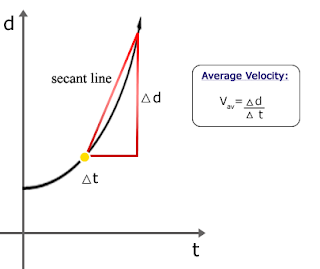
We can sort of feel the direction the points are headed. But there is a more precise way of determining which way the point is tending to fly-off at a certain place along the curve. Consider first when we examine a region of the curving variation, to determine the average change. Imagine we are representing the motion of a ball, distance per time.
average velocity graph
(Image attribution sought. Again, thank you, source)

The diagonal line tells us where the curve was generally tending during that region of variation. But it does not tell us where it was tending at any point. In other words, it does not give us what speed the object was tending at a particular place and time in its motion. To do so, we use a technique that diminishes both the change-in-time and the change-in-distance down to an infinitely small magnitude. Each value by itself no longer has a magnitude in comparison to the finite magnitude it began as. However, these two infinitely small magnitudes can still maintain their ratio value to one another. And this value in a sense has a quantity. Deleuze explains this by referring us to Leibniz' doubled triangle demonstration. Two right triangles, whose diagonal (hypotenuse) line is mutually constructed, maintain the same proportions as one is reduced while the other increases. So as the lines of the small one diminish to the infinitely small (but not yet completely zero), they still maintain the same ratio as the lines of the larger triangle. Hence we can still conceive of a finite value holding between two non-finite (infinitesimal) magnitudes.

leibniz calculus triangles from Justification of the Infinitesimal Calculus by that of Ordinary Geometry
(Image my own, made with OpenOffice Draw and GIMP)

Leibniz Justification of the Infinitesimal Calculus by that of Ordinary Algebra diagram animation
(Animation above is my own, made with Open Office Draw and Unfreeze.)

So watch as we reduce the two magnitudes of the axis. See how it alters the angle of the diagonal, until it seems to depict the way the curve is tending at the given point.


instantaneous velocity graph
(Image attribution sought. Thank you very much, source)

This animation shows how the tangent is angled at each place along the curve, and we can see how it depicts the way the curve is tending at each point. [When it turns black, it hits points of inflection. Some day we will turn to this concept that Deleuze discusses in The Fold.]

Sliding tangent curve
(Thanks wiki)

So we are deriving the tangent on a curve. Our curves can be described by functions. What we find is that in order to find the derivative, we need the x and the y values to be at different powers, that is, having different exponents. Deleuze refers us to a concept of depotentialization, which he very well might have drawn from Hegel's calculus writings in the Science of Logic (especially§§569-570). Consider the graph below. If we just have y = x, then we just have a straight line, and not a curve.
graph of y = x^2 x squared and y = x^-2 square root of x
(Image my own, made with Geogebra, OpenOffice Draw and GIMP)

But when we have y = x squared or y = the square root of x, then we have curves. What seems to allow for the function's line to curve is that there is a difference of power between them. In the case of y = x, they both tug on each other about the same amount throughout their variations. But in y = x squared, it is as though y pulls more-and-more on x as x increases, which is why the curve rapidly tilts upwards. So we might think of y having an increasing power, or having power of a higher order. For each standard unit of increase of y, it has an increased influence on x, and the magnitude of that influence itself increases with each unit. Deleuze refers to this as an acceleration. We will need to use this metaphorically to extract an idea we later use: we can only find the power relations on a curve if our line is curved, and we can only have a curved line if x and y have different powers in relation to one another.


Spinoza's Body Differentials

So we turn now to Deleuze's Spinozistic theory of affection and the body. At any moment, we are affected more-or-less by something [see Deleuze Cours Vincennes 20-01-1981]. This gives us more-or-less power to survive, and it indicates our capacity to endure such influences. As well, it tells us our power to influence other things. Our level of affection is always in continuous variation, like a curve. So at any moment, there is an instantaneous affection. It is the degree to which our level of affection is trying to change. It is the intensity of the change, stripped from the actual transition, and this transition requires duration to express itself fully. So if someone poisons us with arsenic, we lose power to survive, act, withstand influences and cause influences. Too much, and we die.

Deleuze further incorporates the differential calculus to explain this in physical terms. He finds implicit in Spinoza's thinking the idea of "simple bodies" [see Spinoza's Letter 32, Deleuze's Cours Vincennes 10-03-1981, and Deleuze's Expressionism in Philosophy, Chapter 13.] Spinoza discusses the composition and coherent relations of parts in the world in his Letter 32 to Oldenburg. Spinoza says that parts cohere when "the laws or nature of one part adapts itself to the laws or nature of another part in such wise that there is the least possible opposition between them" (Spinoza
Letters 192d). So he is taking into consideration
things as parts of a whole to the extent that their natures adapt themselves to one another so that they are in the closest possible agreement. In so far as they are different from one another, to that extent each one forms in our mind a separate idea and is therefore considered as a whole, not a part. (Spinoza Letters 192-193)
Spinoza offers an example "the motions of particles of lymph, chyle, etc.," which he regards as the parts of the blood. The particles
adapt themselves to one another in accordance with size and shape so as to be fully in agreement with one another and to form all together one single fluid, to that extent only are the chyle, lymph, etc. regarded as parts of the blood. But in so far as we conceive the particles of lymph as different from the particles of chyle in respect of shape and motion, to that extent we regard them each as a whole, not a part. (193a)
We will find that Deleuze will emphasize not so much the principle that allows the parts to accord with one another, but rather the difference which makes them different and thus relatable to begin with. We will first note how Deleuze conceives these parts which differentially relate to one another. Bodies, including our own, extend in space. This means they are made of smaller extending parts. We can keep dividing parts and only find more extensive pieces. But if we were to infinitely divide an extending part, we would have something that no longer extends, because it is infinitely small. So blood is made of lymph and chyle. We can divide chyle up into infinitely small pieces. They do not actually exist, because they are no longer extending bodies. But they are virtually there. Consider how we looked at an infinitely small part of time and an infinitely small part of space when finding the instantaneous velocity. We cannot have speed without an extent of time or space, because there is no motion. However, the instantaneous velocity is real. So it is real but not actual. This is Deleuze's virtual. We will try to apply this to extending bodies. There are not really infinitely small bodies making up our larger bodies. However, they are there virtually, and they can be explicated by means of our differential analysis. Deleuze will explain more.

So we consider that we may find some infinitely small reduction of a part of chyle. It is not really there, but when we place that tiny value in relation to another one, we can find the differential value holding between them. So note first the following. Our blood has a certain quantity of power (and so does the arsenic). What does this value come from? Deleuze says that the particles relate according to differences in speed and slowness. It could be that an infinitely small part of chyle moves at a different speed than an infinitely small part of lymph. I would suggest another conception. We might say that the lymph and chyle affect one another, but the one being of a greater power, like the x squared. So the difference in power would be like different speeds, one pulling harder and faster than another, causing the acceleration of the line's change in our graphs. Let's try this interpretation. So chyle and lymph are made of infinite sets of infinitely small parts. There is a power struggle between the sets, and this produces a value, indicating the blood's power. So if there are violent forces of variation in a body, it will be more powerful. It will be able to undergo the influence of very strong other differential values. So consider then if arsenic enters our blood. Our blood already has a differential value, so too does the arsenic. The bodies of our blood and those of the arsenic collide. If we can somehow be beings with arsenic in our blood, and still survive, then we are incorporating more differential variation within us. We evidently are strong, because it can survive even when poisoned. But if our blood decomposes, causing our body to decompose with it, then the arsenic decreased our power. This is power based on constitutive difference, on variation.

When the arsenic enters our blood, it will differentially relate to the blood's parts, and in that way affect the blood's relations. This will affect the way the other parts of our bodies differentially relate, in a chain reaction ending in the decomposition of our bodies. So the arsenic caused waves of affection to flow through our bodies, and this happens on the basis of a differential encounter. Later when discussing Deleuze's aesthetic affection, we will return to this notion.


One Body, One Blood?

The reason we consider blood to be one thing with parts is only because the parts have differentially related. If they assimilated, there would be no composition of parts, just a heterogeneous composition, whose parts are only spatially different. In other words, consider when the arsenic enters the blood. The two differentially relate in such a way that blood decomposes. We might rather say that it deforms. The blood is already a deformation of lymph and chyle. So when lymph bodies meet chyle bodies, one has more power than the other, but the two benefit from each other's differences and continue relating until new bodies like arsenic disrupt the differential relations. So blood is one body not in the sense that it consists of assimilated parts, quite the opposite: we call it a body because conditions allow its parts to persist in their differentially affecting one another, until something causes alteration.


Bodies of Rhythm

Let's now clarify then Deleuze's Spinozistic concept of body, by turning to his
Spinoza: Practical Philosophy. In Spinoza: Practical Philosophy, he will associate two somewhat parallel distinctions:

Kinetic / Dynamic
Longitude / Latitude

When we define a body kinetically, we regard their being infinitely small parts that differentially relate to one another in terms of differences in speeds and slownesses.
How does Spinoza define a body? A body, or whatever kind, is defined by Spinoza in two simultaneous ways. In the first place, a body, however small it may be, is composed of an infinite number of particles; it is the relations of motion and rest, of speed and slownesses between particles, that define a body, the individuality of a body. (Practical Philosophy, 123a)
He writes in a footnote that these particles whose speeds and slownesses differentially relate are 'simplest bodies,' which are the infinitely small divisions of extensive bodies [for more on simplest bodies as infinitely small divisions of extensive bodies, see Cours Vincennes 10-03-1981, and Deleuze's Expressionism in Philosophy, Chapter 13.] This kinetic dimension is also what Deleuze calls the longitude of the body:
We call longitude of a body the set of relations of speed and slowness, of motion and rest, between particles that compose it from this point of view, that is, between unformed elements. (Practical Philosophy 127c) [ft.3: Cf. what Spinoza calls "the simplest bodies." They have neither number nor form nor figure, but are infinitely small and always exist as infinities. The only bodies having a form are the composite bodies, to which the simple bodies belong according to a particular relation. (Practical Philosophy 127d)]
In a course lecture, he explains how according to this kinetic sense of the body that: "L’individualité du corps, pour lui, de chaque corps, c’est un rapport de vitesses et de lenteurs entre éléments" (Cours 02/12/1980 - 1). Since we are dealing with relations between speeds, and because speeds are quantities, perhaps we might translate 'rapport' as 'ratio,' at least in certain cases like this. So when we speak of the 'relations' of speeds and slownesses, perhaps we could also think of them as the 'ratios of speeds and slownesses.'

We might find ourselves interested at times in form and at other times in the changes that forms undergo. Yet both the form of something and its mutations are both grounded on the differential relations of speeds and slownesses of the parts. Blood is composed by the differential relations between infinitely small parts of chyle's speed and infinitely small parts of lymph's speed (that is, all the one's tendencies-toward-change and all the other's). The sum integrated total of all these differential relations, at a given time, between the infinitely small parts under differential relations between the sets, might be the form. The mutation of forms might then come from the differential relations between the elements of one moment with those of another moment. This would look at how one body relates to itself over time as it continually alters. So while we might find form and alteration to be interesting, Deleuze says:

The important thing is to understand life, each living individuality, not as a form, or a development of form, but as a complex relation between differential velocities, between deceleration and accelerations of particles. (Practical Philosophy 123bc)

That fact that things change, or that they 'become' can be quite interesting. But what might interest us more are what underlies those becomings, which are the differential relations. These perhaps are more matters of logic than metaphysics. They are the source of the power that secondarily gets expressed as change.

Deleuze also defines these differential relations of speeds and slownesses in musical terms, and we will return to this metaphor of music later.

Now, however, we define a body dynamically when we take into account the way it affects other bodies and is capable itself of withstanding affections.
Secondly, a body affects other bodies, or is affected by other bodies; it is this capacity for affecting and being affected that also defines a body in its individuality. (Practical Philosophy 123a)
Deleuze points-out that we will understand the things in our world differently when we comprehend them in terms of their capacity for giving and enduring affections instead of in terms of their formal relations. He has us consider the way we understand plow horses, racing horses, and oxen. Normally we would think that the horses are more akin to each other than is either horse to the ox. But let's consider these animals in terms of their affective capacities.
Take any animal and make a list of affects, in any order. Children know how to do this: Little Hans, in the case reported by Freud, makes a list of affects of a draft horse pulling a cart in a city (to be proud, to have blinders, to go fast, to pull a heavy load, to collapse, to be whipped, to kick up a racket, etc.) (Practical Philosophy 124a)
A draft horse has much the same capabilities as an ox. A race horse might struggle too much under the burden, respond wickedly to the whip, fear the situation rather than respond with pride in its abilities. But even capabilities might vary according to circumstances. If we were meditating in the dark, and someone turns on the light, this will dazzle our eyes and decrease our powers. But if we were looking for our glasses in the dark and then someone turns on the light, it increases our powers. These increases and decreases are always instantaneous and infinitesimal. [Deleuze Cours Vincennes 20-01-1981].

Deleuze also refers to the dynamic sense of body as latitude.

We call latitude the set of affects that occupy a body at each moment, that is, the intensive states of an anonymous force (force for existing, capacity for | being affected). (Practical Philosophy 127-128)

We turn now to Deleuze's using the metaphor of music to illustrate the kinetic view of the body:
The important thing is to understand life, each living individuality, not as a form, or a development of form, but as a complex relation between differential velocities, between deceleration and accelerations of particles. A composition of speeds and slownesses on a plane of immanence. In the same way, a musical form will depend on a complex relation between speeds and slownesses of sound particles. It is not just a matter of music but how to live: it is by speed and slowness that one slips in among things, that one connects with something else. (Practical Philosophy 123c)
Deleuze will develop this music metaphor further. He will also use the example of a wave. So let's take a look at what he might mean by taking a look at what could be the differential relations in sound waves.

When waves intersect, the can either add or subtract from one another, depending on how the waves are lining up.

So you can see the different possibilities.


So when two waves intersect, they push and pull on each other, and thereby create a co-composed deformation. Even a harmonic combination is still a deformation of the original waves:

harmonic sound wave combination
(Thanks jimloy.com)

We might see this better with a three dimensional animation of waves differentially deforming one another. [This animation comes from one of Paul Falstad's absolutely amazing simulators].


(Thanks Paul Falstad)

Now consider also this animation from the University of Salford, showing how the overtones of a string combine. These are additional smaller waves that accompany all real waves in the world around us. [See this entry on Pythagoras for a detailed explanation.]


So we see that these wave-combinations, even when harmonic, produce deformed waves. But such deformations perhaps would only come about if the parts were differentially related, each one communicating its differences to the other.

Deleuze uses the musical metaphor to describe Spinoza's vision of the world's composition. Bodies are made of these differential relations between the infinitely small parts of infinite sets. The values of those relations determine the combined differential body's affective power. Again, this affective power is its capacity to sustain a differential relation to another body without disintegrating apart or becoming assimilated into the other body. We saw in the three-dimensional animation how the smaller wave can still be seen in the larger one, and the larger one still discerned despite the smaller one's cutting through it.

three dimensional waves smaller flowing through larger
(Thanks Paul Falstad)

But even for the more complex wave forms, like the guitar string one above, we may still extract the component overtone values by means of Fourier analysis [discussed in this entry]. This means that no matter how much the component waves seem to have been swallowed-up and assimilated, they are still implied in the composite wave. So if we could see the sound waves in the air while a symphony plays, we would notice the effects of all the differential variations affecting one another as they come into contact. In other words, we would see the composition in the air as a network of differential relations that are the affections between different speeds and slownesses.
we are concerned [...] with a symphony of Nature, the composition of a world that is increasingly wide and intense. In what order and in what manner will the powers, speeds, and slownesses be composed? A plane of musical composition, a plane of Nature, insofar as the latter is the fullest and most intense Individual, with parts that vary in an infinity of ways. [126d]
In his seminars on Spinoza, Deleuze better explains the differential and compositional relations of affective speed. He begins with the idea of the simplest bodies, the infinitely small parts of a body [The following is from Cours 12 du 17/03/81]. They have no internal composition, because they are like the infinitely small values of vanishing terms. So they can only have external relations. When another body impacts us, that is, when our differentially related parts shockingly impact the other body's parts, both sets will differentially relate, causing changes in the relations of our internal parts, like a wave moving through us, changing all the other waves as it passes. We might know then how we were changed by that external wave. This is the first kind of knowledge. But we might also something about our own differential relations and how they differentially relate to other differential relations. Deleuze gives the example of swimming through a wave. The second kind of knowledge is 'know-how', which involves knowing how our body differentially relates to others and also our knowing how to change our own inner differential relations so that we sustain our differential relation with the thing we encounter.

When we jump into the water to swim, our simplest bodies and the wave's simplest bodies shockingly contact one another and send through each other waves of affective variations. This impact registers on our body, and the imprint is like the first kind of knowledge. This is the effect of the shock. But that does not mean we know anything about our own relations or the wave's relations.

But if we adjust our body so that we swim through the wave, then we have more than just a knowledge of the immediate shocking impact that the wave has on us. Deleuze calls it a sense of rhythm. This is a knowledge of how our differential relations differentially relate to other differential relations.
Alors, au contraire je sais nager, ça veut pas dire forcément que j’ai une connaissance mathématique ou physique, scientifique du mouvement de la vague, ça veut dire que j’ai un savoir faire. Un savoir faire étonnant, c’est à dire qui une espèce de sens du rythme. La rythmicité. Qu’est-ce que ça veut dire le rythme ? Ca veut dire que mes rapports caractéristiques je sais les composer directement avec les rapports de la vague. ça se passe plus entre la vague et moi, c’est à dire ça se passe plus entre les parties extensives, les parties mouillées de la vague, et les parties de mon corps, ça se passe entre les rapports. Les rapports qui composent la vague, bon, les rapports qui composent mon corps, et mon habileté, lorsque je sais nager, à présenter mon corps sous des rapports qui se composent directement avec les rapports de la vague. Alors c’est : Je plonge au bon moment, je ressort au bon moment, j’évite la vague qui approche ou au contraire je m’en sers, etc. Tout cet art de la composition des rapports (Cours 12 du 17/03/81)
Recall also our reasoning for using the term 'ratio' instead of 'relation' when speaking of the differential relations of speeds and slowness between parts. This was because the speeds or slowness (or better, their instantaneous tendencies toward speed or slowness) are quantitative, so their relation could be one of a ratio. This also could help explain why our knowing how the speeds and slownesses relate is a matter of a sense of rhythm. We normally think of rhythms as a repeating pattern per some amount of time. And we might say that a rhythm has a certain relative speed to it, depending on how it divides temporal portions. But in this Deleuzean sense, rhythm is the way speeds differentially relate. When we jump in the water, knowing how to maintain ourselves within the water, despite our continual differences with the wave, is a sense of rhythm. So rhythm in this sense is something immediate, and it is not so much like a pattern repeating through time. Specifically, rhythm is the way the different speeds of bodies affect themselves and one another in response to each other.

Deleuze uses both the swimming example and a dancing example in another seminar. He says when we encounter the wave or enter the dance floor, we are living in the rhythm of our interaction, where we are continually anticipating how the wave or dance-body will affect us, and then also we adjust ourselves so that we survive through it. He notes that those who do not know how to dance might anger everyone by dancing however they can so to disrupt the overall flow. (
Cours - 03/02/81 - 2) This would be a case where one body fails to cause itself to self-differentiate in such a way that it sustains its differential relation with another body. The bad dancer causes the dance to break-down, and hence there becomes no point for him to be dancing anymore. And he himself, by angering everyone, has lowered his own social powers of affection.

Deleuze also uses the metaphor of musical instruments playing together to illustrate the rhythmic combination of a third body. He says that rhythm is something like the shared interaction at the boundary of two meeting bodies. Rhythm is not so much to be found in the violin or the piano alone, rather rhythm is to be found in violin responding and reacting to the piano all while the piano at the same time responds and reacts to the violin. This is sort of like them dancing. The third body then is the musical work that their shared rhythmic interaction produces. [Le rythme c’est une notion commune à deux bords au moins. Le rythme il est fondamentalement commun à au moins deux bords. Il n’y a pas le rythme du violon, il y a le rythme du violon qui répond au piano et le rythme du piano qui répond au violon. Ça c’est une notion commune à ce moment là. Vous savez la notion commune de deux corps, le corps du piano et le corps du violon, sous l’aspect, sous tel ou tel aspect, c’est-à-dire, sous l’aspect du rapport... du rapport qui constituera telle œuvre musicale et qui forme le troisième corps.] (
Cours 31/03/81 - 14_- 2)


Sources:

Deleuze, Gilles. Spinoza: Practical Philosophy. Transl. Robert Hurely. San Francisco: City Lights Books, 1988.

Deleuze's Spinoza Course Classes:

Cours 20/01/1981
webdeleuze.com
French and English

Cours 03/02/81 - 2
http://www2.univ-paris8.fr/deleuze/article.php3?id_article=221

Cours 10/03/1981
(webdeleuze.com)
French and English

Cours 17/03/81
http://www2.univ-paris8.fr/deleuze/article.php3?id_article=151

Cours 31/03/81 - 14_- 2
http://www2.univ-paris8.fr/deleuze/article.php3?id_article=46

Cours 02/12/1980 - 1
http://www2.univ-paris8.fr/deleuze/article.php3?id_article=91
http://www.webdeleuze.com/php/texte.php?cle=209&groupe=Spinoza&langue=1


Spinoza. The Letters. Transl Samuel Shirley. Cambridge: Hackett Publishing Company, Inc., 1995.


Image and animation sources.

Derivative animation
http://faculty.uncfsu.edu/msiddiqu/Maple_Animations.htm
(Thanks Fayetteville State University Department of Mathematics and Computer Science)

Wikipedia sliding tangent
http://en.wikipedia.org/wiki/File:Graph_of_sliding_derivative_line.gif
(Thanks wiki)

3-D Wave animation made using:
http://www.falstad.com/mathphysics.html
(Thanks Paul Falstad)

Phase sound wave image:
http://www.mediacollege.com/audio/images/wave-interaction.gif
(Thanks mediacollege.com)


Combining wave animation:
http://pages.physics.cornell.edu/courses/p101/6/demo2.html
(Thanks physics.cornel)

String combination animation from:
http://www.acoustics.salford.ac.uk/feschools/waves/string.htm
(Thanks acoustics.salford.ac.uk)

Harmonic wave combination image:
http://www.jimloy.com/physics/harmony.htm
(Thanks jimloy.com)