

Showing posts with label Brakhage. Show all posts

21 Dec 2011

Rhythm without Time: Difference & Phenomena


by Scott Wollschleger and Corry Shores

Search Blog Here. Index-tags are found on the bottom of the left column.]
[Central Entry Directory]
[Scott Wollschleger Entry Directory]
[Corry Shores, Entry Directory]

[The following is a presentation we gave at the London Graduate School's Rhythm & Event conference, 29 October 2011. May I thank Eleni Ikoniadou and all those involved in organizing the conference, and may I thank John Mullarkey for his incredible help with my research.]


Scott Wollschleger
Corry Shores

"Rhythm without Time:
Difference & Phenomena"

Presentation at the London Graduate School
Rhythm & Event conference


[Audio]

Deleuze defines the phenomenon as the flash of difference communicated between the terms of heterogeneous series. Now, following Husserl, we might consider simultaneous and successive elements of our phenomenal consciousness. At any moment of our visual awareness, for example, there will be variations throughout our field of vision that are all given together at once. But even if we are staring at a motionless scene, there will still be slight variations in the way things appear from moment to moment. Yet from this Husserlian perspective, there will be associating similarities within each moment and also carrying-on between moments. A more traditional phenomenology might be concerned with how these parts synthesize into self-same phenomenal objects over the course of time. A Deleuzean phenomenology, however, would instead be concerned with the differences flashing between the simultaneous and successive series of variations. So, something appears phenomenally when it stands-out. And something stands-out on the basis of a differential relation. A Deleuzean phenomenology would regard these differential flashes as lying at the basis of phenomenal appearings.

Deleuze also describes rhythm in similar terms. The rhythm of sensation, for example, involves the differential coupling of continuously varying waves of intensity. What we wonder is whether time as we normally understand it in phenomenology and music is in fact not what is most immediately involved in our experiences of musical and phenomenal rhythm.


Photobucket

[Audio]

In Husserl’s phenomenal time consciousness, for example, each moment overlaps with its neighbors, creating a bloated and somewhat extending now-moment of our awareness. The now of consciousness is not instantaneous, and it is impossible for any moment to be discontinuous with the rest. It is on the basis of these continual overlappings of moments that objects become constituted as self-same, despite their variations over time. Also, in Merleau-Ponty’s portrayal of phenomenal time, each moment is thoroughly integrated with the rest. What we now experience already in an implicit way is indirectly announcing future phenomena, because all moments of our consciousness are woven together like a fabric. One value of Deleuze’s concept of rhythm is that is can give us a way to understand phenomenal givenness on the basis of a different sort of temporality, one which is bordering on being a sort of non-temporality.

In Difference & Repetition, Deleuze distinguishes cadence repetition from rhythm repetition. Cadence repetition is “a regular division of time, an isochronic recurrence of identical elements.” Consider if we were to focus on the ticking of a clock. At first it might begin as the phenomenon in the forefront of our awareness. But as its homogenous and redundant pattern becomes increasingly monotonous, it fades from our attention, becoming less phenomenal. If the clock malfunctioned, however, and produced irregular ticking, it would pop back into our awareness again. This is something like what he calls rhythm repetition. It is heterochronic rather than isochronic. Its recurrences appear through unequal and incommensurable relations. Deleuze writes “The reprise of points of inequality, of inflections or of rhythmic events, is more profound than the reproduction of ordinary homogeneous elements.”

Deleuze derives this concept of rhythm as heterochronic from the theoretical writings of music composers Messiaen and Boulez. Boulez speaks of rhythm in terms of an irregular pulse. He says that one way he accomplishes it is by dividing the time into such a nuanced pattern that only a machine could perform it with perfect precision. This causes the human performer to produce a rhythmic pulse that continually defies a regime of regularity. According to Messiaen, a military march is not rhythmic, because there is nothing about its regular pattern that interferes with the listener’s pulse, breathing, or heartbeats, and thus she receives no shock. He continues, “the march, with its cadential gait and uninterrupted succession of absolutely equal note-values, is anti-natural. True marching is accompanied by an extremely irregular swaying: it’s a series of falls, more or less avoided, placed at different intervals.” What seems to underlie these notions is that rhythm is characterized by motion and change; and if the same standardized patterns are repeated without variation, then the motion stagnates and loses its rhythmic feel.

Deleuze says that artists and musicians should hone our attention so that we directly perceive the infinitely intricate differential variations of rhythm from moment to moment. He writes, “When Fred Astaire dances the waltz, it is not 1,2,3, it is infinitely more detailed. When Africans dance, they are not seized by a rhythm demon, they hear and perform all the notes, all the times, all the tones, all the pitches, all the intensities, all the intervals.” Here is some of Fred Astaire’s infinitely intricate waltzing.


[Audio]

Like Fred Astaire, when Horowitz plays the waltz, he adds infinitely more rhythmic detail. Compare the mechanized midi version with Horowitz’s rendition. [Below we use Stephen Malinowski’s amazing Music Animation Machine.]


[Audio]

Photobucket
When discussing non-pulsed time, Deleuze refers us to Boulez’ Eclat. In this piece, Boulez instructs the musicians not only to vary the tempo, but also to do so in continuous variation, as if slowing down or speeding up a turn-table. He indicates these tempo disfigurations with up and down arrows. We will look at the opening part.
Photobucket

[Audio]

We might feel the acceleration in the way that the piano notes seem to tumble out with increasing rapidity. We repeat those notes, each time slowing them down so we might perceive the variation more closely.


[Audio]

In this clip we see Boulez overseeing the performance, and we might also sense the continuous variations of tempo.


[Audio]

We will now look more closely not merely at successive heterogeneity but also at simultaneous heterogeneity, which adds another layer of differential rhythm.

Photobucket
We see these two rhythmic differentiations at work in Michael Gordon’s composition, Yo Shakespeare, described as having “irregular rhythms, sudden, precise tempo changes, and simultaneous different meters.” Or as Gordon himself says “there's […] three types of dance rhythms going on at the same time […] almost as if there are three different dance rooms with three different dance bands playing at [once] […] playing different songs and different tempos, but somehow you […] dance to it.”

A glitch in Gordon’s computer program allowed him to juxtapose even and odd divisions of time along the motion of particular instruments. So each such instrumental voice collides with itself in a continual stutter. Yet also, each instrumental motion is in metrical defiance with the others.


[Audio]

Let's now consider Deleuze’s analysis of Leibniz’ micro-perceptions. They are the differential relations between perceptions that have diminished to the infinitely small. They have vanished, but the relation between them remains. To help us visualize this, Leibniz describes a geometrical figure with two triangles, constructed with the same line. As this line moves to the right, one triangle increases while the other decreases.

Photobucket

Yet the sides of both triangles remain proportional, so the ratio of the larger one always indicates the ratio of the smaller one. This holds even as the smaller triangle’s sides diminish to the infinitely small. They have vanished, but their differential relation remains, still discernible in the larger triangle.


Our micro-perceptions are also like these differential relations between vanished terms. For example, when we perceive green, we are really noticing the differential relations between infinitely small perceptions of blue and yellow. At their basis, all our perceptions are primarily these undetectable micro-perceptions.

Deleuze microperceptions yellow blue green differential perception animation
So the perception of green is not merely the addition of yellow and blue, like when we mix paint. Green results not from their assimilation and bleeding into one another, but rather from their jarring up against each other.

So at any moment, seeing green might be a matter of viewing differential flashes between simultaneously given tiny blues and yellows.

Now, to better grasp the phenomenality of successive variations, I suggest we turn to filmmaker Stan Brakhage.


Deleuze refers to him when discussing the infinites of variation in our fields of perception. One thing Brakhage says he likes about film are its “sharp hard clarities of snapping individual frames.” In many later works, he hand-painted every frame individually. Each one could be a work of art on its own. But, is it only the pictures that we notice when watching his films? Or is there phenomenal content to the differences between the images, which are responsible for making each new frame stand-out in the first place?


First consider this simpler example from an earlier work. Moving one frame to the next, we change from black to red then return to black, all between other shifting imagery. We will repeat this rapid transition here a few times, because it is easy to miss.


[Audio]

Is the phenomenon the red or the black, or is it not the shock we feel between the two?

Rhythm and phenomena in this Deleuzean sense are based on differential relations between simultaneities and within instantaneities. In other words, at their basis, neither rhythm nor phenomena are most fundamentally experienced throughout an extended flowing passage of time. They are given in immediacy. I would like to close with this passage from Brakhage where he articulates a sort of rhythmic appearance of phenomena that are given to him on the basis of their differential incompatibilities.


Questions Section

[Audio only]


Audio gratefully taken from:
http://backdoorbroadcasting.net/2011/10/corry-shores-scott-wollschleger-manhattan-school-of-music-rhythm-without-time/
Thanks for recording the presentations and making them available


Conference page:
http://www.thelondongraduateschool.co.uk/blog/symposium-rhythmevent/


7 Jun 2011

Cézanne and the Phenomenon: Painting Divergences in Merleau-Ponty and Deleuze


by Corry Shores
[Search Blog Here. Index-tags are found on the bottom of the left column.]

[Central Entry Directory]
[Corry Shores, Entry Directory]


[The following is my presentation that I gave at the Dutch Association of Aesthetics conference
in Ghent, Belgium, May 2011.]

[May I sincerely thank the sources of the images
Concrete Rules and Abstract Machines
awesome-art.com
dl.ket.org
Joy A's flickr / Joy A
all about Weybridge. / Rachael Talibart
students.sbc.edu
russianpaintings.net
wikipedia
sai.msu.su
Machotka
analog-synth.de
theatreorgans.com / synthtech.com
G. Fernández - theartwolf.com
travel.webshots.com and rajbaut
Credits are given below the image and at the end.]


Cézanne and the Phenomenon:
Painting Divergences in Merleau-Ponty and Deleuze


[Thanks Concrete Rules and Abstract Machines]

Deleuze is often considered an anti-phenomenologist. He even writes disparagingly of phenomenology’s lived-body that we find in Merleau-Ponty’s thinking. Nonetheless, Deleuze still generated an original theory of phenomena. So rather than determining whether Deleuze was a phenomenologist or an anti-phenomenologist, we might instead attempt to formulate what a Deleuzean phenomenology would be like. For Merleau-Ponty, phenomena are possible on account of three levels of harmonic integration: among the parts of the phenomenal world, among our bodily parts functioning in sensation, and between our body and the world enveloping us. All these overlappings bind us into the flesh of the world. Yet, a Deleuzean phenomenology would be based on precisely the opposite principles: the phenomenal world consists of incompatible differences shockingly forced upon us, all while our body functions disjunctively within itself and with our surroundings. Both Merleau-Ponty and Deleuze express their different views through their seemingly convergent readings of quotations attributed to Cézanne. But as we will see, there is one line in Deleuze’s commentary that indicates his different fundamental principles.

Both Merleau-Ponty and Deleuze turn their focus to painters when at times describing sensation and perception. Painters exercise a certain phenomenal sensitivity. They do not just see, they also become aware of how we see. Merleau-Ponty thinks painters have a ‘secret science,’ because they live purely in our emersion in the world, which they visually express in their art. Cézanne aimed to paint not the immediate impressions, like the impressionists, nor did he paint the finished perception as a photo-realistic rendition. Instead, he wanted to paint the way our eyes and minds deal with our impressions. We see in his earlier attempts that objects are often misshapen.

Cézanne. Still Life, Fruit and Pitcher on Table

Cups and saucers, for example, should normally appear elliptical, but Cézanne paints them with swollen ends. Fruit that should appear more spherical are also deformed.

Cézanne: Still Life with Apples (1890-94)
(Thanks dl.ket.org)

These still lifes depict not a photographic representation of reality, but rather allow us to enter into the process of objects coming into formation in our perception. What interests us is how Merleau-Ponty accounts for the ways and reasons that our perceptions come about through integrations.


For Merleau-Ponty, our phenomenal parts integrate by means of our horizonal awareness. Consider if we view a red carpet. Each part of our perception looks its particular way on account of the other qualities and objects expressing themselves in that appearance, for example, the overlaying shadow that tinges the color or the illuminated portions that lighten its tone.
We are not surprised when looking up to see the source of light and the objects that block it. The red’s particular shaded or lighted look refers our mind to things not explicit in what we directly perceive.


Or consider how a stream’s surface might reflect the brownish hue of an overlying bridge. When looking at the water, we are not directly aware of the bridge, but it is being implicitly spoken or announced by the stream’s color. The stream would appear differently to us were it not for its integrated relation with the bridge above it. And likewise, when looking up at the bridge, we see in its appearance the motion of the water, reflecting up upon it. Our minds have an awareness of these related phenomena, but they are not in the forefront of our attention. As implicit phenomena, they hover at the edges of our awareness.

This horizonal integration of phenomenal objects is so involved that to see one object from a given perspective is also to have on the horizon of our awareness the way that object looks from the perspectives of every other object facing it. Merleau-Ponty illustrates this effectively with the arm-shadow in Rembrandt’s
The Night Watch.

Rembrandt. De Nachtwacht (The Night Watch) 1642
Rembrandt Nightwatch

(Thanks www.students.sbc.edu)

Notice how the man in the foreground holds-out his arm, which casts a shadow on the man standing next to him.

Rembrandt. De Nachtwacht (The Night Watch), detail

We do not merely see his arm from just our perspective; we also see it as if we were looking from his right side at the angle of the light source, because the shadow we see from our perspective presents to us the appearance of his arm from the sun’s perspective.

Rembrandt. De Nachtwacht (The Night Watch), detail
Rembrandt Nightwatch detail hand shadow
(Again, thanks russianpaintings.net)

The parts of our body also have horizons that integrate, with each sense giving us phenomenal data that is on the margins of the other senses as well.“ Synaesthetic perception is the rule,” Merleau-Ponty writes, continuing, “The senses intercommunicate by opening-on to the structure of the thing. One sees the hardness and brittleness of glass, and when, with a tinkling sound, it breaks, this sound is conveyed by the visible glass."


And when we are given an impression of the world around us, we enter into communion with the world by means of the sympathetic relation of that sensation. When our hands are about to feel something smooth, they take-up a certain ‘degree,’ ‘rate’ and ‘direction of movement’ appropriate for feeling that kind of surface, instead of the sorts of motion and readiness needed to feel something rough. The smooth thing called-out to our hands to tell them how it needed to be felt; so even before making physical contact, the smooth thing placed itself upon our hands. So we cannot say that we are the toucher performing the action, and the smooth thing is something passively receiving our action. The smooth object acts on us just as much as we act on it. The thing we sense begins as a ‘vague beckoning’ whose call to us allows us to ‘synchronize’ with it. In this way, there is a ‘crisscrossing’ of the touching and the tangible. By opening themselves up in this way, our hands incorporate themselves into the world they feel-out. So we might think of ourselves together with the world we perceive as being of one flesh. There is an intimacy between us “as close as between the sea and the strand.”

Merleau-Ponty flesh diagram animation
So here we may display the three sorts of integrations at work in phenomenal appearances. The parts of the world integrate, because each part of our perception of the world has the other parts on the horizon of our awareness. Such perceptions are possible because the parts of our body, including our sense organs, themselves have the other senses on their horizon, and in that way integrate synaesthetically. And it is on account of our sympathetic interaction with the world that we may come into phenomenal contact with it.

Before turning to the Cézanne material, let’s note Merleau-Ponty's account of the way the child perceives colors before learning the names for them.


Children first are only able to distinguish colored things from non-colored ones. Next they differentiate warm and cool shades of colored regions. Finally, they can discern different distinct colors. And then gradually, they can distinguish further variations of each color. Merleau-Ponty says that this is not because the child originally perceived the different specific colors in their determinacy, being only unaware of the colors’ identities. Merleau-Ponty instead says that the colors were originally seen in an | indeterminate form, and only gradually does the child come to constitute them distinctly. In other words, the child sees different colors but not so much the distinctions between them, although these differences hang implicitly on the horizon of their awareness. There are relations, then, between the colors that are seen, but only implicit ones. As Cézanne writes, these are “the confused sensations which we bring with us when we are born.”
Cézanne describes his initial experience when painting his landscape or motif as involving this raw encounter with the visual givenness of the world.

I breathe the virginity of the world [...]. A sharp sense of nuances works on me. I feel myself colored by all the nuances of infinity. At that moment, I am as one with my painting. We are an iridescent chaos. I come before my motif and I lose myself in it.


Deleuze speaks of filmmaker Stan Brakhage as having explored a “Cézannian world before man, a dawn of ourselves, by filming all the shades of green seen by a baby in the prairie,” and he refers us to a text quoting Brakhage describing this world. Yet, we have Brakhage himself reciting that passage in this interview.


[Alternate version: "Imagine an eye unprejudiced by compositional logic, an eye which does not respond to the name of everything, but which must know each object encountered in life through an adventure of perception. How many colors are there in a field of grass to the crawling baby unaware of “green?” How many rainbows can light create for the untutored eye? Imagine a world alive with incomprehensible objects and shimmering with an endless variety of movement and innumerable gradations of color. Imagine a world before the “beginning was the word."]


So Cézanne begins by taking up such a stance where he views his landscape with an untutored eye. Yet what he sees is not merely an iridescent chaos, because from the beginning, the geometry of the geological structures has already begun taking formation in his perception. In both Deleuze’s and Merleau-Ponty’s commentaries, we see they take note of this emergence of phenomena, although Deleuze accents the chaotic origins a little bit more.

Cézanne continues,
slowly geographical foundations appear, the layers, the major planes form themselves on my canvas. Mentally I compose the rocky skeleton. […] A pale palpitation envelops the linear elements. The red earths rise from an abyss. […] Geometry measures the earth.


So he begins with a primordial chaos of visual perception. In this beginning stage the general geometrical forms are given as emergences of geological structures. But he does not continue by painting these formations as they find more determinate boundaries, but rather makes them collapse by submitting them to a catastrophe: he converts them into something completely unlike how they began. He turns geometry into color. Again, we see by comparing Deleuze's and Merleau-Ponty's commentaries that they say essentially the same thing, but with a little more emphasis on the chaotic in Deleuze's case.


Cézanne first sketched the linear features of the structures roughly in charcoal. But instead of working on making those lines clearer and more definite, he instead worked to use color patches to create volumes encompassing the figure. When arriving at this state of harmony and equilibrium in the color tone and saturation, Cézanne declares:
I have my motif. . (He clasps his hands together [..] intertwining his fingers) […] I join [nature’s] wandering hands . . . I pick her tonalities, her colors, her nuances […]. I fix them; I bring them together . . . They form lines. They become objects, rocks, trees, without my thinking about it. They take on volume. They have color values. If these volumes and values correspond on my canvas and in my senses, to my planes and patches, that you also see before you, well, my painting joins its hands together.


We can see in their commentaries that both Deleuze and Merleau-Ponty stress this idea of the intertwining of phenomenal parts.

So far, both Deleuze’s and Merleau-Ponty's commentaries seem to fall in line. However, Deleuze introduces a new concept when he writes: “The diagram is exactly what Cézanne called the motif.” Deleuze gives the most detailed explanation of painted diagrams in his analysis of Francis Bacon’s artwork. Here we see Bacon explaining his aim of rendering reality in the alternate medium of painted imagery.


Bacon gives us the experience of immediate reality not by painting photo-realistically, but rather by forcing our bodies to contend with incompatible differences. Reality in its immediate givenness is a paradox to our senses. Objects of our experience are recognizable only secondarily after we had a moment to process the information we see. But the absolutely immediate impact of reality is un-processed newness.

Photo of an eagle landing
(Thanks wikipedia)

The problem Bacon faces is that if he painted recognizable and comprehendible imagery, the viewer would process the visual data and convert it into a summarized narrative, for example, ‘this is a bird landing on a field.’ After recognizing what we see, we can then walk away and forget the image.

Bacon would begin with such a proto-formation, then make random markings like splatters or smears.

Francis Bacon's Diagram: Detail From Painting, 1946
Francis Bacon's Diagram: Detail From Painting 1946

Bacon reads these new lines as if they were a diagram pointing out new directions to develop the imagery.

Francis Bacon animation of Painting 1946 with bird, Deleuze's analysis
(Animation is my own,
made with
Open Office Draw and Unfreeze,
with images thanks to
www.sai.msu.su and wikipedia)

In this way, the diagram causes a catastrophic chain reaction to spread over the painting. What results is a conglomerate of images that we feel inclined to put together, and yet find it impossible to do so entirely.

Francis Bacon and Diagram in Painting 1946

This holds us in the paradoxical givenness of immediate reality. The diagram here is a mechanism that forces variations into what we see. It ensures that the painting maintains its phenomenal intensity, even after a prolonged view.
In a similar way, Cézanne’s color patches also do not always resemble the original thing’s colors.

Rochers à l'Estaque
cézanne Rochers à l'Estaquecézanne Rochers à l'Estaque
(Thanks Machotka)

Le Lac d'Annecy
cézanne Le Lac d'Annecycézanne Le Lac d'Annecy
(Thanks Machotka)

Cézanne once confused a visitor who saw him paint a gray wall green. He chose his colors on the basis of how those selections would act on our minds, and in this way he was able to give us a sense of the volumes and depths of a scene without depending on outlines and shading. His color modulations turned geometry into color, intertwining our sense impressions with the structural forms around us.

But what is important is not how the color patches integrate, but rather how they differ. We feel his depth in the way that one color patch changes to another. The color-change does not tell our senses that this other part of the object has another color, but rather that it faces toward another angle, and thus is more apt to reflect flashes of color from an alternate light source.

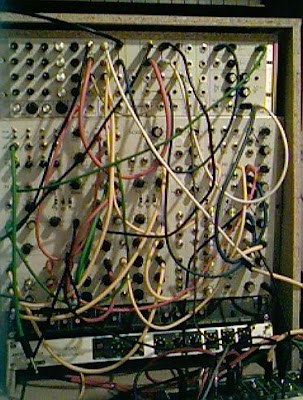
Analog Modular Synthesizer
modular analog synthesizer
(Thanks analog-synth.de)

Analog Modular Synthesizer
Frank Vanaman's MOTM Modular Synthesizer
(Thanks theatreorgans.com, citing as source: synthtech.com)

We move from color-patch to color-patch much the same way that a sound-signal moves from module to module in an analog synthesizer, with each transition modifying the sound’s appearance.


So let’s consider a Deleuzean interpretation of Cézanne’s words. The color modulation in Cézanne's paintings would be a series of differential perceptions. The fingers of Cézanne's folded hands are intertwined not in integration, but as incompatible differences that are mashed together. And this does not integrate us with the world, because the world as it is given and rendered is not the same world that we sense. Regarding the integration of our body-parts, it is not evident that in Cézanne it is based on differential relations rather than integrations. Perhaps this is one reason Deleuze turns to Bacon, whose shocking artworks throw the parts of our body into disarray.

So what would it be like to do phenomenology in a Deleuzean way? I think it would be based on phenomenal differences and incompatibilities. I would like to end with Stan Brakhage’s spontaneous and eloquent account of how things phenomenally stand-out and appear to him. It seems in part to be based on phenomenal differences and incompatibilities.


Image Credits:

First Cézanne fruit painting:
http://ajnabee.tumblr.com/post/5169621182/paul-cezanne-nature-morte-with-commode-1883-87
Thanks Concrete Rules and Abstract Machines

Cézanne. Still Life, Fruit and Pitcher on Table
http://www.awesome-art.com/awesome/shop/category.aspx?catid=44&page=1&sortby=
(Thanks awesome-art.com)

Cézanne: Still Life with Apples (1890-94)
http://www.dl.ket.org/webmuseum/wm/paint/auth/cezanne/sl/apples/index.htm

Red Carpet:
http://www.flickr.com/photos/21295189@N04/3028115809
(Joy A's flickr. Thanks Joy A)

Bridge:
http://www.allaboutweybridge.co.uk/aaw/weybridge/surrey/weybridge-photos/weybridge-wey-bridges.htm
(Thanks all about Weybridge. Thanks Rachael Talibart.)

Eagle picture:
http://upload.wikimedia.org/wikipedia/commons/8/86/American_Bald_Eagle%2C_landing.jpg
(Thanks wikipedia)

Bacon. Francis Painting 1946
(c) 2009 The Estate of Francis Bacon/ARS, New York/DACS, London

Cezanne comparison images:

Machotka Pavel. Cézanne: Landscape into Art.
http://www.machotka.com/library/landscapetoart/index.htm

Analog Modular Synthesizer, vertical image
http://www.analog-synth.de/synths/formant.htm
(Thanks analog-synth.de)

Analog Modular Synthesizer, square image
http://theatreorgans.com/walnuthill/wall-frankvanaman.htm
http://www.synthtech.com/motm.html

Cézanne. Mont Sainte Victoire.
http://www.theartwolf.com/articles/50-impressionist-paintings.htm
(Thanks G. Fernández - theartwolf.com)

Mont St Victoire. la montagne Sainte-Victoire vue des Lauves, photo
http://travel.webshots.com/photo/1525735117041399610tbQuZP
(Thanks travel.webshots.com and rajbaut)