













Corry Shores
With Thomas Smid's input, I updated the entry on his critique of relativity's time dilation. Click on this link:

"if you think childlike, you'll stay young. If you keep your energy going, and do everything with a little flair, you're gunna stay young. But most people do things without energy, and they atrophy their mind as well as their body. you have to think young, you have to laugh a lot, and you have to have good feelings for everyone in the world, because if you don't, it's going to come inside, your own poison, and it's over" Jerry Lewis "I don’t believe in the irreversibility of situations" Deleuze

time, as measured by the speeding space traveler, slows down compared to time as measured by a friend left home on Earth. This is sometimes described as the "twin paradox": two identical twins, one of whom goes off on a voyage close to the speed of light, and the other one stays home. When the space-traveling twin returns home, he or she has aged only a little, while the twin who has remained at home has aged at the regular pace. So we have two identical twins who may be decades apart in age. Or maybe the traveling twin returns in the far future, if you go close enough to the speed of light, and everybody he knows, everybody he ever heard of has died, and it's a very different civilization. ("Sagan on Time Travel.")
Let the twins move apart for some time so that the difference in aging measured by each is substantial; then bring the twins back together and let them stand side by side and compare their appearances. Each will say that his sibling is younger than he, but both cannot be right. Which twin is, in fact, older, or is there any age difference seen at all? (Mook & Vargish 110c)
The resolution of the "paradox" depends upon a careful analysis of how the experiment actually can be carried out. When the twins separate on the tracks it is true that each will claim the other is aging more slowly than he, but notice that this is a conclusion based on measurements made of the other twin. Unless we change the direction of motion of at least one twin (that is, accelerate the twin), the two twins will continue to separate forever, and we cannot directly compare their two ages (this is like bringing two events to the same point in space so that simultaneity can be determined directly). But since we do want to compare the twins' ages directly by comparing their simultaneous appearance, suppose that we accelerate twin #1 and bring him back to stand at rest with respect to twin #2. Notice that now the two twins no longer have identical histories. One twin has undergone an acceleration (and the twins can tell which has been accelerated because the accelerated twin moved in a non-inertial frame for a time and so experienced some sort of force, as described in section 2.4). As we will see in the following chapter, in accelerating, twin #1's clock will be slowed relative to twin #2. When the twins are standing at rest with respect to one another, the twin who suffered the acceleration will have aged less than the other. (Mook & Vargish 110b-111).
The standard textbook approach treats the twin paradox as a straightforward application of special relativity. Here the Earth and the ship are not in a symmetrical relationship: the ship has a "turnaround" in which it undergoes non-inertial motion, while the Earth has no such turnaround. Since there is no symmetry, it is not paradoxical if one twin is younger than the other. Nevertheless it is still useful to show that special relativity is self-consistent, and how the calculation is done from the standpoint of the traveling twin.Special relativity does not claim that all observers are equivalent, only that all observers at rest in inertial reference frames are equivalent. But the space ship jumps frames (accelerates) when it performs a U-turn. In contrast, the twin who stays home remains in the same inertial frame for the whole duration of his brother's flight. No accelerating or decelerating forces apply to the homebound twin.There are indeed not two but three relevant inertial frames: the one in which the stay-at-home twin remains at rest, the one in which the traveling twin is at rest on his outward trip, and the one in which he is at rest on his way home. It is during the acceleration at the U-turn that the traveling twin switches frames. That is when he must adjust his calculated age of the twin at rest. (Twin Paradox)
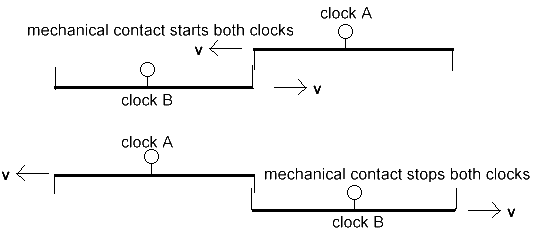
Some physicists claim that the situation would in practice not be symmetric as one observer has to turn around in order to compare the clocks (see for instance http://www.phys.vt.edu/~jhs/faq/twins.html), but it is clear that this argument does not hold water as the time dilation should already be apparent before one observer turns around. (Smid Time Dilation and Twin Paradox Debunked)

The clocks are started and stopped in each reference frame simultaneously (by definition, the contact starts each clock from zero) and both clocks will thus show identical times (for identical rods and clocks) after having been stopped (and after the clocks have been stopped, it is obviously irrelevant if A or B (or both) turn around to compare the clocks). (Smid Time Dilation and Twin Paradox Debunked)
It should also be pointed out that the signal propagation time from the trigger points to the clocks is actually irrelevant here (whatever way of transmitting the signal is used): if the corresponding distances are identical in both systems, then the delay times will also be identical and there won't be any difference in the clock readings afterwards (Time Dilation and Twin Paradox Debunked)
According to relativity, clock differences should arise solely due to a constant relative velocity, but as this leads to the twin paradox, a hand-waving argument is being made that one system has to turn around (i.e. accelerate) to compare the clock (which of course doesn't resolve the paradox, as a) you could in principle make the period of acceleration arbitrarily short, and b) it would violate causality as the clock difference would have to build up already before the acceleration occurs). (Smid Relativity Discussion Forum page 4)