


Showing posts with label Carné. Show all posts

8 Jun 2011

Motionless Duration in Deleuze's Bergson


by Corry Shores
[Search Blog Here. Index-tags are found on the bottom of the left column.]

[Central Entry Directory]
[Corry Shores, Entry Directory]


[May I thank the sources of the images:
eyefetch
diagonalthoughts.com
marinagraham
Credits given below the image and at the end.]

The following is from my presentation at Leuven's Husserl Archive's Graduate Workshop in Phenomenology. May I thank Roland Breeur, Ullrich Melle, and Carlo Ierna for including me at the last minute, and may I also thank the other presenters, Akos Krossoy, Özlem Gürbüz, and Allen Jones, for their excellent presentations and their kind tolerance for my presentation's media needs. As well, I am grateful to Rudolf Bernet for his insightful question. This presentation is an expansion of the one I gave at the London Bergson conference [the new material begins with Bergson's double jets].


Motionless Duration in Deleuze's Bergson

Deleuze is often considered an anti-phenomenologist. Yet perhaps his critique of phenomenology is more of a constructive critique. Deleuze is not against the project of studying phenomenal appearances; he merely does so on the basis of different principles and methods. Namely, Deleuze seems interested mostly in the intensity of phenomena. Phenomenologists, however, often turn their attention to how phenomenal appearances become constituted throughout the flow of our internal time consciousness. But for Deleuze, a phenomenon is a flash. It could appear instantaneously. What we will explore is the possibility that a Deleuzean phenomenology need not appeal to a flow of time consciousness.

This endeavor is inspired by an article that phenomenologist Michael Kelly wrote, where he defends Husserl’s time consciousness against Deleuzean-Bergsonists. These critics charge that Husserl’s theory of internal time cannot “accommodate time’s fundamental characteristic, namely its passage.” This is supposedly because Husserl’s time consciousness struggles to explain how the present undergoes its radical conversion to the past. In Bergson, however, present perceptions are immediately shadowed as virtual memories in the past in general. So, he avoids the problem of a transition from present to past. Yet, Kelly shows that Husserl’s later writings on temporality are immune to this critique.

We might note how Deleuze famously said of his
Bergsonism book that it is a classic instance of his buggering technique. He writes, “I imagined myself getting onto the back of an author, and giving him a child, which would be his and which would at the same time be a monster. It is very important that it should be his child, because the author actually had to say everything that I made him say. But it also had to be a monster because it was necessary to go through all kinds of decenterings, slips, break ins, secret emissions, which I really enjoyed.”

So what we will explore is the possibility that one such conceptual offspring is a surprising interpretation of Bergson’s duration: for Deleuze, duration’s fundamental characteristic is not its flowing passage. Perhaps we might characterize duration by employing terms with more of an a-temporal connotation, like instantaneous, simultaneous, and eternal. But these provisional characterizations should really only serve to avert our attention away from time’s flow in order to focus more on time in its absolute immediacy. Hence, I will not respond to Kelly’s specific defenses of Husserl’s temporality, because I do not adopt the opposing position that he disputes. I am not a Deleuzean Bergsonist. No. I am a Bergsonist Deleuzean. So I do not maintain Bergson’s model of time, but instead, I take-up Deleuze’s variation on it, which was fathered through his close reading of Bergson and articulated by means of cinematic illustrations.

So let’s first examine
Bergson’s expanding circuit diagram.


Bergson uses it to illustrate the way that the past is always contemporaneous with the present. He first has us consider what he calls an ‘after image’. They are always a part of our perception.


We look at some object, then abruptly avert our gaze to another place. For a split-second, the image of the initial object will carry-into and overlay-upon the new scene we see. The prior object remains in our field of perception, even though it is actually no longer there. Instead, it is virtually there.


The virtual past image inserts itself so thoroughly into the new actual image that “we are no longer able to discern what is perception and what is memory.” Perhaps this is why fast moving objects leave a blurry trail behind them.

According to Bergson, just while the perceived image is sent to our brain, the most recent image in our memory has already arrived-upon and overlaid our current perception, with both moving lightning fast in a continuous circuit.


But just as soon as we see something, it will already begin to appear differently to us, because we move our eyes or notice something new in what we see. Like before, the new image and its predecessor circulate immediately. Yet the even older image has not gone away; it too re-imposes itself on the present perception, but in a somewhat less vivid way. Nonetheless, this enriches the object with another layer in its appearance.


With each additional moment, another new inner circuit pushes-out the former ones.
So we see, then, that the past and present are perpetually crystallized together. “In truth,” writes Bergson, “every perception is already memory. Practically we perceive only the past, the pure present being the invisible progress of the past gnawing into the future.”


Yet even though all of our past is always interposed in the present in an implicit way, sometimes what we see causes one recollection to stand-out more explicitly among the rest. Often we observe something in our daily life that causes certain prior memories to flare-out before our “mind’s eye.”

And sometimes our flashbacks can be so vivid that they drown-out the actual things we see. We then begin to feel as though we are reliving that past experience.

Deleuze illustrates these recollection-circuits with
the cinematic flashbacks in Carné’s movie
The Daybreak (Le jour se lève). The film follows events happening from sundown to dawn. During this short period, a murderer flashes back into his past. Whenever we return to the present, we hear a heavy doom-filled bass and drum beat. It gives us the feeling we are moving inevitably toward a fatal end. So during the flashbacks, the past is so vibrant that it completely covers-over the actual present things standing before him in his room. As viewers, we only see what he is remembering, and not the events still carrying-on in the present while he dreams. But because upon returning we hear that fatal march toward the end, we are reminded that even while reminiscing, we never escaped the current doomed situation.


Now consider if we were to memorize a series of spoken lines for a play. Each time we practice it, we create a new individual memory. When it comes time to perform, we just start with the first word, and the rest seems to follow automatically, without our needing to recall any single rehearsal. All the previous times were contracted into that present moment of automatic habitual bodily performance. But after the show, someone might ask us about how we memorized the lines. Then we could relax and daydream about those moments, seeing them in their vivid detail.


Bergson illustrates this with his famous cone diagram. As new things enter our memory, they add to a cone.


If we are acting automatically, like when performing something we rehearsed, then we are down closer to the S point.


Being near this tip does not mean our memories have gone away. Rather, they are all contracted into our physical actions, like how a performance expresses physically all our memories of past recitals. When instead we daydream about the past, the images expand-out in our minds, as during a flashback. In these moments, we reside at a higher layer of the cone. Always we are varying somewhere between automatic action and dreamful reflection, so we might be at any of the many possible layers of expansion or contraction of our memory.

Photobucket

So during flashback scenes, the character’s memory leaps-up to a higher level. But during an action scene where he acts automatically, his memory is contracted into the present moment, down at the cone’s tip. We are always changing level, varying ‘melodically’ between our intense physical engagement in the present moment and our drifting somewhere in dream-land.

So the larger circuits are more distant memories, and the higher cone levels are increased degrees of expansion on one part of those memories.

The cone levels and the circuits are not equivalent, but we might place them in correspondence by noting that when moving to a distant circuit, we are also expanding our memories. In these slides we might correlate the movement-into-flashback with the expansions in the diagrams.

What we notice are the simultaneity of the layers. At any one moment, our consciousness is expressing, implicitly or explicitly, all our past actions and memories. We do not need time to flow in order for it to fully present itself in its immediacy. When the hero sees a memento and flashes back to an event taking place a couple months prior, he does not feel two months of time in their continuous passage. Instead, he experiences two months time in a sudden flash. So the simultaneity of the distant past with the active present becomes immediately evident to him. It is not an extent of time that he undergoes in this flash, but rather time in the form of an intensity.

To further illustrate, Deleuze discusses flashback movies made by Joseph Mankiewicz. In these films, flashbacks are the product of bifurcations. There are two dimensions to these bifurcations or forkings.

The first sort we will consider is the forking as a break in a linear progress,
as described by Prigogine and Stengers.

Photobucket

They describe how for certain chemical reactions, changes in one variable can be correlated to the variations of others, but then one variable will reach a point when its path is indeterminable. It could increase or decrease, but this outcome is always left to chance.


The other sort of bifurcation we find in Borges’ story ‘The Garden of Forking Paths.’ It describes a Chinese monk’s unfinished manuscripts for a novel with this same title. It went unpublished because it was incomprehensible. The chapters did not proceed just sequentially. A following chapter would be like an alternate version of the same prior one.

The Garden, then, forks-not through space but rather through time. Characters in stories normally must choose between diverging paths. In the Garden, however, the character, “chooses— simultaneously—all of them. He creates, in this way, diverse futures, diverse times which themselves also proliferate and fork.”

There is one remarkable scene in
Mankiewicz’
Barefoot Contessa, which showcases both senses of bifurcation. The soon-to-be Contessa quite abruptly switches companions, taking her down a drastically different path. But this scene was remembered by two different people, each in their own way and with their own slight variations. We will place both scenes side-by-side, listening just to the audio from one.


We notice that sudden instant of the slap, that crack in the flow of time, when the next moment is completely undetermined, entirely discontinuous with the present, that moment which is truly phenomenal, that pure, intense, dramatic moment outside the flow of time.

Now, the Contessa’s forking is the reason each of these people recalled the event. We see the relation between bifurcation and flashback shown even more vividly in
Mankiewicz’
A Letter to Three Wives. In this story, a woman writes a letter to three wives saying she ran off with one of their husbands, but she does not specify which one. This is a forking in their lives, and it causes them to recall prior forkings in the past that foreshadowed the current situation. In one wife’s recollection, we see her discover a possible reason her husband might have left with the other woman. Her face makes a certain expression that is almost identical with her current one, as if in her past she was already flashing forward to the future. And likewise, events in the present unfold where she gets news that seems to confirm her suspicions, and she makes that same facial expression again, linking all three moments together.


So when something happens in our lives that takes us down a diverging unexpected path, we on the one hand might flash back to another forking in the past that only implicitly hinted at the current bifurcation; yet on the other hand, we are already living the present moment as a memory given in advance of its future recollection, only we don’t know yet what future forkings will bring out the present moment’s implicit significance. In the instant of the flashback, past, present, and future are all simultaneous and immediate to our consciousness, as if we are always in a way standing outside of time’s flow and experiencing events from the perspective of eternity.


The flashbacks in Carné and Mankiewicz give us recollections from certain parts of the past, but they do not give us impressions of the so-called past in general. Bergson writes that “The formation of memory is never posterior to the formation of perception; it is contemporaneous with it. Step by step, as perception is created, the memory of it is projected beside it.” And memory is “twofold at every moment, its very up-rush being in two jets exactly symmetrical, one of which falls back towards the past whilst the other springs forward towards the future.” And we also might wonder how to conceive the way differences arise and fill duration with new content. For these matters, Deleuze turns our attention to Jerry Lewis and filmed musicals.

American musicals might annoy us when the flow of normal theatrical action is interrupted by silly song and dance scenes. Deleuze references a number of musicals where such scenes resemble dream-like recollections. Yet these memories do not recall real events in the past, but rather they merely have the feeling of the past as given in dream. This unspecified past is Bergson’s past in general.

Here are some memorial dream scenes from
Singing in the Rain, An American in Paris, and The Bandwagon.


But if duration involves injections of radical difference and newness, how might we conceptualize this? Deleuze refers us to the chaotic forces of variation that reverberate through Jerry Lewis’ body and the world around him. These forceful energies produce new phenomenal data that pushes duration forward by infusing it with waves of original content. Here are scenes from Jerry Lewis’
The Patsy, Who’s Minding the Store, and Hollywood or Bust.


Recall Bergson’s circuits. They layer into the past, yet they all remain virtualities that are contemporaneous with the actual present.


Certain Orson Welles scenes make this visible. Special lenses allowed him to keep many spatial layers all in focus simultaneously, even though they extend very far back into the movie set.


In The Magnificent Ambersons, an impression of time is conveyed by placing two generations at different simultaneous layers of depth.


In Citizen Kane, there is a scene with Kane walking toward the office of an old friend.


They have not spoken for years, so Kane’s journey expresses a movement backward through simultaneous layers of time, presented visually as spatial depth.


We noted at the beginning how phenomenology requires time to pass in order for phenomena to appear. This in a way gives the present moment a sort of thickness. It swells out from the present, fading into the past like a comet tail, as Husserl puts it.


And we are only able to constitute a phenomenal object by means of associative similarities that present themselves and synthesize across a span of flowing time. But for Deleuze, we need not think that appearances show themselves through time in its flowing.

Bergsonist Deleuzean Depth of Time

(Thanks eyefetch)


(Thanks diagonalthoughts.com)


(Thanks marinagraham)

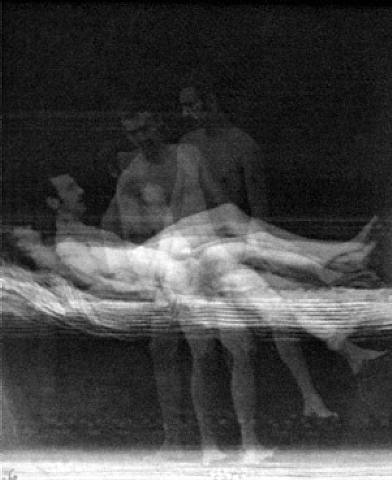
The phenomenon of motion, for example, might just be the diminishing vibrancy of layers of after images all showing in one instant of perception.

If ever we feel time, we feel it as a difference or a gap, like when peering in the mirror and seeing someone who looks older than we thought we were. Abruptly-noticed signs of age make us feel the depth of many years all in that sudden instant when they flash before us. Instead of an extensive thickness of time, we might think of an intensive depth of time. Each moment in our lives has the depth of all time, here and now immediately. A Deleuzean phenomenological time need not flow, and perhaps should not flow. If the flow is based on associating similarities bridging one moment to the next, then more flow would mean less difference from moment to moment, and thus less standing out, less appearing, less phenomenality.


Image credits:
http://www.marinagraham.co.uk/files/IMG_355.jpg

http://www.diagonalthoughts.com/wp-content/uploads/2008/12/idris-khan.jpg

http://www.eyefetch.com/image.aspx?ID=1193241


2 Mar 2011

The Still of Time: A-Temporal Phenomena in the Duration of Deleuze’s Bergson


by Corry Shores
[Search Blog Here. Index-tags are found on the bottom of the left column.]

[Central Entry Directory]
[Corry Shores, Entry Directory]


[May I thank the sources of the images:
eyefetch
diagonalthoughts.com
marinagraham
Credits given below the image and at the end.]


The following is from my presentation at the Bergson and his Postmodern and Immanent Legacies conference.


The Still of Time:
A-Temporal Phenomena in the Duration of Deleuze’s Bergson


Deleuze is often considered an anti-phenomenologist. Yet my sense is that his critique of phenomenology is more of a constructive critique. Deleuze is not against the project of studying phenomenal appearances; he merely does so on the basis of different principles and methods. Namely, Deleuze seems interested mostly in the phenomenality of phenomena. Phenomenologists, however, often turn their attention to how phenomenal appearances become constituted throughout the flow of our internal time consciousness. But for Deleuze, a phenomenon is a flash. It could appear instantaneously. What we will explore is the possibility that a Deleuzean phenomenology need not appeal to a flow of time consciousness in order to account for the production of phenomena.

This endeavor is inspired by an article that phenomenologist Michael Kelly wrote, where he defends Husserl’s time consciousness against Deleuzean-Bergsonists. These critics charge that Husserl’s theory of internal time cannot “accommodate time’s fundamental characteristic, namely its passage.” . Yet, Kelly shows that Husserl’s later writings on temporality are immune to this critique.

We might note how Deleuze famously said of his Bergsonism book that it is a classic instance of his buggering technique. He writes, “I imagined myself getting onto the back of an author, and giving him a child, which would be his and which would at the same time be a monster. It is very important that it should be his child, because the author actually had to say everything that I made him say. But it also had to be a monster because it was necessary to go through all kinds of decenterings, slips, break ins, secret emissions, which I really enjoyed.”

So what we will explore is the possibility that one such conceptual offspring is a surprising interpretation of Bergson’s duration: for Deleuze, duration’s fundamental characteristic is not its flowing passage. Perhaps we might characterize duration by employing terms with more of an a-temporal connotation, like instantaneous, simultaneous, and eternal. But these provisional characterizations should really only serve to avert our attention away from time’s flow in order to focus more on time in its absolute immediacy.

To do this, let’s first examine Bergson’s expanding circuit diagram.


Bergson uses it to illustrate the way that the past is always contemporaneous with the present. He first has us consider what he calls an ‘after image’. They are always a part of our perception.


We look at some object, then abruptly avert our gaze to another place. For a split-second, the image of the initial object will carry-into and overlay-upon the new scene we see. The prior object remains in our field of perception, even though it is actually no longer there. Instead, it is virtually there.


The virtual past image inserts itself so thoroughly into the new actual image that “we are no longer able to discern what is perception and what is memory.” Perhaps this is why fast moving objects leave a blurry trail behind them.

According to Bergson, just while the perceived image is sent to our brain, the most recent image in our memory has already arrived-upon and overlaid our current perception, with both moving lightning fast in a continuous circuit.


But just as soon as we see something, it will already begin to appear differently to us, because we move our eyes or notice something new in what we see. Like before, the new image and its predecessor circulate immediately. Yet the even older image has not gone away; it too re-imposes itself on the present perception, but in a somewhat less vivid way. Nonetheless, this enriches the object with another layer in its appearance.


With each additional moment, another new inner circuit pushes-out the former ones.
So we see, then, that the past and present are perpetually crystallized together. “In truth,” writes Bergson, “every perception is already memory. Practically we perceive only the past, the pure present being the invisible progress of the past gnawing into the future.”


Yet even though all of our past is always interposed in the present in an implicit way, sometimes what we see causes one recollection to stand-out more explicitly among the rest. Often we observe something in our daily life that causes certain prior memories to flare-out before our “mind’s eye.” And sometimes our flashbacks can be so vivid that they drown-out the actual things we see. We then begin to feel as though we are reliving that past experience.

Deleuze illustrates these recollection-circuits with the cinematic flashbacks in Marcel Carné’s movie The Daybreak (Le jour se lève).

The film follows events happening from sundown to dawn. During this short period, a murderer flashes back into his past. Whenever we return to the present, we hear a heavy doom-filled bass and drum beat. It gives us the feeling we are moving inevitably toward a fatal end. So during the flashbacks, the past is so vibrant that it completely covers-over the actual present things standing before him in his room. As viewers, we only see what he is remembering, and not the events still carrying-on in the present while he dreams. But because upon returning we hear that fatal march toward the end, we are reminded that even while reminiscing, we never escaped the current doomed situation.


Now consider if we were to memorize a series of spoken lines for a play. Each time we practice it, we create a new individual memory. When it comes time to perform, we just start with the first word, and the rest seem to follow automatically, without our needing to recall any single rehearsal. All the previous times were contracted into that present moment of automatic habitual bodily performance. But after the show, someone might ask us about how we memorized the lines. Then we could relax and daydream about those moments, seeing them in their vivid detail.

Bergson illustrates this with his famous cone diagram. As new things enter our memory, they add to a cone.


If we are acting automatically, like when performing something we rehearsed, then we are down closer to the S point.

Being near this tip does not mean our memories have gone away. Rather, they are all contracted into our physical actions, like how a performance expresses physically all our memories of past recitals. When instead we daydream about the past, the images expand-out in our minds, as during a flashback. In these moments, we reside at a higher layer of the cone. Always we are varying somewhere between automatic action and dreamful reflection, so we might be at any of the many possible layers of expansion or contraction of our memory.

Photobucket

So during flashback scenes, the character’s memory leaps-up to a higher level. But during an action scene where he acts automatically, his memory is contracted into the present moment, down at the cone’s tip. We are always changing level, varying ‘melodically’ between our intense physical engagement in the present moment and our drifting somewhere in dream-land.

So the larger circuits are more distant memories, and the higher cone levels are increased degrees of expansion on one part of those memories.

The cone levels and the circuits are not equivalent, but we might place them in correspondence by noting that when moving to a distant circuit, we are also expanding our memories. In these slides we might correlate the movement-into-flashback with the expansions in the diagrams.

What we notice are the simultaneity of the layers. At any one moment, our consciousness is expressing, implicitly or explicitly, all our past actions and memories. We do not need time to flow in order for it to fully present itself in its immediacy. When the hero sees a memento and flashes back to an event taking place a couple months prior, he does not feel two months of time in their continuous passage. Instead, he experiences two months time in a sudden flash. So the simultaneity of the distant past with the active present becomes immediately evident to him. It is not an extent of time that he undergoes in this flash, but rather time in the form of an intensity.

To further illustrate, Deleuze discusses flashback movies made by Joseph Mankiewicz. In these films, flashbacks are the product of bifurcations. There are two dimensions to these bifurcations or forkings. The first sort we will consider is the forking as a break in a linear progress, as described by Prigogine and Stengers.

Photobucket

They describe how for certain chemical reactions, changes in one variable can be correlated to the variations of others, but then one variable will reach a point when its path is indeterminable. It could increase or decrease, but this outcome is always left to chance.


The other sort of bifurcation we find in Borges’ story ‘The Garden of Forking Paths.’ It describes a Chinese monk’s unfinished manuscripts for a novel with this same title. It went unpublished because it was incomprehensible. The chapters did not proceed just sequentially. A following chapter would be like an alternate version of the same prior one.

The Garden, then, forks-not through space but rather through time. Characters in stories normally must choose between diverging paths. In the Garden, however, the character, “chooses— simultaneously—all of them. He creates, in this way, diverse futures, diverse times which themselves also proliferate and fork.”

There is one remarkable scene in Mankiewicz’ Barefoot Contessa, which showcases both senses of bifurcation. The soon-to-be Contessa quite abruptly switches companions, taking her down a drastically different path. But this scene was remembered by two different people, each in their own way and with their own slight variations. We will place both scenes side-by-side, listening just to the audio from one.


We notice that sudden instant of the slap, that crack in the flow of time, when the next moment is completely undetermined, entirely discontinuous with the present, that moment which is truly phenomenal, that pure, intense, dramatic moment outside the flow of time.

Now, the Contessa’s forking is the reason each of these people recalled the event. We see the relation between bifurcation and flashback shown even more vividly in Mankiewicz’ A Letter to Three Wives. In this story, a woman writes a letter to three wives saying she ran off with one of their husbands, but she does not specify which one. This is a forking in their lives, and it causes them to recall prior forkings in the past that foreshadowed the current situation. In one wife’s recollection, we see her discover a possible reason her husband might have left with the other woman. Her face makes a certain expression that is almost identical with her current one, as if in her past she was already flashing forward to the future. And likewise, events in the present unfold where she gets news that seems to confirm her suspicions, and she makes that same facial expression again, linking all three moments together.


So when something happens in our lives that takes us down a diverging unexpected path, we on the one hand might flash back to another forking in the past that only implicitly hinted at the current bifurcation; yet on the other hand, we are already living the present moment as a memory given in advance of its future recollection, only we don’t know yet what future forkings will bring out the present moment’s implicit significance. In the instant of the flashback, past, present, and future are all simultaneous and immediate to our consciousness, as if we are always in a way standing outside of time’s flow and experiencing events from the perspective of eternity.


We noted at the beginning how phenomenology requires time to pass in order for phenomena to appear. This in a way gives the present moment a sort of thickness. It swells out from the present, fading into the past like a comet tail, as Husserl puts it.

And we are only able to constitute a phenomenal object by means of associative similarities that present themselves and synthesize across a span of flowing time. But for Deleuze, we need not think that appearances show themselves through time in its flowing. The phenomenon of motion, for example, might just be the diminishing vibrancy of layers of after images all showing in one instant of perception.

Deleuzean Bergsonist Depth of Time

(Thanks eyefetch)


(Thanks diagonalthoughts.com)


(Thanks marinagraham)

If ever we feel time, we feel it as a difference or a gap, like when peering in the mirror and seeing someone who looks older than we thought we were. Abruptly-noticed signs of age make us feel the depth of many years all in that sudden instant when they flash before us. Instead of an extensive thickness of time, we might think of an intensive depth of time. Each moment in our lives has the depth of all time, here and now immediately. A Deleuzean phenomenological time need not flow, and perhaps should not flow. If the flow is based on associating similarities bridging one moment to the next, then more flow would mean less difference from moment to moment, and thus less standing out, less appearing, less phenomenality.


Image credits:
http://www.marinagraham.co.uk/files/IMG_355.jpg

http://www.diagonalthoughts.com/wp-content/uploads/2008/12/idris-khan.jpg

http://www.eyefetch.com/image.aspx?ID=1193241


4 Mar 2010

Dawning Recollections: Bazin on the Flashbacks in Carné's Le Jour se lève


Dawning Recollections:
Bazin on the Flashbacks in Carné's Le Jour se lève


In footnote 6 of Chapter 3 in Cinema 2, Deleuze cites André Bazin's Le cinéma français de la Libération à la Nouvelle Vague. In a future post, we will explain how Deleuze applies this material. Below, we merely summarize the relevant parts of the text. My additions are bracketed.


In cinema, the content is not much different than the form. We see that in Le Jour se lève, the technique is inseparable from what underlies the action.

The story is sometimes set in the present, other times in the past. The way Carné does so is unlike how any other director has employed flashbacks (78d).

There are three main flashbacks. They divide-up the present time into four blocks.

Normally in literature, action happening in the past can be described by using past tenses of a verb. However, in film, there is no easy way to clearly demarcate past and present events, because they will look about the same when projected on the screen. Say for example the director wants to do a scene from the past. The same table that is there now was also there back then. But the director cannot shoot the table in the past. She can only film it in the present. Carné must get us to believe that in the room an event happened in the past, while the character recalls it in the present.

In film, when scenes are set in distant times and spaces, often the director will use a dissolve technique (fondu enchaîne). [This is analogous to cross-fading in music, when one song fades-out just as another one fades-in.] So the image of the previous scene fades-out little-by-little so to allow the next image to appear.

In Le Jour se lève, there are two ways that one scene moves to the next. For events in the present, the changes use rapid wipes (volets), where the next shot in a sense sweeps across the screen, replacing the previous one. [The video should work when you press play, even though no image shows until then.]


But when a scene shifts from the present to a past event recalled in the mind of the main character, François, then Carné uses an exceptionally long dissolve.

[In this clip, we see the main character, François, drift into a flashback. One scene dissolves into the next.]


The dissolve corresponds to two things.

1) The fading of the dissolve is like how we physiologically experience the transition to daydream. Our eyes become fixed. Our pupils enlarge. And the images we see become blurred. (80b)

2) The dissolve superimposes images. This allows us to know when something is imaginary. Consider how in ghost films a semi-transparent figure is superimposed on the full imagery of the scene. The long dissolves in Le Jour se lève are a sensible symbol (symbole sensible) of the purely imaginary nature of the images to come. This way we can visibly sense that we are changing the sorts of reality from the real of the present moment to the imaginary of memory. (80c.d)

Recall again how in literature, writers may use tense-shifts to alter the temporality of the sentence from present to past. Carné also uses music. There is a heavy drumbeat and bass during the present. It drills obsessively and oppressively. [It gives us the impression that it is François' death march to his fatal end.] Then as he drifts to the past, the drums and bass are replaced with something quite different. A flute fades-in and gives a sentimental feeling. The two themes might be found alone or mixed, but they are always subtle. The lighter theme is the logical and musical counterpoint to the heavy drum theme. The flute theme is melodic, while the drum is rhythmic and percussive. The two have opposing feelings, and their change gives a physical sense of an inversion of mood as we move from past-to-present and present-to-past.


So thanks to Carné's dissolves and Maurice Jaubert's music, we are psychologically prepared for the temporal transitions.

The music does more than accompany the action. It is itself an action. The past weighs on the present. We cannot escape it. When the heavy music fades-in while we return to the present, for example, the music performs a downward action. (82-83) [In a sense, the past never goes away.]

François's room is filled with items which help him recall the past (87a).

François smokes a pack of cigarettes. After running out of matches, he must light the next cigarette as soon as the current one is finishing. This requires that he be vigilant. His smoking vigil in a way creates a rhythm of time. And when he reaches his last cigarette, we sense that his end is near. (89-90)

[The movie begins with a murder, but we just see a man who was shot fall from the stairs. The movie takes place from that moment until dawn. However, during this period, François reflects back three times on the events leading up to the murder he commits. Each time the flashback brings us closer to the murder. Right before the final flashback, when he recalls the killing, he yells angrily out the window to a crowd gathered in the streets below his window. Then after this is the flashback. It shows him at a point unable to control his anger, and then shooting the man in his room. But note that his angry murder happens chronologically before he yelled angrily out the window, even though it occurs afterward as a flashback.]

Bazin says that François' burst of anger before killing the man in his room cemented him to his destiny: to kill the man and soon be kill himself (99d).


Bazin, André. Le cinéma français de la Libération à la Nouvelle Vague (1945-1958). Ed. Jean Narboni. Paris: Cahiers du cinéma, 1998.