













by Corry Shores
[Search Blog Here. Index-tags are found on the bottom of the left column.]
[Central Entry Directory]
[Deleuze Entry Directory]
Gilles Deleuze
Spinoza et le problème de l'expression
Expressionism in Philosophy: Spinoza
Ch.12
"L'Essence de mode : Passage de l'infini au fini"
"Modal Essence: The Passage from Infinite to Finite"
As eternal and infinite qualities, attributes are indivisible; hence even Extension, insofar as it is a substantial quality or attribute, is indivisible [See section XI of Gueroult's "Spinoza's Letter on the Infinite."] However, under certain conditions, each infinite quantity can be divided into parts, because attributes in one sense are "divided" into modes. But modes are not really distinct, rather they are just modally distinct. (173ab/191ab) [Citations give French version first, followed by English.]
But "part" takes on two senses:
1) Part of a power, "of intrinsic or intensive parts, true degrees, degrees of power or intensity" (de parties intrinsèques ou intensives, véritables degrés, degrés de puissance ou d'intensité) (173c/191c). Hence modal essences are defined as degrees of power. In this way, Spinoza follows the Scholastic tradition that equates modus intrinsecus = gradus = intensio. [See the Oresme entry for intensio represented as latitude of forms, an important articulation of intensity for Deleuze.]
2) Extensive parts, which are extrinsic parts that are "external to one another, and acting on one another from outside" (extérieures les unes aux autres, agissant du dehors les unes sur les autres) (193d/191d). Hence Spinoza's "simplest bodies" are the "ultimate extensive modal divisions of Extension." [see the end of Deleuze's Cours Vincennes 10/03/1981 for more on intrinsic and extrinsic relations of simple bodies.]
The modes of extension are defined by degrees of power; and even the attribute of Thought has extensive modal parts corresponding to the simplest bodies (174a/192a).
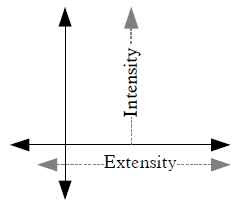
So to each attribute belongs two infinite quantities divisible under certain conditions:
1) The intensive quantity that divides into intensive parts
2) The extensive quantity that divides into extensive parts.
Deleuze then equates extensity and intensity with Spinoza's two types of infinities [distinguished in his "Letter on the Infinite"].
1) The infinity of intensities stems from their being indefinite: they cannot be equated with any number, although they can be conceived as greater or less. [see the beginning of Deleuze's Cours Vincennes 10/03/1981 for more on indefinite magnitudes.]
2) The infinity of extensities stems from their being caused by substance, which is infinite, so no matter how many times we divide extensities, there is always more to be divided. (174b.c/192b.c) [Again, see section XI of Gueroult's "Spinoza's Letter on the Infinite."]
Modal essences are physical realities, not logical possibilities, not even metaphysical entities. There are no non-existent modes, because it is necessary that all modes' essences exist. The modes themselves however have durations, so while their essences always have necessary physical reality, the modes themselves do not (174-175/192-193). This is contrary to Leibniz, who regards an essence or individual notion as a logical possibility with a "tendency to exist." However in Spinoza, non-existent essences are still contained in God's understanding as ideas (175b/193b). [See comparison with Leibniz towards the end of Deleuze's Cours Vincennes 10/03/1981 for more on modal essence as not possibility.]
Both modal essences and existing modes have God as their efficient cause. So Spinoza defines a mode's essence as not involving (n'enveloppe pas) its existence, and this is because the mode's essence does not contain within it the cause of the mode's existence. (175c/193c).
Although there is a distinction between the mode's essence and its existence, there is no real distinction between the existence of the mode's essence and the essence itself. We see this in Scotus: existence necessarily accompanies essence, but only because the essence is caused by something that is necessary (substance). So the essence's existence is not included or involved in essence (incluse ou enveloppée), rather it is added to it in such a way that it is not actually distinct from it, for instead the essence's existence is a determination of the essence, whose cause makes this determination. (176a/193-194)
For this reason, the essence's having an existence or physical reality goes hand-in-hand with God being the efficient cause of the essence, because the existence of the essence results from God causing it to be. Thus the essence's existence is no different from its being caused. (176b.c/194b)
Unlike Descartes' thinking, God does not cause possibilities for Spinoza, so it is only by abstractly considering modal essences as though divorced from their cause can we can think of them as possible. (176-177/194b.c)
Essences agree for two reasons:
1) They are all causes of one another in a complex web of causations.
2) All essences have a common cause: God.
Thus essences form a total system, an actually infinite whole.
C'est pourquoi les essences forment un système total, un ensemble actuellement infini. (177b/194c)
The question of how to distinguish essences brings us to the problem of individuality in Spinozism (177c/194-195).
Spinoza makes the matter more difficult by saying in the Short Treatise that when modes are not existing, their corresponding essences are indistinguishable from their proper attribute and from one another, hence they lack a principle of individuality. Thus individuation occurs only by means of the mode's existence. (177-178/195a.b)
However, we cannot conclude with certainty that in the Short Treatise Spinoza really means that there is no singularity and distinction of essences as such; for, he seems to mean that when modes do not exist, their essence is contained solely in their attribute, and because in that state they do not exist anywhere else, their ideas cannot represent them as being distinct from their attribute. Also, when a mode does not exist, the idea of its essence cannot be distinct, even if the essence can be, because like the totally white wall, nothing can be distinguished in it, even though there are still differences within it. (178a.b/195b.c)
So when something is contained in something else, as the modal essences in their attributes, in a way, they cannot be distinct from each other. Hence distinction in this sense is extrinsic distinction, which requires that one thing must be taken apart from something else (thus not be contained in it) in order for the two to be distinguished. (178c/195d)
But when a mode exists, it has duration, during which it is no longer simply contained in its attribute, so it is through their durations that existing modes obtain their extrinsic individuation (178-179/196a).
When the wall is white — and thus when we cannot make-out any shapes in it — the quality of the wall's whiteness is not affected by anything extrinsically distinct from it. However, there nonetheless can be another sort of modal distinction that presents an intrinsic principle of individuation. Deleuze also notes that the mode's existence alone is not enough to distinguish it; moreover, any extrinsic distinctions seem to presuppose prior intrinsic ones [because before one thing can be distinguished from another, it must have intrinsic properties for the comparison]. So modal essences should be singular in themselves, even if their corresponding mode does not exist, and their singularity must be intrinsic, [all because otherwise we would not be able to say that there are numerous modes to begin with.]
To explain how this is so, Deleuze returns to Duns Scotus, who holds that whiteness has various intensities that are not added to the whiteness as though they were separate things, like when we add a shape on the wall by inscribing it there. The whiteness' varying degrees of intensity are intrinsic determinations, that is, intrinsic modes, of this whiteness which itself remains self-same despite its various modalities. (179c/196c.d)
Similarly, for Spinoza modal essences are likewise intrinsic modes or intensive quantities. So attributes remain as the self-same qualities they are, while containing all those degrees that affect it modally without altering its "formal reason." (179d/196-197)
Modal essences are thus distinguished from their attribute as intensities of its quality, and from one another as different degrees of intensity.
les essences de modes se distinguent donc de l'attribut comme l'intensité de la qualité, et se distinguent entre elles comme les divers degrés d'intensité.
(179-180/197a)
Although Spinoza does not make this argument explicitly, we might still conclude that he considers here modal essences' distinct singularities; because the modal essences are distinguished in these cases intrinsically in terms of being different quantities of intensity. If the modes are to be qualitatively identified with absolute substance by means of their belonging to their proper attribute, then the only sort of distinction between modes would be a quantitative one, their being more or less of that attribute or quality, which is an essential difference of intensity. (180a.b/197a.b)
each finite being must be said to express the absolute, according to the intensive quantity that constitutes its essence, according, that is, to the degree of its power. Individuation is, in Spinoza, neither qualitative nor extrinsic, but quantitative and intrinsic, intensive.
chaque être fini doit être dit exprimer l'absolu, suivant la quantité intensive qui en constitue l'essence, c'est-à-dire suivant son degré de puissance. L'individuation chez Spinoza n'est ni qualitative ni extrinsèque, elle est quantitative-intrinsèque, intensive.
(180b/197b.c)
So because they differ in power, modal essences are distinct from one another intrinsically, and because each are singular degrees, they obtain a sort of intrinsic distinction from the attribute that contains them. (180bc/197c)
Intensive quantities are infinite in the sense that there is infinite series of differing degrees of intensity in an attribute or substantial quality. In this way, the attribute contains — better, complicates — all its modes' essences, because it contains them as its own infinite series of degrees of intensive quantities. (180c/197d)
In one sense, this intensive infinite is indivisible, because the only way we could possibly divide it is abstractly, but by doing so, we strip it of its physical reality (180d/197-198) [so if we draw lines around regions of generally-similar intensive values, as for example commonly shaded white areas of the wall, then we are considering them ideally or imaginatively, rather then in their fully physical and irreducible complexity]. Thus modal essences cannot be separated from each other, and for this reason we may characterize them as being in total agreement with each other [just as if we had a shade continuum from white to black, we might say the white and black agree with each other on account of the bridging continuum of shades of difference that brings them together on the same plane of intrinsic quality-differentiation]. Despite their agreement, however, modal essences nonetheless maintain their unique singularity and particularity by being intrinsically distinguishable from one another. Because they are together linked by a continua in their "concrete system"(système concret), essences are involved in each other's production [for each directly follows from another]. This is the case for all degrees of essences, because the series of essences/degrees is "actually infinite" (actuellement infinie) [for more on actual infinity, see Spinoza's 12th Letter and Gueroult's commentary, Deleuze's Cours Vincennes: 10/03/1981. and Deleuze's commentary on Spinoza's critique of Boyle's notion of divisibility]. And nonetheless, despite their continuity, each essence is an irreducible degree that we regard has a singular unity. "Such is the system of 'complication' of essences" (Tel est le système de la « complication » des essences). (180-181/197-198)
Spinoza's sense of particular essence is unlike Leibniz', because we are not to take them as microcosms, all contained within each other; rather for Spinoza, modal essences are all involved in each other's production. They are pars intensiva (intensive parts of the attribute itself) rather than pars totalis (whole in the parts). (181b/198b)
Modal essences have the expressive power to express the infinity of the absolutely infinite substance, although we see this involves the problem of the passage from the infinite to the finite. Substance, as the absolute ontological identity of all attributes or qualities, is thus indivisible; and likewise attributes, as substance's infinite forms or qualities, are also indivisible. Thus anything that is finite is neither substantial nor qualitative. But for Spinoza, finitude is no illusion, because the finite is modal and quantitative.
Each substantial quality has intensive modal quantity, itself infinite, which actually divides into an infinity of intrinsic modes. These intrinsic modes, contained together as a whole in an attribute, are the intensive parts of the attribute itself.
Chaque qualité substantielle a une quantité modale-intensive, elle-même infinie, qui se divise actuellement en une infinité de modes intrinsèques. Ces modes intrinsèques, contenus tous ensemble dans l'attribut, sont les parties intensives de l attribut lui-même.
(181d/198d)
And because they are parts of the attribute, intrinsic modes are parts of God's power: "their essence is itself part of God's power, is an intensive part, or a degree of that power" (leur essence même est une partie de la puissance de Dieu, c'est-à-dire un degré de puissance ou partie intensive) (181-182/199a). For this reason, modes are essentially expressive, because they express God's power in accordance with that degree of power constituting their essence.
The individuation of the finite does not proceed in Spinoza from genus to species or individual, from general to particular; it proceeds from an infinite quality to a corresponding quantity, which divides into irreducible intrinsic or intensive parts.
L'individuation du fini chez Spinoza ne va pas du genre ou de l'espèce à l'individu, du général ou particulier; elle va de la qualité infinie à la quantité correspondante, qui se divise en parties irréductibles, intrinsèques ou intensives. (182a/199a.b)
From:
Deleuze, Gilles. Spinoza et le problème de l'expression. Paris: Les Éditions de Minuit, 1968.
Deleuze, Gilles. Expressionism in Philosophy: Spinoza. Trans. Martin Joughin. New York: Zone Books, 1990.
Labels continued here.