Showing posts with label poetics. Show all posts

19 Apr 2017

O Mayeux, '[2403] "of between us : / it was good or leather'


by Corry Shores


[Search Blog Here. Index-tags are found on the bottom of the left column.]


[Central Entry Directory]

[Literature, Poetry, Drama, entry directory]

[Asemic Writing, entry directory]

[O Mayeux, entry directory]


O Mayeux


Artefacts


‘[2403] “of between us : / it was good or leather’


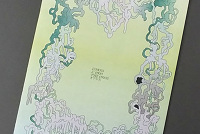
O Mayeux is a poet and linguistics scholar at the University of Cambridge. He writes poems and processes them using a software program that rearranges the typology to produce new “asemic” poems. I found his  ‘[2403] “of between us : / it was good or leather’, featured at The New Post-literate: A Gallery Of Asemic Writing, to be especially powerful when I tried reading it.


I am interested in the phenomenology of the literary experience. There is an affective element to the literary or poetic experience that may be hard to analyze on account of the complexity of the mental states. Normally our acts of literary awareness involve the conceptual and imagistic components evoked by the texts. These components can distract us from the affective element.

00003

There is  a similar sort of idea in Gilles Deleuze’s treatment of Francis Bacon. Bacon writes that “the moment there are … several figures on the same canvas – the story begins to be elaborated. And the moment the story is elaborated, the boredom sets in; the story talks louder than the paint” (Bacon & Sylvester 1987: 22). When reading O Mayeux’s poem, I experienced strong affects without the distraction of other layers of my awareness. Just as the experience of Bacon’s paintings is like a phenomenological reduction to the raw experience of sensation, perhaps such asemic writing as O Mayeux’s can as well present a  phenomenological reduction to the affective components of poetic experience.


I invite you to try to read the poem to see if you can feel certain intensities in the sounds. It is perhaps like Deleuze’s notion of stuttering. This work  also brings out the intensities of punctuation. I find Clifford Duffy’s poems also very powerful in these ways, too. See for example his “war machine the ...” [my comments],  his “remand” and “turf” [my comments], “fantasy 2010 labour work” [my comments] and “cărbune” [my comments].


Works:


O Mayeux.  ‘[2403] “of between us : / it was good or leather’.  From Artefacts. Image taken from (and used with the author’s permission):

http://thenewpostliterate.blogspot.com.tr/2017/04/oliver-mayeux-2403-of-between-us-it-was.html


Also:

Bacon, Francis & David Sylvester. The Brutality of Fact: Interviews with Francis Bacon. New York: Thames & Hudson, 1987.

More information from the publisher here:

http://www.thamesandhudson.com/9780500274750.html


.

.

26 Apr 2011

Let Slip: Works of Mihaela Brumar

At a posting at his dADa dUffy, Clifford Duffy displays an incredible art poem at Mihaela Brumar's liniadefuga...................

[The one here]
http://liniadefuga.over-blog.com/article-incoltita-de-cuvinte-72128394.html

It is really something to see. I don't know what, but there is something unique about the incorporation of text into the imagery. A painter, Theresa Mussato, once told me that the danger of incorporating text into a visual work is that the viewer might not be able to see it as a painting anymore, because our minds might shift modes from a visual receptive sort to a conceptual abstract one. It helps that I do not know Romanian, so I would not have this problem anyway in Brumar's pieces, if the text is written in that language. Although, the slant in the text makes me think it is written backwards. The style of the handwriting reminds me a little of the Voynich script, which so far is not decoded, and might never have been meant to be interpreted.


And the incorporation of the text, as well as some of the imagery, reminds me a little of William Blake's poetic engravings.


The image here, in particular, calls to my mind Blake's depictions of gates or door-ways:
http://liniadefuga.over-blog.com/article-epifania-revelatia-pe-care-unii-dintre-noi-o-pot-avea-altii-nu-72046913.html


(Thanks bible-art)

And also, I was impressed with this poem here, because even without knowing the meanings, I still somehow found myself enjoying it as I tried to read along, even though certainly the way I read it is not the way it should be read.
http://liniadefuga.over-blog.com/article-cadenta-71627444.html

I will try to diminish my ignorance of the language to enjoy the works more properly. I am at least grateful to have a curiosity in learning more about Romanian, which I otherwise would not have.

What is it about Brumar's works that can speak to us without interpreted meaning? What is meaning without interpretation? Would it be a direct affective communication of some sort? But I don't think we are affected by these works in the way a photograph might affect us. There is still something textual about our experience of it, even without us knowing what the words mean. The words are not just lines like brush strokes, but they are much more than representations. For, even the pure text poems communicate, and it is not just the way the letters look to us on our computer screens. I am particularly impressed again with the image we began looking at from here.
http://liniadefuga.over-blog.com/article-incoltita-de-cuvinte-72128394.html

The words here seemingly flow from the person's head and it looks like they take on the formations of other people in the background. It is as if our minds make a gradual transition from words as thoughts to words as things. And words as well slip through the woman's fingers, like how we use words to try to communicate things on our mind, but find that the words we use cannot completely capture our meaning, which slips through and must find another form of expression. Has Brumar found another sort of expression, a way to say something in a manner that is not reducible to either text or image?


Image Credits

Voynich image:
http://www.keyscorner.com/archives/2004/09/06/voynich-a-fake/
(Thanks John)

William Blake:
http://www.gailgastfield.com/innocence/soi.html
(Thanks gailgastfield.com)

http://ebooks.adelaide.edu.au/b/blake/william/urizen/
(Thanks adelaide.edu)

http://www.bible-art.info/Resurrection.htm
(Thanks bible-art)

No Reign May Be: Infinite Unsaying in Clifford Duffy's 'around'

response to Clifford Duffy's poem, by Corry Shores
[Search Blog Here. Index-tags are found on the bottom of the left column.]

[Central Entry Directory]
[Clifford Duffy Entry Directory]


All images are screen-shots of Duffy's work, from:
http://recalltopoetry.blogspot.com/2011/04/around.html
May I thank Clifford Duffy for sharing his creations.


No Reign May Be:
Infinite Unsaying in Clifford Duffy's 'around'


Without words, without things: so, what else would remain? Heidegger famously wrote, "where words break off, no thing may be." If we did not have the word-meaning for 'beside', would our world have things one-beside-another? If we cross-out all our word-meanings and grammatical functions (like predication, 'The tulip is a flower, is yellow,') can anything in our world remain? Not only would all the namable things be crossed-out, so too would the possibility of making designations; for, to designate something, we need to differentiate it from other things in its context or against which it would be counter-defined (we might need 'dark' to know 'light'). But without grammatical-functions like predication, negation, and prepositional relation (dark lingers before light), can we even begin to have a world of things?

How might we further this line of thinking? Regarding the sentence, "where words break off, no thing may be," let's draw our attention to no thing. We could think of it as nothing, or perhaps as a 'no-thing.' What would a no-thing be? It is not a thing, but it is not nothing, either. And from this sentence, we would assume that a no-thing appears when words 'break off'. It could be that the no-thing was there even while there were words, but we only notice it when the words break-off and leave the no-thing standing by itself.

Such observations might be of interest when we consider the mechanics of language. When driving and we see a stop signal, our feet hit the brake without a second thought. It is as if there is no need to translate the meaning of the sign: the same way that one gear need not think about another gear in order for them to turn one another, our bodies too are like gears that react automatically to the signs we see. But first recall when we initially learned how to drive. When we saw the red, we did not automatically stomp our feet without hesitation. There were so many possibilities available. Where exactly is the brake pedal? We have to hit it without looking for it? But is not the gas pedal right next to it? If we hit the gas accidentally, our situation could become unpredictably catastrophic. Our body does not yet have the word-thing 'red means stomp on brake'. Instead, we have something much more interesting. But after we learn the meaning of the sign, there is no longer anything there. We hit the brake without the red, the stomp, or the stopping entering our attention. These are all very concrete real things in our world, and they are so much a part of our world that we do not notice them. But before they existed, before we had the word-meanings for these parts of our world, they were so much more, they were infinitely more, they could have been anything! Red could very easily have meant catastrophe as much as total safety and orderliness. In this case, words broke-off, but there was not nothing, nor was there a concrete something. Rather, there was a no-thing, an infinite non-something, a something = x to the power of infinity, or we might say, a thing = x to the nth power.

Recalling again us first learning to drive, we had to learn a new language, of sorts, the language of traffic signs, both customary ones, like traffic-lights and official street signs and signals, and also contextual signs, like seeing a fluid on the road and knowing this signals to us to slow down so not slip-off the road. But when first acquiring this 'vocabulary', we learn that the language-meanings we already know do not always help. We need to learn the new language, yet we are lost at first because we try to apply the languages we already know. Perhaps we first considered those mechanical reactions we knew from the language of bike-riding, but back-peddling or gripping the steering wheel does not brake the automobile. So when first learning to brake the car, we exhaust all the 'words' we have in the 'languages' we know, running through all the things already in our world. That does not mean only nothing remains! There is an infinity at the edge of these limits!: catastrophe or safety from death, happening by so many unforeseeable ways. When we exhaust the words of our language and the things of our world, what remains is infinite no-thingness.

So let's not interpret this no-thing as an absence. It could hardly be so! How is something infinite also something absent? This means then that when Heidegger speaks of 'saying,' which is also an 'unsaying,' we need not think that language (in how we feel it immediately) has anything to do with something missing from it. When first learning how to brake a car, it is not that we face a nothing or an absolutely foreign otherness. Language becomes exhausted. All its possibilities have run-through and run-out. At last!: the birth of the full and immediate no-thing, the absolute thing = xn. Please note the difference between thing = x and thing = xn (or no-thing = xn. Also consider the formulations sign = x and no-Sign = xn.) An extensional meaning refers to the things in the set it refers to. Oedipus, recall, married his mother. So 'son of Jocasta' and 'husband of Jocasta' refer to the same thing, the same object in a set, which in this case is a set with one member, the thing we also call Oedipus. But what happens in our minds and bodies when we say to ourselves, 'The son of Jocasta is the husband of Jocasta'? This does not give us the same feeling as when we say 'Oedipus is Oedipus' or 'Oedipus is Jocasta's son', for example. This is because even though both 'son of Jocasta' and 'husband of Jocasta' extend into the same meaning-reference (Oedipus), they do not at all intend the same meaning. The words and propositions in our language have intensional meanings as well as extensional ones. It is hard to define what an intensional meaning really is, but we might think of it as the impulses and tendencies for a meaning to want to reach-out into different suggested or 'virtual' implications. It is implicit rather than explicit, and in a way, it is inexplicably implicit, because it is difficult to formalize (those with superb analytical philosophical skills can in fact formalize this, as for example the remarkable contributions Roger Vergauwen has made to formalized intensional logic and semantics). So 'thing = x' might suggest that there is an unknown thing, or an empty set; in the case of sign = x, we might at first think of it as an empty reference, or we may even regard it to indicate that at the core of all signification there is absence, in the sense that absence is always a prerequisite condition for representation (for otherwise, if the thing were present, it would be mere presentation and not representation). But this is to regard 'x' only in an extensional way. When however x is to the nth power, this means that while no extensional meaning is designated, there is an infinity of virtual intensional meaning. It is not just that the x is an empty place-marker meaning that it could be filled by anything, but rather that it virtually is tending with infinite power to mean a great variety of things, like how the no-thing/no-sign of learning to brake a car virtually implies so many meanings, ranging from utter disaster to complete safety to so much else that it may prove itself to mean.

So let's consider a Deleuzean reading of Heidegger's philosophies of language, rather than one that follows a more post-structuralist leaning (I tried that here). Perhaps we see such an approach suggested in Deleuze's essay, 'An Unrecognized Precursor to Heidegger: Alfred Jarry' (may I thank Miguel Paley for bringing this text to my attention and for offering his research on it). A closer analysis is forthcoming. For now, let's look at the final line:
The thing is the limit of language, as the sign is the language of the thing. When a language is hollowed out by its turning within language, it finally completes its mission: the Sign shows the Thing, and effectuates the nth power of language, for
"where word breaks off no thing may be." (98d)
Let's return to this for a deeper explanation another time, after we conduct a closer reading of the article. For now, I suggest we turn again to Clifford Duffy's works in our effort to understand language in a Deleuzean way, in this case, what might be a poetic unsaying to the nth power.

Duffy's poem, 'around', says to us things about rain. But consider when we watch rain falling on a puddle. It has a chaotic pattern of falling. In one way, it is completely redundant, because it's just drop drop drop, every time. But also, its chaos makes it continually unique, which can entrance us, much like how this happens when we watch the dance of fire tongues, always repeating, while always unique and singular. Rain, in a way, is continually exhausted, having done the same thing in seemingly every possible arrangement and combination, and yet also somehow always uniquely this particular fall of drops. Rain, like fire, can give us this experience of the no-thing = xn. Having seen so much rain in our lives, we have exhausted all possible words to give what we witness. And yet, that does not mean we stop noticing the raindrop patterns. They keep giving to us something infinite, lying at the limits of language.


The falling of rain is cyclonic cycling, one that is as wild as a cyclone but cyclical in its self-exhaustive repetition, like the variational rhythm of these lines above, and the rhythm of space-text temporalizations, the breaks which make our eyes fall from line-to-line, word-to-word, in a rain-like way. This is rhythm in an intensive sense, as a something creating the feeling of motion by acceleration-changes. We do not feel motion when our train or car maintains the same speed. It is only when the speed changes that we feel ourselves move forward or backward. There is no such thing as a steady rhythm, at least it would not be a rhythm with any intensity.

The no-thing is not these gaps, nor would it be a sense that something is being left-out of these poetic lines. Where the words break-off is not the empty spaces. Those are words too, don't forget! Rather, the words here are in a continual state of self-breaking, of being cracked and self-differentiated. 'rain to rain' and 'rain on rain'. It is rain raining upon itself, as different unto itself. The word/thing 'rain' is self-broken from the beginning of its utterance/appearance. Rain unsays itself with each drop. That's how it keeps being rain. Something that repeats without changing has not actually reappeared. Something can only reappear if its next appearance is self-differentiated, so that it may stand-out from itself. This is not as simple as rain at time1 being different from rain at time2. Rather, rain1 and rain2 are found in time = 0; which is to say, rain varies from itself from the beginning and before any time has passed, and it is only on account of the tension, the intensity, of an imcompossible combination of differences between a self and itself that we get the power to create the motion of time. If there were no paradoxes right now, no contradictions, no things being themselves and not themselves, then everything will have stopped! There would be no power, no tension, no force for change. 'Becoming' is not a process of something moving from being itself to not being itself; no; rather; 'Becoming' involves something already from the start not being itself, and on account of that, it has the cause, reason, ground, motivation, and power to change itself.

Duffy's 'rains' here, are becomings: each is a self-difference upon itself; it is 'rain to rain' and 'rain on rain', where each rain is itself self-differential. And it is at least partly because each moment differentiates from itself that there is intensive rhythm and the unsaying of no-things to powers n-infinite (or put more simply, true becomings).

Following that first part is something like a pause in the rain or a calm before a storm, if you will. During such moments, we do not at all feel a lack, a lack of rain and storm. In fact, these are the moments we feel the weather most acutely, when it announces itself in its infinite no-thingness, in those moments we would exhaust all words to describe it, and instead just have a direct immediate affectual connection with the weather itself.


Now consider the raining of words to come.


Our eyes rain rhythmically down the text, again in self-differential repetitions. The poem goes through words we have that might exhaust the meaning of rain. It is a god, a faucet, a reigning, a goddess, a goddess raining by reigning /and/ reigning by raining, over the earth.

Loves have secret loves. Why is it each dropping is a repetition but self-differential? Like when watching fire, we love not just what we see, but the motions that continue arriving. We did not expect them, so the next moments we did not previously know that we loved. They are secret loves of our loves, and by giving to us each time these ever newer and newer secret loves, the rain repeats in a delightfully differential way.


Clifford Duffy. 'around.'
http://recalltopoetry.blogspot.com/2011/04/around.html


Gilles Deleuze. 'An Unrecognized Precursor to Heidegger: Alfred Jarry.' in Essays Critical and Clinical. Transls. Daniel W. Smith & Michael A. Greco. Minneapolis: University of Minnesota Press, 1997.

26 Mar 2009

Schlegel, On the Study of Greek Poetry, Selective Summary

by Corry Shores
[Search Blog Here. Index-tags are found on the bottom of the left column.]

[Central Entry Directory]
[Sublime, Entry Directory]


[The following summarizes only parts of the text regarding the ugly.]


Friedrich von Schlegel

On the Study of Greek Poetry

Selective Summary

Modern poetry strives. But either
1) it has not reached its goal, or
2) it never had one to begin with: "its striving has no established goal, its development [Bildung] no specific direction, the sum of its history no regular continuity, the whole no unity." (217)

However, there are some cases where poetry has achieved an aim, namely in supremely great works.

But even these overpowering works leave us dissatisfied. They do not unify our minds. They tear it apart.

We are satisfied only by the complete pleasure resulting when our expectations are fulfilled and our concerns answered. All longing ends. But,
This is what is missing from the poetry of our age! (18b)
Modern poetry does not satisfy us with harmony and completion. Many artists escape the "intolerable expanse of their existence" by filling the "infinite emptiness of their minds" with "everything that is unusual or new." (18c) Poetry should not merely cater to our fancy and senses.

Some still have not experienced genuine culture. Their art is vulgar and purely sensuous.

However, there is a better class of art. Its works hover high above vulgar ones. Its creators are like gods.

Every now and then in the recent history of art we come across poets who, in the midst of a oblivious age, appear to be foreigners from a nobler world. with all the strength their minds can marshal, they seek the eternal.

Even if they fall short, they inspire us to believe that other art forms might succeed.

Modern poetry does not come close. But at least it harbors noble and good things that schools had banished. However, truth and morality is their aim. Beauty it is not. Nowhere in modern poetry is beauty the fundamental principle. In fact, beauty is so devalued that modern poetry's best works are displays of the ugly. The only time we experience beauty in modern poems is in "unsatisfied longing." They have blurred the boundaries between science and art, and between the true and the beautiful.

Philosophy poeticizes and poetry philosophizes: history is treated as poetry and poetry is treated as history. (18d)
Even poetic genres have blurred.
A lyrical mood becomes the object of a drama, and dramatic material is forced into lyrical form. This anarchy is not confined to the outer limits; rather, it spans the entire realm of taste and art. The creative force is restless and fickle. (18-19)
Theory no longer has a "fixed point in the endless flux." The public taste or fashion is the only guide. Each artistic 'idol' is worshiped then overthrown by another empty idol.

Artists either
a) strive for sensuousness, even if it leaves our soul feeling empty and offends our sense of propriety,
b) aim too much for perfection, when in fact there is none, and it is irrelevant to beauty,
c) try to replicate things with absolute fidelity, even the obscure peculiarities.

Poetic theory aims for
1) charm
2) correctness, and
3) truth.

Sometimes modern works are presented as eternal models of imitation, at other times as absolute originality.

Either it demands strict submission to arbitrary rules, or it considers artistic genius in a mystical sense, and thereby makes anarchy the fundamental principle. We cannot use theory to make art. Theorems and concepts cannot construct beauty.

Theory has lost favor because it
a) never succeeded in explaining the nature of the poetic arts,
b) never gave a satisfactory classification of types of arts, and
c) has not come to an agreement on what art is in general.

If theorists can be said to agree on anything, it is that there is no universally valid law of art and no constant goal of taste. The beauty of art relies solely on coincidence.

We have seen this anarchy through poetry's history. We see no enduring peculiarity among all the many poets throughout history.

The common background for the modern poets' spirit is the desire to capture the 'beneficent effects' of a great maser or of a felicitous age. But they do not believe there is one spirit for all modern artists. That would efface the individual's peculiarity, injure her rights, and cripple her inventive power.

An endless swarm of the most wretched imitators follows every great original artist -- as long as he is born by the time of fashion -- until finally the originary image has become so common and loathsome because of the eternal repetitions and distortions that, in the place of deification, there enters abhorrence or eternal oblivion. (20c)

Modern poetry's only characters tic is lack of character. The common theme running through it is confusion. The spirit of its history is lawlessness. The result of its theory is skepticism. Its peculiarities do not have specific and fixed boundaries. So French, English, Italian and Spanish poetry exchange their national characters like a masquerade. German poetry represents all cultures except German.

The public only demands interesting individuality from its artists. It wants an effect, and it wants it to be strong and new. How that effect is obtained is of little interest. And each time their demands are satisfied, their expectations for the next satisfaction are raised.
The new becomes old; the unusual becomes common; the frisson of what is charming becomes dull. (21b)
Art descends into crudity and void. Satisfaction is always immediate, but never entire. So the hunger never subsides.

Each of modern poetry's parts by itself might be excellent. But the whole of it is purposeless and lawless. The sum of these two factors "appears like an ocean of warring forces." In it, the shattered pieces of beauty move confusedly through each other.
One could call it a chaos of everything sublime, beautiful, and charming, which just like the Chaos of old out of which, according to legend, the world emerged -- awaits a love and a hatred in order to separate the different parts and to unify the similar parts. (21)
There seems to be no guiding thread. But modern poetry's origin, interrelation, and ground should somehow be explicable. Perhaps by examining its history we can determine the meaning of its current efforts, its direction, and its goal. Often times the anarchy was the means for a better state. "Cannot the aesthetic anarchy of our age expect a similar felicitous catastrophe?" Perhaps now either art will advance or further decline. We have these questions:
1) What is the task of modern poetry?
2) Can it be attained? and
3) What are the means to this?

To answer them we need to determine modern poetry's
a) character,
b) principle of development, and
c) the original traits of its individuality.

Modern poetry does have a common element, a characteristic trait, and common inner foundation. Modern poetry makes-up a coherent whole, even if there are no universal principles.

Consider how diverse Europe is. Nonetheless, there is still the European character. All its cultures share a common spirit and origin. As well, the different parts mutually influence each other. It has a common goal. So in this sense Europe is a whole.

As well, modern poetry is such an interrelated whole. We see for example the reciprocal imitations between cultures. At certain points in history, one natural character spread through the rest. Germany is the only culture that has been influenced by other cultures, but not an influence back to them. Hence the original national character becomes increasing diminished. Then, all of European poetry homogenizes, making the gradual transition from the original unique national character to the character of an artificial culture.

But despite these original differences that homogenize, all European cultures have a common origin. And we see archetypal narratives.

So first European culture was homogeneous. Then after a total revolution they dispersed and diversified. But their common origin remained. This similarity has influenced poetry.

We may also distinguish modern poetry from the other sorts preceding it in history. It
1) insists on imitating antiquity's art
2) demands that theory explain it and tell it how to proceed
3) is internally divided into high and low art.

[skip to page 66]

We may consider Greek poetry as a maximum and canon of natural poetry.
With bold certainty the outlines are simply sketched and then filled and completed with exuberant vigor; every formation is the complete intuition of a genuine concept. (66c)

Greek poetry:
a) contains the entire cycle of the organic evolution of art is concluded and completed
b) contains the entire gamut of taste,
c) is not constricted by the boundaries of its poetic types. Rather, these boundaries are produced through its formative nature. And through its development all the poetic types developed.
d) is an eternal natural history of taste and art.
e) contains the pure and simple elements that make-up the chaotic organization of modern poetry. For example, we may describe Goethe's style as a combination of Homer, Euripides, and Aristophanes.

But the moderns will reject Greek poetry. They will consider it immoral. It is too sensuous. Its comedies glorify folly. And they defame the noble.

Schlegel will not give a single, valid, objective principle of aesthetic criticism. Then he can explain the subjective origin of modern poetry's misconception of Greek poetry.

All assessments must meet two conditions:
1) the standard must be universal,
2) the application of the standard must be conscientiously faithful.

Our current philosophy of taste and art is incompletem because it has not established a theory of ugliness.

Beauty is the pleasing appearance of the good. Ugliness is the displeasing appearance of the bad. Beauty rouses the mind by means of sensuousness to pursue spiritual pleasures. So a hostile attack on sensuous causes ethical pain.
Thus life in all its charm invigorates and refreshes us, and even terror and suffering is fused with grace; while here the disgusting, the grievous, the horrible fills us with revulsion and abhorrence. Instead of graceful ease, a clumsy awkwardness oppresses us; instead of lively vitality, dead weight. Instead of a symmetrical tension in a beneficent alternation of movement and calm, a painful rending pulls one's interest to and fro in opposite directions. Where the mind longs for peace it is tormented by a destructive rage; where it yearns for movement, it is fatigued by languorous weariness. (68c.d)
When we represent ugliness, animalistic pain is the only source of the ethically bad. We do not posit anything positive or absolutely bad against the absolutely good. Instead, we merely negate pure humanity, which encompasses totality and multiplicity. Ugliness is an "empty pretense" within real physical evil. Yet, it is without moral reality. "Only in the sphere of animality is there positive evil -- pain.' In pure spirituality, there is only pleasure and painless limitation. But in pure animality there is only pain and gratification of need without pleasure. Man has a composite nature. In him are blended the negative limitations of the spirit and the positive pain of the animal.

The opposite of plentiful abundance is emptiness, monotony, uniformity, spiritlessness. Disparity and struggle are the opposite of harmony. Wretched confusion is opposed to actual beauty in the strict sense. Beauty in the strict sense is the appearance of a finite diversity in a conditioned unity. The sublime, however, is the appearance of the infinite--infinite abundance or infinite harmony. It has thus a twofold antithesis: infinite deficiency and infinite disharmony. (69a)

The degree of negation determines the level of baseness. However, the level of ugliness is determined by the intensive quantity of the drive that is being contravened. So for there to be ugliness, there must be a deluded expectation and an aroused and then frustrated yearning.
The feeling of emptiness and struggle can grow from mere discomfort to the most raging despair, even though the degree of negation remains the same and only the intensive strength of the drive increases. (69b)
Sublime beauty gives us absolute pleasure. Sublime ugliness is the delusion that comes about through and exertion of the drive. So it is despair, which is an absolute unmitigated pain. It also causes the displeasure or pain that results when we perceive ethical incongruities.

There is no ultimate in beauty. Likewise none in ugliness. So even within the highest level of ugliness there is something beautiful. Hence to bring about the ugly sublime, we must create the utmost abundance of strength.

Artists should obey both the laws of beauty and ugliness.


From:
Schlegel, Friedrich. On the Study of Greek Poetry. Ed. Stuart Barnett. Albany: SUNY Press, 2001.
6 Nov 2008

Freedom Feeds Hope: Barack Obama the Tragicomic


by
Corry Shores
[Search Blog Here. Index-tags are found on the bottom of the left column.]

[Central Entry Directory]
[Politics Entry Directory]


In Euripides’ prologues, a deity foretells the tragic event. At the beginning of Hippolytus, for example, Aphrodite says of the title character that “for little he reckons that Death hath opened his gates for him, and that this is his last look upon the light.” As predicted, the tragedy ends with Hippolytus concluding: “'Tis finished, my endurance; I die, father; quickly veil my face with a mantle.”

Nietzsche claims that Euripides maintained a revolutionary theory of tragic effect: it is obtained not by suspense, but through heightened eloquence.

Longinus notes that Euripides “forces his own genius, in many passages, to tragic heights, and everywhere in the matter of sublimity it is true of him” (On the Sublime §15).

What Longinus terms sublime, we call heightened eloquence:

Sublimity is a certain distinction and excellence in expression, and that it is from no other source than this that the greatest poets and writers have derived their eminence and gained an immortality of renown (§3).

This sublime eloquence supersedes any normal eloquence, because its effect

is not persuasion but transport. At every time and in every way imposing speech, with the spell it throws over us, prevails over that which aims at persuasion and gratification. Our persuasions we can usually control, but the influences of the sublime bring power and irresistible might to bear, and reign supreme over every hearer. Similarly, we see skill in invention, and due order and arrangement of matter, emerging as the hard-won result not of one thing nor of two, but of the whole texture of the composition, whereas Sublimity flashing forth at the right moment scatters everything before it like a thunderbolt, and at once displays the power of the orator in all its plenitude (§4).

Longinus explains that one of the primary ways sublime eloquence is obtained is through melody and rhythm.

Sublime eloquence, for Longinus, must be tragic, because at certain times Aeschylus falls short of being tragic solely because he is not sublime, that is, not supremely and powerfully eloquent (§3).

After the 9/11 terrorist attacks, Cornel West diagnosed the American people with a self-destructive nihilism. He asks: “Now that the nation has the Blues, can that nation learn from a Blues people?” (“The Paula Gordon Show” September 24, 2004, in Atlanta, Georgia, US).

The great American truth tellers, be they artists, be they song writers...blues artists...or be they hip-hop artists, they recognize that you have to muster the maturity to face truths that are painful. And in the end America either faces those truths with courage and dignity...or America loses its democratic experiment. That’s why after 9/11, the question is, can a blues nation learn from a Blues people? (On Point, September 20, 2004).

He theorizes that African Americans survived despondency through a unique cultural strength: tragicomic hope:

Tragicomic hope is what the Blues is all about: the ability, the courage to muster a smile in the face of tears, to keep laughing in the face of darkness, not to allow despair to have the last word even as it looks as if you have a chance of a snowball in hell for your project to be realized. You been lookin’ up and down for so long, but you keep movin’ anyway. You been feelin’ down for so long, but you keep pushing anyway. That’s Curtis Mayfield. That’s Louie Armstrong. That’s John Coltrane (On Point).

Black culture consists of black modes of being-in-the-world obsessed with black sadness and sorrow, black agony and anguish, black heartache and heartbreak without fully succumbing to the numbing effects of such misery – to never allow such misery to have the last word.

The ‘ur-text’ of black culture is

a guttural cry and a wrenching moan – a cry not so much for help as for home, a moan less out of complaint than for recognition. The most profound black cultural products – John Coltrane’s saxophone solos, James Cleveland’s gut gospels, Billie Holiday’s vocal leaps, Rev. Gardner Taylor’s rhapsodic sermons, James Baldwin’s poignant essays, Alvin Ailey’s graceful dances, Toni Morrison’s dissonant novels – transform and transfigure in artistic form this cry and moan. The deep meaning of this cry and moan goes back to the indescribable cries of Africans on the slave ships during the cruel transatlantic voyages to America and the indecipherable moans of enslaved Afro-Americans on Wednesday nights or Sunday mornings near godforsaken creeks or on wooden benches at prayer meetings in makeshift black churches. This fragile existential arsenal – rooted in silent tears and weary lament – supports black endurance against madness and suicide. The primal black cries and moans lay bare the profoundly tragicomic character of black life. Ironically, they also embody the life-preserving content of black styles – creative ways of fashioning power and strength through the body and language which yield black joy and ecstasy (Cornel West Reader 102).

Thus the tragicomic is not merely tragic, because it also inspires a mature hope. It is not the crude optimism found in feelings of imperial superiority. Hope realizes one’s own flaws, while yet pushing forward (On Point).

At the moment in which we must look defeat, disillusionment, and discouragement in the face and work through it – a sense of the tragicomic keeps alive some sense of possibility. Some sense of hope. Some sense of agency. Some sense of resistance (Hope on a Tightrope: Words and Wisdom 3).

West provides the example of lines from the Negro spiritual Nobody Knows the Trouble I’ve Seen:

Nobody Knows the Trouble I’ve Seen

Nobody knows but Jesus

Nobody Knows the Trouble I’ve Seen

Glory hallelujah.

This exemplary shift from a mournful brooding to a joyful praising is the product of courageous efforts to look life’s abyss in the face and keep ‘keepin’ on.’ This struggle is sustained primarily by the integrity of style, song and spirituality in a beloved community (e.g., Jesus’ proclamation of the Kingdom). It is rather like Ishmael’s tragicomic “free and easy sort of genial, desperado philosophy” in Moby Dick, but it is intensified by the fiery art of Aretha Franklin’s majestic shouts for joy (“W.E.B Is its Bois: An Interpretation” in Africana: The Encyclopedia of the African and African American Experience 103).

Cornel West’s theory is that only by means of Black cultural tragicomic hope can America emerge from the darkness of its nihilism and imperialism. Only a Bluesman can save the nation.

Barack Obama displays this tragicomic hope in his extraordinarily eloquent speeches, in their rhythm, melody, and message.

Like the Nobody Knows spiritual, Obama often turns his message from despair to tragicomic hope:

We know the battle ahead will be long, but always remember that no matter what obstacles stand in our way, nothing can withstand the power of millions of voices calling for change.

We have been told we cannot do this by a chorus of cynics who will only grow louder and more dissonant in the weeks to come. We've been asked to pause for a reality check. We've been warned against offering the people of this nation false hope.

But in the unlikely story that is America, there has never been anything false about hope. For when we have faced down impossible odds; when we've been told that we're not ready, or that we shouldn't try, or that we can't, generations of Americans have responded with a simple creed that sums up the spirit of a people.

Yes we can.

(Concession Speech, 8-Jan-2008, New Hampshire)

And:

The journey will be difficult. The road will be long. I face this challenge with profound humility, and knowledge of my own limitations. But I also face it with limitless faith in the capacity of the American people. Because if we are willing to work for it, and fight for it, and believe in it, then I am absolutely certain that generations from now, we will be able to look back and tell our children that this was the moment when we began to provide care for the sick and good jobs to the jobless; this was the moment when the rise of the oceans began to slow and our planet began to heal; this was the moment when we ended a war and secured our nation and restored our image as the last, best hope on Earth. This was the moment - this was the time - when we came together to remake this great nation so that it may always reflect our very best selves, and our highest ideals.

(Nomination Victory Speech, St. Paul, 3-June-2008).

The rhythms in Obama's speeches have the tragicomic affect of steadily marching through darkness toward light.

History has proven West’s theory: the U.S. healed by means of African-American tragicomic eloquence, with its profound musical power.

And Longinus’ theory as well:

a question which a certain philosopher has recently mooted. 'I wonder,' he says, 'as no doubt do many others, how it happens that in our time there are men who have the gift of persuasion to the utmost extent, and are well fitted for public life, and are keen and ready, and particularly rich in all the charms of language, yet there no longer arise really lofty and transcendent natures unless quite exceptionally. So great and world-wide a dearth of high utterance attends our age.'

'Can it be,' he continued, 'that we are to accept the trite explanation that democracy is the kind nursing-mother of genius, and that literary power may be said to share its rise and fall with democracy and democracy alone? For freedom, it is said, has power to feed the imaginations of the lofty-minded and inspire hope, and where it prevails there spreads abroad the eagerness of mutual rivalry and the emulous pursuit of the foremost place (§44).


Musical Arrangement of Words in Longinus' Sublime


by Corry Shores
[Search Blog Here. Index-tags are found on the bottom of the left column.]

[Central Entry Directory]
[The Sublime, Entry Directory]


Harmonious arrangement of words is a “natural source of persuasion and pleasure,” as well, a “wonderful instrument of lofty utterance and of passion.” Tones and rhythms cast spells on our ears. Likewise in speech do we use such music: “the building of phrase upon phrase raises a sublime and harmonious structure.” By mastering our minds, it elevates our noblest emotions.

Longfellow’s “Evangeline” uses the most sublime of meter, the dactylic:
This is the forest primeval; but where are the hearts that beneath it
Leaped like the roe, when he hears in the woodland the voice of the huntsman?

If we use a different rhythm, we loose the effect:
This is the primeval forest. But where are the hearts that leaped beneath it just like a row does, when he hears the huntsman’s voice in the woodland?

A translation of Longinus' Demosthenes example reads:
This decree caused the danger which then beset the city to pass by just-as a cloud.

But if we cut off a syllable from the end: “caused to pass by as a cloud,” we lose the sublime rhythm. “The abrupt grandeur of the passage loses its energy and tension.”

Longinus On the Sublime, section 39. W. Rhys Roberts translation.