Showing posts with label Cézanne. Show all posts

2 Jan 2013

Pt2.Ch4.Sb3 Somers-Hall’s Hegel, Deleuze, and the Critique of Representation. ‘Depth in Deleuze and Merleau-Ponty.’ summary


[Note: All boldface and underlining is my own. It is intended for skimming purposes. Bracketed comments are also my own explanations or interpretations.]


Henry Somers-Hall


Hegel, Deleuze, and the Critique of Representation.
Dialectics of Negation and Difference


Part 2: Responses to Representation

Chapter 4: The Virtual and the Actual

Subdivision 3: Depth in Deleuze and Merleau-Ponty


Very Brief Summary:
In his aesthetics, Merleau-Ponty creates an idea of depth that is like Bergson’s continuously integrated heterogeneous multiplicity and Deleuze’s difference as intensity. We see this depth in the way that variational lines and color in Klee and Cézanne generate the differential space of the painting. This differential generative aspect not visible in the work is like Deleuze’s virtual intensity, which explicates into extensity. Yet all objects are a mixture of virtual and actual.

Brief Summary:

In Merleau-Ponty’s later aesthetics, he articulates a concept of depth in painting that is like Bergson’s heterogeneous multiplicity. Before modern painting, special dimensions were something depicted, as if the objects filled a pregiven homogeneous Euclidean space. But with Cézanne and Klee, lines and color now generate space. On account of continuous variation, parts of the painting are continuously self-differentiating while remaining intrinsically related through these differential relations. It is like Bergson’s continuous heterogeneity. This for Merleau-Ponty is the real depth of the world that the painter depicts. It is the being of the world. and it is on the basis of this depth that spatial depth can be generated. For Cézanne and Klee, depth “is that which binds objects to one another, as the ground through which they interpenetrate”. (116) This fulfills Deleuze’s three criteria for the idea: this depth is not overtly sensible, it’s elements are reciprocally determined, and it is actualized in a multiplicity of spatio-temporal relations. This depth for Deleuze is the virtual intensive spatium, which is a multiplicity of continuous differential relations. The movement from virtual to actual produces the individual entities in extensity which may take on external relations (including opposition) and have an identity, but this was impossible while being intensities. This gives us a univocal rather than an equivocal sense of being. But all objects including artworks, which tend more toward the virtual, are composites of virtual and actual. For, if the object were completely actualized, it could be no further differentiated, and if it were purely virtual, there would be nothing actual to crystallize the system’s order. And when we bring into clarity the Idea, we confuse all the differential incompossible tendencies making it up.


Summary

Previously we saw how Deleuze’s Idea can be viewed in terms of topological phase space; for, it is multidimensional, non-sensible and non-conceptual, and it actualizes in various spatio-temporal relationships. Section two of this chapter was about the logic of multiplicities, and section three was about this new relation to science that the concept of heterogeneous multiplicity creates.

Now the third thing we will discuss in Bergson’s thought that Deleuze emphasizes is the method of intuition. It will allow us to see what happens between the two kinds of multiplicity. Deleuze’s concept of depth will show the how things happen in the middle ground between the two tendencies, and he draws from Merleau-Ponty’s later aesthetical writings.  Here Merleau-Ponty’s concept of depth allows him to create a Bergsonian space, where space is not something fixed and external to the bodies in it. It is a generative theory of space. “Merleau-Ponty wishes to show that space and the object are generated at the same time, characterizing depth as that which brings the other dimensions into being.” (111) Deleuze takes up this concept of depth, and he considers it an intensive space. We can divide extensive space into homogeneous parts, but an intensity cannot be divided like this.
Dividing it in half leads to two quantities of water that behave similarly to the original quantity. Dividing the temperature of the system can change the nature of the system itself, however, as the behavior of the system becomes radically | altered once it passes through the various phase transitions. (111-112)
Intensity then is like Bergson’s duration, and it is unlike Euclidean space; rather it is more like virtual non-Euclidean space. Intensity is what actualizes the virtual, because it “allows the structure inherent in the virtual idea of the system to become an actual geometrical structure”. (112) The egg has extensive dimensions, but its development undergoes phase transitions, which are [somehow] alterations in intensity. “In this section we will therefore turn to Merleau-Ponty's aesthetics to clarify the role of the intensive. In order to incorporate it into our reading of Deleuze, we will first deal with two points. First, we will need to show that Merleau-Ponty's analysis is an ontological analysis, and second, that this ontology is fundamentally compatible with Deleuze's.” (112)

We begin with Merleau-Ponty’s Eye and Mind. Here he sees the artist disclosing the world in a way unlike how science does. A theory of painting for him is a metaphysics. Like with Bergson, Merleau-Ponty sees two ways of relating to the world. The scientists approach is operationalism, so she avoids dealing with the world’s properties directly and instead defines “concepts purely through our operations of measuring them, making science in this sense autonomous, since it deals simply with the correlation and analysis of data. In this approach, according to Merleau-Ponty, there is no longer any contact with the 'opacity of being,' which was present even in the early moments of modem science.”  (112) Science is abstract. It renounces metaphysical questions | in order instead to characterize its success in terms of the manipulability of the object.” (112-113) The artist, however, has a nonmanipulative approach to the world. Yet the artist’s mind is not separate from the world. The essay explores how the artist opens the world, seeing how Renaissance geometrical perspective gives way to non-geometrical renditions in modern painting, beginning with Cézanne’s developments with depth. The essay does not want to renounce science but instead to give it the metaphysics it lacks. It also tries to give the transcendental grounds for perception, which is the invisible in the visible. (113)

We now consider parallels between the structures that Merleau-Ponty and Deleuze bring out.
[1] Painting’s action within space does not define what is painted.
The artist can actualize their Idea in various media, like painting, sculpture, drawing etc. This involves a move away from the spatio-temporal. [Each variation in a line is not just another point in a space but rather a new space for new self-relations, redefinitions.]
Within such a painting, each inflection of the line forms "another aspect of the line's relationship with itself, will form an adventure, a history, a meaning of the line" (EM, 183). Furthermore, when we ask what the nature of this line is, we find that it "is no longer the apparition of an entity upon a vacant background, as it was in classical geometry. It is, as in modem geometries, the restriction, segregation, or modulation of a pre-given spatiality" (EM, 1 84). [113]
This is like Deleuze’s Idea. “While the elements of the painting have sensible form, what is painted does not.” (114) Abstract art for Merleau-Ponty does not need to relate to some particular external state of affairs. It is only when the painter gives it a name that it takes on such a relation to a particular object or event. Like Deleuze’s Idea “its actualization is possible in a variety of contexts, depending on the relation the artist gives it to the visible.” (144) Also for Merleau-Ponty [and similar to Deleuze] the work itself convolutes space rather than occupies it, in that nonEuclidean, Riemannian, topological way. So Klee in Merleau-Ponty’s analysis meets Deleuze’s three criteria for Ideas. Klee’s lines do not tell us the sensible spatial dimensions of an object, but rather give us the lines continuous self-genesis. [It is like the development of an egg through intensive space rather than through extensive space.] Both the line and its space are reciprocally determined, meeting the second criteria. And because the painting with a different name would have different particular relations to objects and events, the painting can be actualized in many different contexts, meeting the third criteria.

For Descartes, we see the geometrical forms of things under deformation, in the way they hit our retinas. So squares take on the form of rectangles, for example [depending on the angle we view them. A cup saucer will be painted as an oval.] Paintings depict these deformations, and by doing so recreates a three-dimensional space. For Descartes, we perceive a third dimension merely from the two that are present in the painting. (114-115) Also note that we could imagine God’s eye located everywhere, thus there would be no visual depth, because depth is a relation between near and far. “In order for depth to be considered in this way, objects have to be conceived of as outside one another, with solid boundaries. The Cartesian approach therefore mirrors the approach of atomism in science that Bergson attacked”  (115) Such a space is homogenous, always in itself, everywhere equal to itself, and its dimensions are interchangeable. (115)

But note how for Descartes, depth is produced through the two other dimensions in the painting. This production of space is important for Klee. “The strands of Sartre's critique of Kant, Klee's reworking of the concept of depth, and the work of Gauss and Riemann all therefore represent a move away from the classical paradigm of a homogeneous space to that of a Bergsonian interpenetrative multiplicity.”  (115) Color for Klee is important, because it does not “give rise to the classical conception of space,” but rather “gives rise to an interpenetrative space  exemplified by the late works of Cezanne.”  (115) [Recall how Cézanne creates depth with color and not shading or modeling.'] “The idea of depth created by the color field differs from that of the brass etching in that the brass etching specifies depth as a third dimension, whereas for Cezanne | and Klee, depth is that which binds objects to one another, as the ground through which they interpenetrate”. (115-116) Depth then is “the first dimension that generates the others. Even the depth of the Cartesian geometry follows from this elementary depth.” (116) Merleau-Ponty sees Klee’s color in a way that is similar to Deleuze’s intensive qualities of the virtual. “That is, color cannot be divided without being changed in nature. Thus, the primordial dimension of depth for Merleau-Ponty is an intensive dimension. It is not color that is an intensity, but that which is more general than color, but can be captured by color's intensive nature.” (116)

Merleau-Ponty’s analyses of painting show us the actualization of intensive depth. [Depth is the movement of individuation, like the painted line that continually redefines itself and the space it generates through its movement. The creation of differentiation in general is the grounds for more specific sorts of differentiations, like the relations of different positions in extensive homogeneous space.]
Just as for Merleau-Ponty, depth generates the other dimensions, including Cartesian depth, for Deleuze, "extensity does not account for the individuations which occur within it" (DR, 229). That is, returning to Merleau-Ponty's analysis of the brass etchings of Descartes, extension itself both implies the already individuated in order to be generated, as Descartes sees the phenomenon of depth to be generated from the relations of bodies, and precludes the movement of individuation itself, since, from Bergson, the notion of a homogenous space renders an interpenetrative analysis impossible, as shown by the replacement of interpenetration with action at a distance in the work of Newton. Instead, Deleuze argues, "individuation and extensity must flow from a '"deeper' instance" (DR, 229). [116]
“Depth therefore forms the generative space from which extensive space | is generated.” (116-117) Deleuze calls this depth spatium. “Returning to Bergson, we can see that the spatium, as an interpenetrative multiplicity, functions for Deleuze like the multiplicity of duration.” (117) For Deleuze, “difference is that by which the given is given (DR, 222)” [117] The intensive field of depth is what gives the given. Difference is what is operating in this intensive field of depth. Intensity has a differential form [being made of a continuity of differential relations]. Actual diversity in the world is an explication of intensive difference.
For Deleuze, "difference is that by which the given is given" (DR, 222). That is, difference exists within the intensive field of depth, which is generative of extensity. In this sense, Deleuze calls it "the closest noumenon" (DR, 222). Thus, difference, as the differential form of intensity, gives rise to diversity by a process of explication. That is, as intensive force finds itself actualized within an extensive system, the unindividuated differential relations give way to relations between bodies external to one another. (117)
We will use differential calculus to understand the movement from virtual to actual. But for Deleuze and Bergson, there is not a logic of negation involved. [Negation and opposition are not a part of the intensive spatium, where multiplicities are intrinsically related differentially. They only come about in actualization into discrete entities. This is intrinsic differential relations inverted into extrinsic ones.]
Negation and opposition govern the state of the system as actualized and, therefore, for Deleuze, do indeed provide the limit case of the world in terms of the fully actual. "The negative is difference inverted, seen from below" (DR, 235). Likewise, the classical conception of identity, which requires individuation, is the result of the explication of differential relations into a spatiotemporal context. (117)
[Difference is a condition of possibility for actualization. (What is actualized are things we can understand.) So difference is transcendental. In Aristotle, being and beings were equivocal, because they had similar names but different meanings. Also note how each being is discrete from the others and externally differentiated from them. In the intensive spatium, there are no discrete beings. There is just difference, thoroughly expressed. So being is univocal, when being is difference. Also, Aristotle distinguished beings on account of oppositions between them. But since there is no opposition in the virtual, we can have a non-hierarchical understanding of being.]
In making difference the transcendental principle of his system, Deleuze has moved away from the principle of the equivocity of being put forward by Aristotle. The differential field of depth that forms the closest noumenon for Deleuze instead allows us to conceive of being as univocal. As the virtual is not defined in terms of opposition, it also allows the possibility of a nonhierarchical understanding of being, as the virtual is not to be understood in terms of opposition, which led to the theory of species and genera for Aristotle. (117)

But we need both the virtual and the actual to explain the givenness of the object [for, without the actualized object, nothing is being given, but without the virtual, nothing is giving the object.] For Merleau-Ponty, the work of art is between an actual thing and the intensive depth that generates things. Also for Deleuze, an artwork can be almost entirely virtual, displaying a “' ‘completely determined structure formed by its genetic differential elements"’ (DR, 209).” (108a) Yet for Deleuze all objects including artworks are double [expressing both virtual and actual] without the two halves resembling each other.  In Descartes, an object’s clarity and distinctness are proportional. In Deleuze’s analysis of Leibniz’s sea example, we can have a clear perception of the sea’s white noise as a whole, but all our tiny perceptions of the different small splashings of water are confused with each other. If we try to focus on one small wave, we obtain a distinct perceptions of the differential relations [between tiny waves] that make up the whole, but our perception of the whole becomes obscure. “Thus the understanding of one kind of order within the murmuring of the sea covers the other.” (118)
For Deleuze, it is the Apolline of Nietzsche's Birth of Tragedy that provides the best expression of the clear-confused, as that tied to representation, whereas the distinct-obscure is the Dionysian and properly philosophical order of the object. It is thus Apollo who gives the power of representation, of actuality, to the object, while Dionysus provides the obscure genetic and virtual conditions of the object, and of its representation. For Deleuze, "the two never unite in order to reconstitute a natural light. Rather, they compose two languages which are encoded in the language of philosophy and directed at the divergent exercises of the faculties: the disparity of style" (DR, 214) In spite of this, however, an object can never achieve pure actuality, as this would mean that it would no longer be capable of being further differentiated, nor can it be pure virtuality, as pure virtuality would be without the grain of actuality around which the order of the actualized system can crystallize. [118]
We saw also that for Bergson, pure space and pure duration are impossibilities, even though they are implied in the directions of expansion and contraction of matter/duration. So for Deleuze, everything happens somewhere between pure virtuality and pure actuality. [Recall Deleuze’s Idea. In the topographical example, instead of drawing all the vectors, we instead create a surface showing the tendencies toward equilibria in the dynamics of the systems. So all the incompossible lines of development become confused together, when the Idea as a whole comes into greater clarity. Thus] “An Idea ‘is confused in so far as it is clear’ (DR, 213).” [118] Virtuality and actuality are like two languages in philosophy that are different in kind, but everything is a matter of degree between them. (118)


Somers-Hall, Henry (2012) Hegel, Deleuze, and the Critique of Representation. Dialectics of Negation and Difference. Albany: SUNY.

7 Jun 2011

Cézanne and the Phenomenon: Painting Divergences in Merleau-Ponty and Deleuze


by Corry Shores
[Search Blog Here. Index-tags are found on the bottom of the left column.]

[Central Entry Directory]
[Corry Shores, Entry Directory]


[The following is my presentation that I gave at the Dutch Association of Aesthetics conference
in Ghent, Belgium, May 2011.]

[May I sincerely thank the sources of the images
Concrete Rules and Abstract Machines
awesome-art.com
dl.ket.org
Joy A's flickr / Joy A
all about Weybridge. / Rachael Talibart
students.sbc.edu
russianpaintings.net
wikipedia
sai.msu.su
Machotka
analog-synth.de
theatreorgans.com / synthtech.com
G. Fernández - theartwolf.com
travel.webshots.com and rajbaut
Credits are given below the image and at the end.]


Cézanne and the Phenomenon:
Painting Divergences in Merleau-Ponty and Deleuze


[Thanks Concrete Rules and Abstract Machines]

Deleuze is often considered an anti-phenomenologist. He even writes disparagingly of phenomenology’s lived-body that we find in Merleau-Ponty’s thinking. Nonetheless, Deleuze still generated an original theory of phenomena. So rather than determining whether Deleuze was a phenomenologist or an anti-phenomenologist, we might instead attempt to formulate what a Deleuzean phenomenology would be like. For Merleau-Ponty, phenomena are possible on account of three levels of harmonic integration: among the parts of the phenomenal world, among our bodily parts functioning in sensation, and between our body and the world enveloping us. All these overlappings bind us into the flesh of the world. Yet, a Deleuzean phenomenology would be based on precisely the opposite principles: the phenomenal world consists of incompatible differences shockingly forced upon us, all while our body functions disjunctively within itself and with our surroundings. Both Merleau-Ponty and Deleuze express their different views through their seemingly convergent readings of quotations attributed to Cézanne. But as we will see, there is one line in Deleuze’s commentary that indicates his different fundamental principles.

Both Merleau-Ponty and Deleuze turn their focus to painters when at times describing sensation and perception. Painters exercise a certain phenomenal sensitivity. They do not just see, they also become aware of how we see. Merleau-Ponty thinks painters have a ‘secret science,’ because they live purely in our emersion in the world, which they visually express in their art. Cézanne aimed to paint not the immediate impressions, like the impressionists, nor did he paint the finished perception as a photo-realistic rendition. Instead, he wanted to paint the way our eyes and minds deal with our impressions. We see in his earlier attempts that objects are often misshapen.

Cézanne. Still Life, Fruit and Pitcher on Table

Cups and saucers, for example, should normally appear elliptical, but Cézanne paints them with swollen ends. Fruit that should appear more spherical are also deformed.

Cézanne: Still Life with Apples (1890-94)
(Thanks dl.ket.org)

These still lifes depict not a photographic representation of reality, but rather allow us to enter into the process of objects coming into formation in our perception. What interests us is how Merleau-Ponty accounts for the ways and reasons that our perceptions come about through integrations.


For Merleau-Ponty, our phenomenal parts integrate by means of our horizonal awareness. Consider if we view a red carpet. Each part of our perception looks its particular way on account of the other qualities and objects expressing themselves in that appearance, for example, the overlaying shadow that tinges the color or the illuminated portions that lighten its tone.
We are not surprised when looking up to see the source of light and the objects that block it. The red’s particular shaded or lighted look refers our mind to things not explicit in what we directly perceive.


Or consider how a stream’s surface might reflect the brownish hue of an overlying bridge. When looking at the water, we are not directly aware of the bridge, but it is being implicitly spoken or announced by the stream’s color. The stream would appear differently to us were it not for its integrated relation with the bridge above it. And likewise, when looking up at the bridge, we see in its appearance the motion of the water, reflecting up upon it. Our minds have an awareness of these related phenomena, but they are not in the forefront of our attention. As implicit phenomena, they hover at the edges of our awareness.

This horizonal integration of phenomenal objects is so involved that to see one object from a given perspective is also to have on the horizon of our awareness the way that object looks from the perspectives of every other object facing it. Merleau-Ponty illustrates this effectively with the arm-shadow in Rembrandt’s
The Night Watch.

Rembrandt. De Nachtwacht (The Night Watch) 1642
Rembrandt Nightwatch

(Thanks www.students.sbc.edu)

Notice how the man in the foreground holds-out his arm, which casts a shadow on the man standing next to him.

Rembrandt. De Nachtwacht (The Night Watch), detail

We do not merely see his arm from just our perspective; we also see it as if we were looking from his right side at the angle of the light source, because the shadow we see from our perspective presents to us the appearance of his arm from the sun’s perspective.

Rembrandt. De Nachtwacht (The Night Watch), detail
Rembrandt Nightwatch detail hand shadow
(Again, thanks russianpaintings.net)

The parts of our body also have horizons that integrate, with each sense giving us phenomenal data that is on the margins of the other senses as well.“ Synaesthetic perception is the rule,” Merleau-Ponty writes, continuing, “The senses intercommunicate by opening-on to the structure of the thing. One sees the hardness and brittleness of glass, and when, with a tinkling sound, it breaks, this sound is conveyed by the visible glass."


And when we are given an impression of the world around us, we enter into communion with the world by means of the sympathetic relation of that sensation. When our hands are about to feel something smooth, they take-up a certain ‘degree,’ ‘rate’ and ‘direction of movement’ appropriate for feeling that kind of surface, instead of the sorts of motion and readiness needed to feel something rough. The smooth thing called-out to our hands to tell them how it needed to be felt; so even before making physical contact, the smooth thing placed itself upon our hands. So we cannot say that we are the toucher performing the action, and the smooth thing is something passively receiving our action. The smooth object acts on us just as much as we act on it. The thing we sense begins as a ‘vague beckoning’ whose call to us allows us to ‘synchronize’ with it. In this way, there is a ‘crisscrossing’ of the touching and the tangible. By opening themselves up in this way, our hands incorporate themselves into the world they feel-out. So we might think of ourselves together with the world we perceive as being of one flesh. There is an intimacy between us “as close as between the sea and the strand.”

Merleau-Ponty flesh diagram animation
So here we may display the three sorts of integrations at work in phenomenal appearances. The parts of the world integrate, because each part of our perception of the world has the other parts on the horizon of our awareness. Such perceptions are possible because the parts of our body, including our sense organs, themselves have the other senses on their horizon, and in that way integrate synaesthetically. And it is on account of our sympathetic interaction with the world that we may come into phenomenal contact with it.

Before turning to the Cézanne material, let’s note Merleau-Ponty's account of the way the child perceives colors before learning the names for them.


Children first are only able to distinguish colored things from non-colored ones. Next they differentiate warm and cool shades of colored regions. Finally, they can discern different distinct colors. And then gradually, they can distinguish further variations of each color. Merleau-Ponty says that this is not because the child originally perceived the different specific colors in their determinacy, being only unaware of the colors’ identities. Merleau-Ponty instead says that the colors were originally seen in an | indeterminate form, and only gradually does the child come to constitute them distinctly. In other words, the child sees different colors but not so much the distinctions between them, although these differences hang implicitly on the horizon of their awareness. There are relations, then, between the colors that are seen, but only implicit ones. As Cézanne writes, these are “the confused sensations which we bring with us when we are born.”
Cézanne describes his initial experience when painting his landscape or motif as involving this raw encounter with the visual givenness of the world.

I breathe the virginity of the world [...]. A sharp sense of nuances works on me. I feel myself colored by all the nuances of infinity. At that moment, I am as one with my painting. We are an iridescent chaos. I come before my motif and I lose myself in it.


Deleuze speaks of filmmaker Stan Brakhage as having explored a “Cézannian world before man, a dawn of ourselves, by filming all the shades of green seen by a baby in the prairie,” and he refers us to a text quoting Brakhage describing this world. Yet, we have Brakhage himself reciting that passage in this interview.


[Alternate version: "Imagine an eye unprejudiced by compositional logic, an eye which does not respond to the name of everything, but which must know each object encountered in life through an adventure of perception. How many colors are there in a field of grass to the crawling baby unaware of “green?” How many rainbows can light create for the untutored eye? Imagine a world alive with incomprehensible objects and shimmering with an endless variety of movement and innumerable gradations of color. Imagine a world before the “beginning was the word."]


So Cézanne begins by taking up such a stance where he views his landscape with an untutored eye. Yet what he sees is not merely an iridescent chaos, because from the beginning, the geometry of the geological structures has already begun taking formation in his perception. In both Deleuze’s and Merleau-Ponty’s commentaries, we see they take note of this emergence of phenomena, although Deleuze accents the chaotic origins a little bit more.

Cézanne continues,
slowly geographical foundations appear, the layers, the major planes form themselves on my canvas. Mentally I compose the rocky skeleton. […] A pale palpitation envelops the linear elements. The red earths rise from an abyss. […] Geometry measures the earth.


So he begins with a primordial chaos of visual perception. In this beginning stage the general geometrical forms are given as emergences of geological structures. But he does not continue by painting these formations as they find more determinate boundaries, but rather makes them collapse by submitting them to a catastrophe: he converts them into something completely unlike how they began. He turns geometry into color. Again, we see by comparing Deleuze's and Merleau-Ponty's commentaries that they say essentially the same thing, but with a little more emphasis on the chaotic in Deleuze's case.


Cézanne first sketched the linear features of the structures roughly in charcoal. But instead of working on making those lines clearer and more definite, he instead worked to use color patches to create volumes encompassing the figure. When arriving at this state of harmony and equilibrium in the color tone and saturation, Cézanne declares:
I have my motif. . (He clasps his hands together [..] intertwining his fingers) […] I join [nature’s] wandering hands . . . I pick her tonalities, her colors, her nuances […]. I fix them; I bring them together . . . They form lines. They become objects, rocks, trees, without my thinking about it. They take on volume. They have color values. If these volumes and values correspond on my canvas and in my senses, to my planes and patches, that you also see before you, well, my painting joins its hands together.


We can see in their commentaries that both Deleuze and Merleau-Ponty stress this idea of the intertwining of phenomenal parts.

So far, both Deleuze’s and Merleau-Ponty's commentaries seem to fall in line. However, Deleuze introduces a new concept when he writes: “The diagram is exactly what Cézanne called the motif.” Deleuze gives the most detailed explanation of painted diagrams in his analysis of Francis Bacon’s artwork. Here we see Bacon explaining his aim of rendering reality in the alternate medium of painted imagery.


Bacon gives us the experience of immediate reality not by painting photo-realistically, but rather by forcing our bodies to contend with incompatible differences. Reality in its immediate givenness is a paradox to our senses. Objects of our experience are recognizable only secondarily after we had a moment to process the information we see. But the absolutely immediate impact of reality is un-processed newness.

Photo of an eagle landing
(Thanks wikipedia)

The problem Bacon faces is that if he painted recognizable and comprehendible imagery, the viewer would process the visual data and convert it into a summarized narrative, for example, ‘this is a bird landing on a field.’ After recognizing what we see, we can then walk away and forget the image.

Bacon would begin with such a proto-formation, then make random markings like splatters or smears.

Francis Bacon's Diagram: Detail From Painting, 1946
Francis Bacon's Diagram: Detail From Painting 1946

Bacon reads these new lines as if they were a diagram pointing out new directions to develop the imagery.

Francis Bacon animation of Painting 1946 with bird, Deleuze's analysis
(Animation is my own,
made with
Open Office Draw and Unfreeze,
with images thanks to
www.sai.msu.su and wikipedia)

In this way, the diagram causes a catastrophic chain reaction to spread over the painting. What results is a conglomerate of images that we feel inclined to put together, and yet find it impossible to do so entirely.

Francis Bacon and Diagram in Painting 1946

This holds us in the paradoxical givenness of immediate reality. The diagram here is a mechanism that forces variations into what we see. It ensures that the painting maintains its phenomenal intensity, even after a prolonged view.
In a similar way, Cézanne’s color patches also do not always resemble the original thing’s colors.

Rochers à l'Estaque
cézanne Rochers à l'Estaquecézanne Rochers à l'Estaque
(Thanks Machotka)

Le Lac d'Annecy
cézanne Le Lac d'Annecycézanne Le Lac d'Annecy
(Thanks Machotka)

Cézanne once confused a visitor who saw him paint a gray wall green. He chose his colors on the basis of how those selections would act on our minds, and in this way he was able to give us a sense of the volumes and depths of a scene without depending on outlines and shading. His color modulations turned geometry into color, intertwining our sense impressions with the structural forms around us.

But what is important is not how the color patches integrate, but rather how they differ. We feel his depth in the way that one color patch changes to another. The color-change does not tell our senses that this other part of the object has another color, but rather that it faces toward another angle, and thus is more apt to reflect flashes of color from an alternate light source.

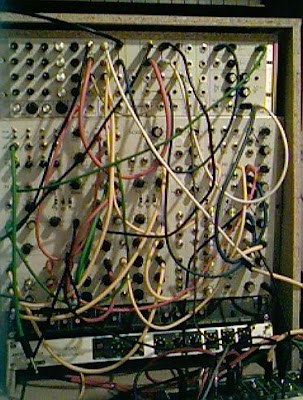
Analog Modular Synthesizer
modular analog synthesizer
(Thanks analog-synth.de)

Analog Modular Synthesizer
Frank Vanaman's MOTM Modular Synthesizer
(Thanks theatreorgans.com, citing as source: synthtech.com)

We move from color-patch to color-patch much the same way that a sound-signal moves from module to module in an analog synthesizer, with each transition modifying the sound’s appearance.


So let’s consider a Deleuzean interpretation of Cézanne’s words. The color modulation in Cézanne's paintings would be a series of differential perceptions. The fingers of Cézanne's folded hands are intertwined not in integration, but as incompatible differences that are mashed together. And this does not integrate us with the world, because the world as it is given and rendered is not the same world that we sense. Regarding the integration of our body-parts, it is not evident that in Cézanne it is based on differential relations rather than integrations. Perhaps this is one reason Deleuze turns to Bacon, whose shocking artworks throw the parts of our body into disarray.

So what would it be like to do phenomenology in a Deleuzean way? I think it would be based on phenomenal differences and incompatibilities. I would like to end with Stan Brakhage’s spontaneous and eloquent account of how things phenomenally stand-out and appear to him. It seems in part to be based on phenomenal differences and incompatibilities.


Image Credits:

First Cézanne fruit painting:
http://ajnabee.tumblr.com/post/5169621182/paul-cezanne-nature-morte-with-commode-1883-87
Thanks Concrete Rules and Abstract Machines

Cézanne. Still Life, Fruit and Pitcher on Table
http://www.awesome-art.com/awesome/shop/category.aspx?catid=44&page=1&sortby=
(Thanks awesome-art.com)

Cézanne: Still Life with Apples (1890-94)
http://www.dl.ket.org/webmuseum/wm/paint/auth/cezanne/sl/apples/index.htm

Red Carpet:
http://www.flickr.com/photos/21295189@N04/3028115809
(Joy A's flickr. Thanks Joy A)

Bridge:
http://www.allaboutweybridge.co.uk/aaw/weybridge/surrey/weybridge-photos/weybridge-wey-bridges.htm
(Thanks all about Weybridge. Thanks Rachael Talibart.)

Eagle picture:
http://upload.wikimedia.org/wikipedia/commons/8/86/American_Bald_Eagle%2C_landing.jpg
(Thanks wikipedia)

Bacon. Francis Painting 1946
(c) 2009 The Estate of Francis Bacon/ARS, New York/DACS, London

Cezanne comparison images:

Machotka Pavel. Cézanne: Landscape into Art.
http://www.machotka.com/library/landscapetoart/index.htm

Analog Modular Synthesizer, vertical image
http://www.analog-synth.de/synths/formant.htm
(Thanks analog-synth.de)

Analog Modular Synthesizer, square image
http://theatreorgans.com/walnuthill/wall-frankvanaman.htm
http://www.synthtech.com/motm.html

Cézanne. Mont Sainte Victoire.
http://www.theartwolf.com/articles/50-impressionist-paintings.htm
(Thanks G. Fernández - theartwolf.com)

Mont St Victoire. la montagne Sainte-Victoire vue des Lauves, photo
http://travel.webshots.com/photo/1525735117041399610tbQuZP
(Thanks travel.webshots.com and rajbaut)


30 Jan 2011

Breath of Color: Merleau-Ponty on Painting and Cézanne in Eye and Mind and Cézanne's Doubt


by Corry Shores
[Search Blog Here. Index-tags are found on the bottom of the left column.]

[Central Entry Directory]

[Other entries in the Merleau-Ponty phenomenology series.]


[Note: all boldfaces in quotations are my own modifications. Quoted citations come from PDF translations on the internet (see works cited). Page citations give PDF number, then 'see ...' for the printed text page citation.]


Breath of Color:
Merleau-Ponty on Painting and Cézanne
in Eye and Mind
and Cézanne's Doubt
Cézanne. Still Life, Fruit and Pitcher on Table
(Thanks awesome-art.com)


What does the phenomenology of painting go to do with you?

Painters are sensitive to the way things appear to us. But what if things appeared to us because we were completely meshed with the world, rather than it be the case that we stand before the world and the objects around us stand over against us? Then the painter could tell us more about how we are inherently mixed-in with the world we perceive.


Brief Summary

Our senses integrate us with a world that is integrated within itself. Painters like Cézanne have insights into how this integration works.


Points relative to Deleuze:

Deleuze also thinks that painters can teach us about phenomena. However, Deleuze thinks we learn much different lessons. Painters show us that our contact with the world is not one of integration, but of us facing a world of difference that is itself different from us. [See
this entry for more.]


Merleau-Ponty:
From Eye and Mind

Our bodies are integrated into the fabric of the world and into what gives it meaning [see this entry on horizonal integration as meaning, from Phenomenology of Perception]. Painters are able to live purely in this enmeshment with the world and express it visually in their works. This is their 'secret science' (Merleau-Ponty, Eye and Mind, 2c, see 161d).

We first note how our vision and movement in the world indicates our integration with it. We move about the world by means of our vision. Because we see the world, we can interact with it, relate to it, move around through it. (see 162b.c)

Now, we are not just able to sense the things in the world around us. We can also sense our selves. But there is more. We can notice that we are seeing something. In other words, we can see our selves seeing. (see 162d)

So we move through the world in an integrated way with it. The fact that we are moving around it tells us we are somehow
apart from it, but the fact we are always integrated indicates that we are also somehow a part of it. [See this entry from the Phenomenology of Perception for more on our integration with the world. There is the famous example of the walking stick. A stick from a tree might seem like a part of the world that is not a part of us. But when a blind person learns to walk with a stick, she soon begins to be able to actually feel the world with the stick, as if her nerve endings extended through the wood to the farthest side that does the feeling. So in a way, parts the world are parts of us.] [And also note the sympathy our sense organs have with the world. Parts of our ears for example vibrate at the same frequency of the sound wave they are receiving. So we profoundly get in touch with the world around us, and it becomes ambiguous who is the sensor and who is the sensed.]
Visible and mobile, my body is a thing among things; it is one of them. It is caught in the fabric of the world, and its cohesion is that of a thing. But because it moves itself and sees, it holds things in a circle around itself. Things are an annex or prolongation of itself; they are incrusted in its flesh, they are part of its full definition; the world is made of the very stuff of the body. (3c, see 163b)
The body's animation is not the assemblage or juxtaposition of its parts. Nor is it a question of a mind or spirit coming down from somewhere else into an automation— which would still imply that the body itself is without an inside and without a "self." A human body is present when, between the see-er and the visible, between touching and touched, between one eye and the other, between hand and hand a kind of crossover occurs. (4a, see 163d)
Our organs are not instruments; on the contrary, our instruments are added-on organs. Space is not what it was in the Dioptrics, a network of relations between objects such as would be seen by a third party, witnessing my vision, or by a geometer looking over it and reconstructing it from outside. It is, rather, a space reckoned starting from me as the null point or degree zero of spatiality. I do not see it according to its exterior envelope; I live it from the inside; I am immersed in it. (12c, see 178ab)
We in a way are integrated with the things around us by means of our vision. Our body has a certain affinity for them which allows us to see them. They have a sort of 'secret visibility' within us. Painting is faced with the task of depicting this inner secret visibility of the external world, based on our bodily affinity and integration with it.
Once this strange system of exchanges is given, we find before us all the problems of painting. These problems illustrate the enigma of the body, which enigma in turn legitimates them. Since things and my body are made of the same stuff, vision must somehow come about in them; or yet again, their manifest visibility must be repeated in the body by a secret visibility. "Nature is on the inside," says Cézanne. Quality, light, color, depth, which are there before us, are there only because they awaken an echo in our bodies and because the body welcomes them. (4a, see 164a)
When we see things, we take them into us, in a sense. And painters must be very sensitive to how our vision takes in the world. We might even say that it is a matter of letting the world see us, that is, to penetrate us the way our gaze penetrates it. It is like our inhalations are the worlds exhalations [we discussed this metaphor in this entry from Phenomenology of Sensation].
We speak of "inspiration," and the word should be taken literally. There really is inspiration and expiration of Being, respiration in Being, action and passion so slightly discernible that it becomes impossible to distinguish between who sees and who is seen, who paints and what is painted. We say that a human being is born the moment when something that was only virtually visible within the mother's body becomes at once visible for us and for itself. The painter's vision is an ongoing birth. (6c, see 167d)
Mirrors help us see the "metaphysical structure" of our our entwinement with the world. We see an image of ourself. We also sympathize with it. It is as if we doubly feel what we are feeling and what the image is feeling. And the image of us will be seen by others. They too might sympathize with what they see. In this way it is as if we and the world share the same flesh. (see 168a.c)

Let's also note how when we see something, we see a world that is integrated with itself. He offers two excellent examples. The first is
Rembrandt's Nightwatch.
The hand pointing toward us in The Nightwatch is truly there only when we see that its shadow on the captain's body presents it simultaneously in profile. The spatiality of the captain lies at the intersection of the two perspectives which are incompossible and yet together. (6a, see 167a)
We might use this example to illustrate another point he made in Phenomenology of Perception about the integration of the parts of the world, how to see the front of an object is also to have on the horizon of our awareness the way that things behind it would be seeing the back side. The Nightwatch example also shows us how when we see something from one perceptive, we see it from all the others, because the way it looks from all the other perspectives influences the way we see it from our own point of view.

Rembrandt. De Nachtwacht (The Night Watch) 1642
Rembrandt Nightwatch

(Thanks www.students.sbc.edu)

We see the shadow of the pointing-man's hand cast upon the captain's body. On the one hand, we see what his hand looks like from the front.

Rembrandt. De Nachtwacht (The Night Watch), detail

So far, we might regard the images before us two-dimensionally. However, the shadow shows us the profile of the arm, as if we were at the same time viewing it from the side.

Rembrandt. De Nachtwacht (The Night Watch), detail
Rembrandt Nightwatch detail hand shadow
(Again, thanks russianpaintings.net)

So we also see how his hand looks from objects standing to his right, all while we look at him from the front. The parts of our world are all coherently interwoven. Another great example is seeing the bottom of a pool. We might think that we are seeing the bottom, even though the water is obscuring it. But in fact, the water is the very reason we can see it. The water is what is letting the light waves through. And when we look to the trees above the pool, we see a reflection of the ripples. The tree has it appearance only because it is integrated with the water motion.
When through the water's thickness I see the tiled bottom of the pool, I do not see it despite the water and the reflections; I see it through them and because of them. If there were no distortions, no ripples of sunlight, if it were without that flesh that I saw the geometry of the tiles, then I would cease to see it as it is and where it is—which is to say, beyond any identical, specific place. I cannot say that the water itself—the aqueous power, the syrupy and shimmering element—is in space; all this is not somewhere else either, but it is not in the pool. It inhabits it, is materialized there, yet it is not contained there; and if I lift my eyes toward the screen of cypresses where the web of reflections plays, I must recognize that the water visits it as well, or at least sends out to it its active, living essence. This inner animation, this radiation of the visible, is what the painter seeks beneath, the words depth, space, and color. (13-14; see 182a.b)
There is something else we noted before in Phenomenology of Perception. Each sense senses things differently. But what they sense is always analogous between the different senses. Our vision has a sense of space. So too does our vision. They are not the same, but the two mesh together in one act of space-perception. Merleau-Ponty in Eye and Mind says something similar. He notes how painters also make good sculptures, for example. This is because what we gain in knowledge of sight translates into knowledge of analogous things in the other senses.
Anyone who thinks about the matter finds it astonishing that very often a good painter can also produce good drawings or good sculpture. Since neither the means of expression nor the creative gestures are comparable, this is proof that there is a system of equivalences, a Logos of lines, of lighting, of colors, of reliefs, of masses—a nonconceptual presentation of universal Being. (15b; see 182c)
So our vision allows us to see things from all perspectives, or at least to have all these other perspectives on the horizon of our awareness. He has us also consider when we look straight down a set of train tracks. They converge on the horizon. But it is only because they converge that we know they remained parallel even at the furthest extent we see. In a way, we are indirectly seeing their being parallel down there by viewing them as convergent from here. So in a sense, when we see the train tracks, we see also something invisible from our perspective, which is their remaining parallel throughout. An invisible absence is given in the visual presence. But we might say there is another sort of invisibility that is given to us. That would be our entwinement with the world, our already being a part of it and enmeshed with it as one flesh.
We must take literally what vision teaches us: namely, that through it we touch the sun and the stars, that we are everywhere at once, and that even our power to imagine ourselves elsewhere—"I am in Petersburg in my bed, in Paris, my eyes see the sun"—or freely to envision real beings, wherever they are, borrows from vision and employs means we owe to it. Vision alone teaches us that beings that are different, "exterior," foreign to one another, are yet absolutely together, are "simultaneity"; which is a mystery psychologists handle the way a child handles explosives. Robert Delaunay says succinctly, "The railroad track is the image of succession which comes closest to the parallel: the parity of the rails." The rails converge and do not converge; they converge in order to remain equidistant farther away. The world is in accordance with my perspective in order to be independent of me, is for me in order to be without me, to be a world. The "visual quale" gives me, and is alone in doing so, the presence of what is not me, of what is simply and fully. It does so because, as a texture, it is the concretion of a universal visibility, of one sole Space that separates and reunites, that sustains every cohesion (and even that of past and future, since there would be no such cohesion if they were not essentially parts of the same space). Every visual something, as individual as it is, functions also as a dimension, because it is given as the result of a dehiscence of Being. What this ultimately means is that the hallmark of the visible is to have a lining of invisibility in the strict sense, which it makes present as a certain absence. (17-18b; see 187a.c)
There is that which reaches the eye head on, the frontal properties of the visible; but there is also that which reaches it from below—the profound postural latency whereby the body raises itself to see—and that which reaches vision from above like the phenomena of flight, of swimming, of movement, where it participates no longer in the heaviness of origins but in free | accomplishments. Through vision, then, the painter touches both extremities. In the immemorial depth of the visible, something has moved, caught fire, which engulfs his body; everything he paints is in answer to this incitement, and his hand is "nothing but the instrument of a distant will." Vision is the meeting, as at a crossroads, of all the aspects of Being. "A certain fire wills to live; it wakes. Working its way along the hand's conductor, it reaches the canvas and invades it; then, a leaping spark, it arcs the gap in the circle it was to trace: the return to the eye, and beyond." There is no break at all in this circuit; it is impossible to say that here nature ends and the human being or expression begins. It is, then, silent Being that itself comes to show forth its own meaning. (18c, see 187-188)


Merleau-Ponty:
Cézanne's Doubt

According to Merleau-Ponty, Cézanne painted things in a distorted way, but this is because he knew how our minds would reconfigure them to have the effect of seeming normal. When we look at something, it is not as though our eyes are photo cameras. Our eyes are constantly shifting. And contextual factors alter the way things look [see this entry for the example of the moon on the horizon.] In a sense, Cézanne paints what we really see and not just what we would see if our eyes were cameras.
This is the reason for his difficulties and for the distortions one finds in his pictures between 1870 and 1890. Cups and saucers on a table seen from the side should be elliptical, but Cezanne paints the two ends of the ellipse swollen and expanded. The work table in his portrait of Gustave Geffroy stretches, contrary to the laws of perspective, into the lower part of picture. In giving up the outline Cezanne was abandoning himself to chaos of sensation, which would upset the objects and constantly suggest illusions, as, for example, the illusion we have when we move our heads that objects themselves are moving—if our judgment did not constantly set these appearances straight. (2; see 13a)
Cezanne did not think he had to choose between feeling and thought, as if he were deciding between chaos and order. He did not want to separate the stable things which we see and the shifting way in which they appear. He wanted to depict matter as it takes on form, the birth of order through spontaneous organization. He makes a basic distinction not between "the senses" and "the understanding" but rather between the spontaneous organization of the things we perceive and the human organization of ideas and sciences. We see things; we agree about them; we are anchored in them; and it is with "nature" as our base that we construct our sciences. Cezanne wanted to paint this primordial world, and his pictures therefore seem to show nature pure, while photographs of the same landscapes suggest man's works, conveniences, and imminent presence. (4a, see 13c.14a)
By remaining faithful to the phenomena in his investigations of perspective, Cezanne discovered what recent psychologists have come to formulate: the lived perspective, that which we actually perceive, is not a geometric or photographic one. The objects we see close at hand appear smaller, those far away seem larger than they do in a photograph. (This is evident in films: an approaching train gets bigger much faster than a real train would under the same circumstances.) To say that a circle seen obliquely is seen as an ellipse is to substitute for our actual perception what we would see if we were cameras: in reality we see a form which oscillates around the ellipse without being an ellipse. In a portrait of Mme Cezanne, the border of the wallpaper on one side of her body does not form a straight line with that on the other: and indeed it is known that if a line passes beneath a wide strip of paper, the two visible segments appear dislocated. Gustave Geffroy's table stretches into the bottom of the picture, and indeed, when our eye runs over a large surface, the images it successively receives are taken from different points of view, and the whole surface is warped. It is true that I freeze these distortions in repainting them on the canvas; I stop the spontaneous movement in which they pile up in perception and tend toward the geometric perspective. (4b, see 14a.c)
Similarly, it is Cezanne's genius that when the overall composition of the picture is seen globally, perspectival distortions are no longer visible in their own right but rather contribute, as they do in natural vision, to impression of an emerging order, an object in the act of appearing, organizing itself before our eyes. In the same way, the contour of an object conceived as a line encircling the object belongs not to the visible we but to geometry. If one outlines the shape of an apple with a continuous line, one makes an object of the shape, whereas the contour is rather ideal limit toward which the sides of the apple recede in depth. Not to indicate any shape would be to deprive the objects of their identity. To trace just a single outline sacrifices depth—that is, the dimension in which the thing is presented not as spread out before us but as an inexhaustible reality full of reserves. That is why Cezanne follows the swell of the object in modulated colors and indicates several outlines in blue. Rebounding among these, one's glance captures a shape that emerges from among them all, just as it does in perception. (4d, see 14-15)
the world is a mass without gaps, a system of colors across which the receding perspective, the outlines, angles, and curves are inscribed like lines of force; the spatial structure vibrates as it is formed. (5a, see 15b)
Cézanne: Still Life with Apples (1890-94)
(Thanks dl.ket.org)

Cézanne. Still Life, Fruit and Pitcher on Table
(Thanks awesome-art.com)

Cézanne: Gustave Geoffrey
Cézanne: Gustave Geoffrey detail
(Thanks en.easyart.com)

Cézanne: Portrait of a Woman in Green Hat (Mme Cézanne) (1894-95)
Cézanne: Portrait of a Woman in Green Hat (Mme Cézanne) (1894-95) detail
(Thanks www.dl.ket.org)

In other words, things appear to us as dynamically deformed. Just moving a little bit will change how the things in a scene before us appear. But that is how we look at things, by moving our eyes around it. But our mind is able to synthesize all the differences together into a perception of something more organized and seemingly stable. This is what a photograph presents to us, the finished product. But Cézanne's paintings give us the experience of seeing the actual things. He knows that even though they might look deformed when compared to a realistic rendition, they will appear natural. They will appear as if we had Cézanne's eyes while he was in the act of seeing the objects.

So all the different ways the object appears are synthesized coherently and holistically so that we properly perceive their visual features. But also, all our senses are together involved in the sensation. They begin already as integrated.
Cezanne does not try to use color to suggest the tactile sensations which would give shape and depth. These distinctions between touch and sight are unknown in primordial perception. It is only as a result of a science of the human body that we finally learn to distinguish between our senses. The lived object is not rediscovered or constructed on the basis of the contributions of the senses; rather, it presents itself to us from the start as the center from which these contributions radiate. We see the depth, the smoothness, softness, the hardness of objects; Cezanne even claimed that we see the odor. If the painter is to express the world, the arrangement of his colors must bear within this indivisible whole, or else his painting will only hint at things and will not give them in the imperious unity, the presence, insurpassable plenitude which is for us the definition of the real. (5a, see 15c, boldface mine)
Cézanne came before an indeterminate scene where its parts are given together, but in a way that allows us to ignore certain aspects in favor of others. So Cézanne tried to present these aspects as interwoven together. Cézanne called this phenomenally rich scene he painted his motif (we discuss Deleuze's interpretation of Cézanne's motif here.) The painter's job is to produce a recognizable image by means of the synthesis of the scene's parts.
He went to the Louvre every day when he was in Paris. He believed that one must learn how to paint and that the geometric study of planes and forms is a necessary part of this learning process. He inquired about the geological structure of his landscapes, convinced that these abstract relationships, expressed, however, in terms of the visible world, should affect the act of painting. The rules of anatomy and design are present in each stroke of his brush just as the rules of the game underlie each stroke of a tennis match. But what motivates the painter's movement can never be simply perspective or geometry or the laws governing the breakdown of color, or, for that matter, any particular knowledge. Motivating all the movements from which a picture gradually emerges there can be only one thing: the landscape in its totality and in its absolute fullness, precisely what Cezanne called a "motif." He would start by discovering the geological foundations of the landscape; then, according to Mme Cezanne, he would halt and look at everything with widened eyes, "germinating" with the countryside. The task before him was, first, to forget all he had ever learned from science and, second, through these sciences to recapture the structure of the landscape as an emerging organism. To do this, all the partial views one catches sight of must be welded together; all that the eye's versatility disperses must be reunited; one must, as Gasquet put it, "join the wandering hands of nature." "A minute of the world is going by which must be painted in its full reality." His meditation would suddenly be consummated: "I have a hold on my motif," Cezanne would say, and he would explain that the landscape had to be tackled neither too high nor too low, caught alive in a net which would let nothing escape. Then he began to paint all parts of the painting at the same time, using patches of color to surround his original charcoal sketch of the geological skeleton. The picture took on fullness and density; it grew in structure and balance; it came to maturity all at once. "The landscape thinks itself in me," he would say, "and I am its consciousness." Nothing could be farther from naturalism than this intuitive science. Art is not imitation, nor is it something manufactured according to the wishes of instinct or good taste. It is a process of expression. Just as the function of words is to name—that is, to grasp the nature of what appears to us in a confused way and to place it before us as a recognizable object—so it is up to the painter, said Gasquet, to "objectify," "project," and "arrest." [...]
We, forgetting the viscous, equivocal appearances, go through them straight to the things they present. The painter recaptures and converts | into visible objects what would, without him, remain walled up in the separate life of each consciousness: the vibration of appearances which is the cradle of things. (6a.c, see 17a.17d; 17-18)
Cézanne as a painter is sensitive to the way we are visually affected by the world, and his job is not so much to paint the world as much as it is to paint our relation with the world, the way it affects us.
Cezanne's difficulties are those of the first word. He thought himself powerless because he was not omnipotent, because he was not God and wanted nevertheless to portray the world, to change it completely into a spectacle, to make visible how the world touches us. (7d, see 19d)
Consider when we see a new painting that really impresses us. We need look at it in a way we have never looked at something before. It teaches us a new way to see the world. And we learn this new way of seeing through the process of our novel encounter with the work. It somehow simultaneously teaches how to 'read a new text' if you will, by means of the new language of that text which we still need to learn.
It is not enough for a painter like Cezanne, an artist, or a philosopher, to create and express an idea; they must also awaken the experiences which will make their idea take root in the consciousness of others. If a work is successful, it has the strange power of being self-teaching. The reader or spectator, by following the clues of the book or painting, by establishing the concurring points of internal evidence and being brought up short when straying | too far to the left or right, guided by the con-fused clarity of style, will in the end find what was intended to be communicated. The painter can do no more than construct an image; he must wait for this image to come to life for other people. When it does, the work of art will have united these separate lives; it will no longer exist in only one of them like a stubborn dream or a persistent delirium, nor will it exist only in space as a colored piece of canvas. It will dwell undivided in several minds, with a claim on every possible mind like a perennial acquisition. (8a, see 19d)


Merleau-Ponty. "The Eye and Mind." Transl. Carleton Dallery. in The Primacy of Perception and other Essays on Phenomenological Psychology, the Philosophy of Art, History, and Politics. Ed. James M. Edie. Evanston: Northwestern University Press, 1964.

Quotations come from the PDF, obtained very gratefully from
Timothy Quigley's course page
http://homepage.newschool.edu/%7Equigleyt/vcs/em-text.pdf


Merleau-Ponty. "Cézanne's Doubt." Transl. Hubert L. Dryfus & Patricia Allen Dreyfus. In Sense and Non-Sense. Chicago: Illinois University Press, 1964.

Quotations from the PDF also obtained with all my gratitude from Robert Innis' course page:
http://faculty.uml.edu/rinnis/cezannedoubt.pdf


Images

Cézanne: Gustave Geoffrey
http://en.easyart.com/canvas-prints/Paul-Cezanne/Gustave-Geffroy-354053.htm

Cézanne: Still Life with Apples (1890-94)
http://www.dl.ket.org/webmuseum/wm/paint/auth/cezanne/sl/apples/index.htm

Cézanne. Still Life, Fruit and Pitcher on Table
http://www.awesome-art.com/awesome/shop/category.aspx?catid=44&page=1&sortby=
(Thanks awesome-art.com)

Cézanne: Portrait of a Woman in Green Hat (Mme Cézanne) (1894-95)
http://www.dl.ket.org/webmuseum/wm/paint/auth/cezanne/portraits/mme/index.htm

Rembrandt's Nightwatch
http://www.russianpaintings.net/doc.vphp?id=753