
9 Dec 2010

Variations on a Line: Wilhelm Worringer's Northern Line (Gothic Line)


by
Corry Shores
[Search Blog Here. Index-tags are found on the bottom of the left column.]

[Central Entry Directory]
[Deleuze on Bacon Entry Directory]


Variations on a Line:
Wilhelm Worringer's Northern Line (Gothic Line)


What does Gothic got to do with you?

By looking within ourselves, we might discover a force of freedom thriving within us. It is not exactly that part of us which is like self-defiance, an element in our personalities that causes us to act in a self-sabotaging way against our best interests, or to recklessly act without thinking. However, it is very similar, and might best be described by considering first certain elements of this more readily conceivable careless freedom. For, unlike the reckless freedom, the other more freer freedom is not a reaction. It does not react against ourselves or against things, people and events in our lives. So consider for example that force in us that might drive us to spontaneously go on a drinking binge after just losing a job. It cannot be this other freer freedom, because it reacts against an unfavorable event, an unfair boss, or a self-pitying and self-despising self. Yet it is a sort of defiance. And maybe the freer freedom is defiance without there first being something that we are defying against. Of course we are born into power structures, but our actions can have the spirit of pure, non-reactive defiance. Perhaps this is what we see in the moments of great artistic creation, a sort of joyful defiance, a continual denying that there ever was a restriction in the first place. Now imagine we try to express this force in the act of drawing a line. But also consider if we first drew a curve with supreme control over our hand, to make it as perfect as possible. And also imagine that we at another time were violently impulsive, and drew an erratic line. But the third case is a line inspired by the freer freedom. Like the nicely-drawn curve, the free line would not be a messy chaos. But also, the free line will not be as regularized. And like the erratic impulsive line, the free line will be liberated from the expectations set by how the line was being previously rendered. In a sense it lives at the tiny infinitely small point of the absolute present moment, never fully bound to the immediate or passing past. But unlike the erratic line, the free line will not be defiant in an artificial or reactive way.

So in one sense the free line is drawn in the infinitely small present moment. But in every such infinitely small moment, the line is tending toward extending into infinity. That is because at no moment does it suggest or move toward an organic completion. How is this so? Consider lines that make a labyrinthine pattern.
interlace ornament Morovingian Worringer. Form Problems of the Gothic. plate 8a
Such labyrinthine patterns make us think that there is no beginning or end. Another example is a Gothic cathedral.
Salisburry Cathedral. Worringer. Form Problems of the Gothic. plate 22
Only the vertical lines are emphasized, which gives us an impression of going up to infinity.

Worringer calls the free line the "Northern line." If we drew our lives as a northern line, we would not be bound to our pasts, or adjust our actions so that they properly react to something else. We would live in the present not in a thoughtless or careless way, but in the sense of making this moment the seed of an infinite future of continued freedom. Such a 'northern life' is powerfully creative.


Brief Summary:

Worringer discusses certain styles that cultures have developed throughout history. There is a trend, called the Gothic, which ornaments its works with a liberated line, termed the "Northern Line". This line is continually undetermined and it strives for infinity.


Points relative to Deleuze
[Under continual revision]:

One of the places Deleuze refers to the northern line is in his Francis Bacon: The Logic of Sensation book. One element that is central to his notion of sensation is continual variation. So consider a part of a painting that we might characterize as being northern or Gothic; it would have lines that are in continuous variation. Visually speaking, this line will act on the other elements of the painting. But because it is in continual variation, then it expresses either explicitly or implicitly self-difference at every point. Thus there is an infinity of different influences it has on the rest of the painting. This prevents our eyes from ever satisfying their effort to make visual sense of what they see. There will never be an organic coherence, because the artwork will be infinitely fertile in the ways its parts can re-relate. This continual defiance to our efforts of recognizing or mentally representing what we see causes our impressions to be in continual variation. We have a sensation when we are confronted with an irreducible difference that forces itself upon us. Thus the northern or Gothic line can be an element of a painting which allows the artwork to continually affect us with its constant variation.


Selective Summary, from:

Wilhelm Worringer

Form Problems of the Gothic

Latent Gothic of Early Northern Ornament

Worringer will speak of "three principal stages in the process of adjustment of man to outer world" (43). He will focus on the Gothic stage, which he says does not correspond with the Gothic historical age. Rather, he examines the Gothic in terms of a "psychology of style" (43b). All the Western World is Gothic in this sense, so long as it is not immediately influenced by the antique Mediterranean culture. Thus Gothic refers to present times as well (44a).

Worringer begins by describing the art of the Northern European peoples at the fall of the Roman Empire. (45d) The art does not represent nature. It is purely ornamental. There is a "purely geometrical play of line" (although he will later clarify this sort of playfulness). (46ab)

They begin to develop their own language of the line, their own "linear fantasy called intertwining band ornament or braid ornament" (46bc).

Worringer. Form Problems of the Gothic. plate 8a.jpg
The lines form various fantastic and intriguing arrangements. Early primitive lines are abstract and geometrical, without any organic interpretation. (47a) Nevertheless, they express an extreme liveliness. (47b) He says that this line style we see above is a clash between "the abstract character of primitive geometric ornament" and "the living character of Classical organically tinged ornament" (47b.d) These two other styles shown respectively.
Worringer. Form Problems of the Gothic. plate 2.jpg
Worringer. Form Problems of the Gothic. plate 5a.jpg
So, classical ornament has organic clearness and moderation, and it seems to spring "without restraint from our sense of vitality." And also, "It has no expression beyond that which we give it" (48b). But by contrast, northern ornament seems to take on a life all its own, and in fact seems to act upon us ourselves.
The expression of northern ornament, on the other hand, is not immediately dependent upon us; here we face, rather, a life that seems to be independent of us, that makes exactions upon us and forces upon us an activity that we submit to only against our will. In short, the northern line is not alive because of an impression that we voluntarily impute to it, but it seems to have an inherent expression which is stronger than our life. (48bc, boldface mine)
The elaborate his idea of the northern line, he illustrates with common experience. We are to pick up a pencil and draw a line.

What do we notice? Worringer suggests we sense two things. One is "the expression dependent upon us" and the other is the "expression of the line seemingly not dependent upon us" (48d). Perhaps in one way, we see that we drew it; we see that it is a line from our hand not that that of someone else. But perhaps in another way, we see a geometrical form that we were trying to render. The line, as a line, expresses something that is geometrically real even without such an attempted instantiation.

He also has us draw the line in "fine round curves". When we do so, we feel the movement of our wrist. But to that motion we also accompany to it our "inner feeling". We sense that the line grows spontaneously from the play of our wrist, and this gives us a pleasant sensation. "The movement we make is of an unobstructed facility; the impulse once given, movement goes on without effort." (48d). This pleasant feeling is a "freedom of creation," and we transfer it
involuntarily to the line itself, and what we have felt in executing it we ascribe to it as expression. In this case, then, we see in the line the expression of organic beauty just because the execution corresponded with our organic sense. (48-49)
But consider if we see a line made by someone else. We will still involuntarily feel inside us the impressions one has if drawing such a line. (49a)

Gothic lines may have this "organic expressive power", like we see in Classical ornament. But it has another such expressive power. Worringer has us imagine drawing a line more excitedly.
If we are filled with a strong inward excitement that we may express only on paper, the line scrawls will take an entirely different turn. The will of our wrist will not be consulted at all, but the pencil will travel wildly and impetuously over the paper, and instead of the beautiful, round, organically tempered curves, there will result a stiff, angular, repeatedly interrupted, jagged line of strongest expressive force. It is not the wrist that spontaneously creates the line; but it is our impetuous desire for expression which imperiously prescribes the wrist's movement. The impulse once given, the movement is not allowed to run its course along its natural direction, but it is again and again over whelmed by new impulses. When we become conscious of such an excited line, we inwardly follow out involuntarily the process of its execution, too. (49b.d, boldface mine)
But when we follow someone else's wild line, we do not feel pleasure. It seems more like "an outside dominant will coerced us" (49cd). What we feel seems like the forces of the ruptures in the line's incoherent discontinuity.
We are made aware of all the suppressions of natural movement. We feel at every point of rupture, at every change in direction, how the forces, suddenly checked in their natural course, are blocked, how after this moment of blockade they go over into a new direction of movement with a momentum augmented by the obstruction. The more frequent the breaks and the more obstructions thrown in, the more powerful becomes the seething at the individual interruptions, the more forceful becomes each time the surging in the new direction, the more mighty and irresistible becomes, in other words, the expression of the line. (49-50, boldface mine)
The line forces its expression upon us. Thus we feel it as something autonomous and independent of us. (50a)

So consider when we were drawing the curved line. We felt physically a pleasure on account of there being no obstructions breaking the flow of our hand's movements. The parts of our wrist worked together to create a line that is self-consistent in its curving motion. With the erratic line, however, there seems to be unpredictable forces which break the flow, in fact prevent one from starting, and prevent any possibility of there being coherence in the motions or the line. Our hands drawing calmly seem to do so merely by means of our bodies acting automatically and with coordination among its parts. So when it is erratic, that suggests to us the forces causing the unpredictabilities do not come from the body, but rather from some psychic or spiritual source.
The essence of this inherent expression of the line is that it does not stand for sensuous and organic values, but for values of an unsensuous, that is, spiritual sort. No activity of organic will is expressed by it, but activity of psychical and spiritual will, which is still far from all union and agreement with the complexes of organic feeling. (50b, boldface mine)
Worringer clarifies that Gothic ornament and such a scrambled line made by an emotionally or mentally excited person are not at all the same things. However, Worringer will compare them to clarify what he means by the northern line. He says for example that the lines of northern cultures tell us that they were
longing to be absorbed in an unnatural intensified activity of a non-sensuous, spiritual sort one should remember in this connection the labyrinthic scholastic thinking in order to get free, in this exaltation, from the pressing sense of the constraint of actuality. (50d, boldface mine)
Worringer sees this supersensuous longing expressed in "fervent sublimity of the Gothic cathedral, that transcendentalism in stone" (51a). Such architecture exhibits "a complete degeometrization of the line for the sake of the same exigencies of spiritual expression" (51ab).

Pointing us to the left item in the image below, Worringer tells us that "primitive ornament is geometric, is dead and expressionless [Pl. III, C]. Its artistic significance rests simply and solely upon this absence of all life, rests simply and solely upon its thoroughly abstract character" (51b).
Egyptian pottery with geometrical designs. Worringer. Form Problems of the Gothic. plate 3c
Worringer then says that the original dualism between man and world weakened the geometrical character of the line. This degrading of the geometrical line can take two courses. One is toward "an organic vitality agreeable to the senses," as with classical ornament. (51bc)
Worringer. Form Problems of the Gothic. plate 5a.jpg
Or instead it can develop toward a "spiritual vitality, far transcending the senses," which we see in northern ornament (51c). Here we find the Gothic character.

Gothic interlace ornament. Tunc Book of Kells. Worringer. Form Problems of the Gothic. plate 8 image
He continues to claim that the Gothic has more expressive power.
And it is evident that the organically determined line contains beauty of expression, while power of expression is reserved for the Gothic line. This distinction between beauty of expression and power of expression is immediately applicable to the whole character of the two stylistic phenomena of Classic and Gothic art. (51cd, boldface mine)

The Infinite Melody of Northern Line

Worringer will further elaborate the distinction between Classical ornament and Gothic/northern ornament.

Classical ornament exhibits symmetry.
late gothic ornament. Worringer. Form Problems of the Gothic. plate 8a b
However Gothic does not. But instead of symmetry repetition is predominant. (52ab) Classical has repetition too, but like a mirroring. The repetitions have the "calm character of addition that never mars the symmetry" (52bc).
Worringer. Form Problems of the Gothic. plate 5a.jpg
Ludovisi Throne Worringer. Form Problems of the Gothic. plate 6c
Gothic repetition, however, is more like a repetition of difference striving to rise to the nth power.
In the case of northern ornament, on the other hand, the repetition does not have this quiet character of addition, but has, so to speak, the character of multiplication. No desire for organic moderation and rest intervenes here. A constantly increasing activity without pauses and accents arises, and the repetition has only the one intention of raising the given motive to the power of infinity. The infinite melody of line hovers before the vision of northern man in his ornament, that infinite line which does not delight but stupefies and compels us to yield to it without resistance. If we close our eyes after looking at northern ornament, there remains only the echoing impression of incorporeal endless activity. (52-53, boldface mine)

Worringer then cites work from Lamprecht where he describes the laberinthine nature of the Gothic lines.
Lamprecht speaks of the enigma of this northern intertwining band ornament, which one likes to puzzle over [PI. VIII]. But it is more than enigmatic; it is labyrinthic. It seems to have no beginning and no end, and especially no center; all those possibilities of orientation for organically adjusted feeling are lacking. We find no point where we can start in, no point where we can pause. Within this infinite activity every point is equivalent and all together are insignificant compared with the agitation reproduced by them. (53a.b, boldface mine)
Worringer. Form Problems of the Gothic. plate 8a.jpg
Worringer. Form Problems of the Gothic. plate 8c jpg. tunc book of kells
In Gothic architecture, "the impression of endless movement results from the exclusive accentuation of the vertical." (53c)
Salisburry Cathedral. Worringer. Form Problems of the Gothic. plate 22


From:
Wilhelm Worringer. Form Problems of the Gothic. New York: G.E. Stechert, 1920.
PDF available online at:
http://www.archive.org/details/formproblemsofth00worruoft


5 Dec 2010

The Glue of Chaos: Isomorphism, Diagram, and Analogy in the Semiology of Charles Sanders Peirce


by
Corry Shores 

[Search Blog Here. Index-tags are found on the bottom of the left column.
[Central Entry Directory] 
[Logic and Semantics, Entry Directory] 
[C.S. Peirce, entry directory]
[Deleuze on Bacon Entry Directory]


The Glue of Chaos
Isomorphism, Diagram, and Analogy
in the Semiology of Charles Sanders Peirce


What does isomorphism got to do with you?

We find a certain coherence in our world, and as well there is a coherence in how we represent our world. We might observe some event, like a ball smashing a window. There is a sort of causal coherence to that event. Then we might formulate a sentence to describe the event to someone else. If the description is accurate, then the description will have a logical coherence to it as well. What is remarkable is that we can move from the parts of the world to the parts of our representations. This is only possible if we designate one-to-one relations between the parts of one domain with those of the other, even though these parts do not always resemble one another, as in the case of symbolic language. This one-to-one relation between the parts of the different domains is an isomorphic relation. It is isomorphism that allows us to place our world in a symbolic medium.


Brief Summary

Peirce distinguishes three types of signs: icons, indices, and symbols. Icons resemble their referent; indices are causally imprinted by their referent, and symbols stand for their referent on account of some convention or habit of relating the two. A diagram can be an icon, because the parts of the diagram resemble the parts of the thing it represents. Symbols are made of icons, because a symbol evokes in us a mental image that resembles the symbol's referent. Because there is a one-to-one correspondence between the symbol and its proper mental icon, we can say that symbols are made of icons on account of isomorphism.


Relevance to Deleuze
[Under ongoing revision]

Deleuze ties together the concepts of diagram, analogy, icon, symbol, isomorphism, and digital coding in the "Analogy" chapter of his Francis Bacon: The Logic of Sensation. His purpose is to explain his highly complex and original concept: the aesthetic analogy. The concept of isomorphism will allow him to characterize an analogous relation between an original and a production, which are related by a medium that does not resemble either one. This medium is the chance influence that deforms by means of modulation the original's parts. In this way it produces something with different parts with new relations. The parts now are incompatible. But the forces that glued the original's parts coherently together now force together the changed parts in an incoherent way. The device which causes this modulatory deformation is what Deleuze calls a diagram. He distinguishes it from Peirce's diagram, which produces similar relations of parts rather than dissimilar ones. Deleuze also speaks of how the symbol for Peirce is made of icons. The importance here is that the new modulated parts might have vague sensible resemblances to the original, although the original and the modulated part refer to different objects. So the new modulated part iconically refers to the original, even though the meanings they symbolize are incompatible. The importance of this is that the iconic relation between the original and the modulation preserves the forces that organized the original's parts, and it is these contracting forces which are pushing together the incompatible parts of the modulation. This will make more sense when we discuss Deleuze's aesthetic analogy in a forthcoming entry.


The following summary is from:


C.S. Peirce

Philosophical Writings of Peirce

Ch7. Logic as Semiotic: The Theory of Signs

I. What is a Sign? Three Divisions of Logic


Peirce will expound his theory of signs. His synonym for sign is representamen (99a). So whenever he uses the term representamen, we may take it to mean 'sign.'

Let's look at the core components involved in his theory. Besides the sign itself is the person who is being aware of its meaning. Another component is what the sign stands for. So he defines a sign:
A sign, or representamen, is something which stands to somebody for something in some respect or capacity. (99a)
The sign 'addresses' the person involved, and creates in her mind an equivalent or more developed sign. This sign created in the addressed person's mind Peirce calls the interpretant of the first sign.

The sign stands for something else, and this other thing Peirce calls the sign's object.

Peirce also discusses the idea that is evoked by signs. The idea is just a notion that we can communicate to others and that we can conceive more than once, with the idea being mostly the same each time. This idea is the ground for the sign or representamen. This is because the sign does not entirely stand in the place of its object, but more importantly it refers to the idea involved in its meaning. (99a.b)

Thus Peirce divides the sign or representamen into three general elements: the ground [the idea related to the object], the object itself, and the interpretant [the sign in the mind of the person whom the sign addresses].

There is then a triadic relation in Peirce's theory of signs.
The (1) sign relates to (2) an object in such a way that it may evoke (3) in the person's mind the sign, the interpretant related to the first sign.


Three Trichotomies of Signs
ii

Peirce distinguishes three types of signs: icon, index, and symbol. [He will clarify in the following section]

1) Icon.
An icon refers to its object solely on account of certain characteristics that it bears. It is 'like' the thing it is a sign for. (102bc)

2) Index
An index refers to an object on account of its actually being affected by that object. The modification that the object causes to the index is what allows it to denote that object. For this reason, it may bear a similar quality to the object, and hence in a way involves a peculiar sort of icon. (102c)

3) Symbol
A symbol denotes an object on account of some law. Usually this is a law of association of general ideas. This association causes the symbol to be taken as referring to its associated object. (102d)


3. Icon, Index, and Symbol

a. Synopsis

1) Icon
Icons possess a character that makes it signify something, even if that thing does not exist. For example, a pencil-line can be an icon for a geometrical line, even though it is only like a geometrical line on account of similar characteristics, and even though geometrical lines cannot exist in actuality. (104bc)

2) Index
An index has some trait caused by the object, and this trait is what allows the index to denote that object. We may think of things that have causally affected one another, leaving their imprint, but without there being some person having a sign in their minds for this object leaving the imprint. In other words, we can remove the interpretant [idea in addressed person's mind] and still have and index, but if we remove the object [and its imprint], the index is no longer significant. Peirce's example is a piece of moulding that was shot, producing a bullet-hole. The hole would be there, regardless of whether there is someone to attribute this hole to a bullet-shot. However, were there no hole, then the moulding cannot possible refer indexically to some bullet-shot. (104bc)

3) Symbol
A symbol is a speech utterance whose signification results from it being understood to have that signification. Hence what happens is that when someone sees a symbol, she then conceives another sign in her mind that stands for the object represented both by the physical sign and the mental one. So a symbol needs an interpretant [mental sign] in order to be significant.


b. Icon

Icon's have a representative quality whose likeness to the object allows it to iconically refer to that object. In a sense, anything can substitute something else that it is like.

Peirce also calls an iconic representamen a hypoicon. A painting, taken just in terms of the resemblances to objects that it produces, is an example of a hypoicon. (105b)

There are three types of hypoicons: images, diagrams, and metaphors. An image bears simple similar qualities to its object. A diagram bears relations in its own parts that are analogous to the relations in the object's parts. A metaphor represents something by means of a parallelism in something else. (105bc)

According to Peirce, we have only one way to directly communicate an idea, and that is by means of an icon. Indirect ways must be grounded on icons. (105c)

Pictures are icons. So too are diagrams, even though there is not really a sensuous resemblance between the diagram and its object. Instead, in diagrams there is merely an analogy between the relations of the diagram's parts to the object's parts. (105d) "it is only in respect to the relations of their parts that their likeness consists." (107a)


c. Index

An index is "in dynamical (including spatial) connection both with the individual object, on the one hand, and with the senses or memory of the person for whom it serves as a sign, on the other hand" (107d).

Peirce offers some examples.
A rap on the door is an index. Anything which focuses the attention is an index. Anything which startles us is an index, in so far as it marks the junction between two portions of experience. Thus a tremendous thunderbolt indicates that something considerable happened, though we may not know precisely what the event was.
. . . A low barometer with a moist air is an index of rain; that is we suppose that the forces of nature establish a probable connection between the low barometer with moist air and coming rain. A weathercock is an index of the direction of the wind; because in the first place it really takes the self-same direction as the wind, so that there is a real connection between them, and in the second place we are so constituted that when we see a weathercock pointing in certain direction it draws our attention to that direction, and when we see the weathercock veering with the wind, we are forced by the law of mind to think that direction is connected with the wind. The pole star is an index, or pointing finger, to show us which way is north. A spirit-level, or a plumb bob, is an index of the vertical direction. (109a.c)


d. Symbol

A symbol is a sign that represents an object on account of some rule or habit determining what mental sign will be evoked in the mind of the person addressed by the symbol. (113a)

Peirce explains here how a symbol can be made of icons (as well as indices). He seems to say that the symbol needs to somehow evoke mental icons whose character refers us to the represented object.
A man walking with a child points his arm up into the air and says, "There is a balloon." The pointing arm is an essential part of the symbol without which the latter would convey no information. But if the child asks, "What is a balloon," and the man replies, "It is something like a great big soap bubble," he makes the image a part of the symbol. (112bc)
He further explains how symbols refer to mental icons.
A Symbol is a sign naturally fit to declare that the set of objects | which is denoted by whatever set of indices may be in certain ways attached to it is represented by an icon associated with it. To show what this complicated definition means, let us take as an example of a symbol the word "loveth." Associated with this word is an idea, which is the mental icon of one person loving another. Now we are to understand that "loveth" occurs in a sentence; for what it may mean by itself, if it means anything, is not the question. Let the sentence, then, be "Ezekiel loveth Huldah." Ezekiel and Huldah must, then, be or contain indices; for without indices it is impossible to designate what one is talking about. Any mere description would leave it uncertain whether they were not mere characters in a ballad; but whether they be so or not, indices can designate them. Now the effect of the word "loveth" is that the pair of objects denoted by the pair of indices Ezekiel and Huldah is represented by the icon, or the image we have in our minds of a lover and his beloved. (112-113)


The following is from:

The Essential Peirce: Selected Philosophical Writings

Of reasoning in general


In another text he offers another example of how symbols refer to mental icons whose character points to that object that the icon resembles.
in the proposition, "A sells B to C for the price D," A, B, C, D form a set of four indices. The symbol "___ sells ___ to ___ for the price ___" refers to a mental icon, or idea, of the act of sale, and declares that this image represents the set A, B, C, D, | considered as attached to that icon, A as seller, C as buyer, B as object sold, and D as price. [20-21, boldface mine]

So we see that symbols are composed of icons. Now we need to understand why Deleuze says that this composition is based on "phenomena of isomorphism." We will look more closely at this passage:
In his great semiological theory, Peirce first defined icons by similitude, and symbols by a conventional rule. But he acknowledged that conventional symbols are composed of icons (by virtue of phenomena of isomorphism), and that pure icons range far beyond qualitative similitude, and consist of "diagrams." [ft.5: "In his theory of the sign, Peirce attaches great importance to the analogical function and to the notion of the diagram. Nonetheless, he reduces the diagram to a similitude of relations." (citations), p.137b] (Deleuze 81c)

We will first look at what makes an isomorphism, first in a somewhat technical manner. Consider two sets:
Set X's members: 1, 2, 3, 4
Set Y's members: A, B, C, D
We will then say that there is a function involved. Recall Edwards' & Penney's "Function Machine":
Edwards & Penney Function Machine
A function is like a machine that takes-in one value and gives-out another. In the case of our isomorphism, we will say that there is a function that takes-in members of the first set, and gives-out members of the other set. If we take-in '1' and give out 'D', we would represent this as:

f(1) = D.
Let's make the other assignments.

f(1) = D
f(2) = B
f(3) = C
f(4) = A
Wikipedia nicely represents this pictorially as:
isomorphism isomorphic bijection Deleuze
We see that the assignments are arbitrary. We also notice that there is a one-to-one correspondence between the elements of the sets (Landsberg 58). This is like how the symbols we use are arbitrary, but refer according to conventions or habits. The convention or habit of association, then, is the function that makes the two domains isomorphic to one another. So we call that thing which is like a great soap bubble a "balloon", because that is the convention. And as we noted before, for Peirce, the symbol evokes a mental icon for the object. So there is something like a 'function' which takes in the symbol, and gives out the mental icon. It is perhaps in this way that Deleuze means symbols are composed of icons by virtue of phenomena of isomorphism. The symbols would be meaningless if they did not isomorphically relate to mental icons that directly refer to objects similar to them.

This then will help us understand how Deleuze means "analogy by isomorphism," when talking about digital coding. Let's take binary as an example of digital coding. There are two abstract elements, the one and the zero. [Perhaps they are abstract, because these numerals refer to discrete machine states, and thus the coding is something like an abstraction for the machine state; that is, its switches or whatever else are either in one or another position.]

Deleuze writes that we may "do at least three things with a code. One can make an intrinsic combination of abstract elements." (Deleuze 80c) So with our 1 and our 0, we may for example combine them to obtain:
0100100001100101011011000110110001101111
Deleuze continues, "One can also make a combination which will yield a 'message' or a 'narrative', that is, which will have an isomorphic relation to a referential set." (Deleuze 80c) So let's take our binary string as an example. We can for example break it into 8-bit parts.
01001000 01100101 01101100 01101100 01101111
Then, we can establish something like an isomorphic function to tell us how to convert these symbol-groups into letters. [Using the ASCII convention, we might say]

f(01001000) = H
f(01100101) = e
f(01101100) = l
f(01101100) = l
f(01101111) = o
[This example is taken from: docdroppers.org] In this way, our string "0100100001100101011011000110110001101111" can be converted into "Hello," on account of the isomorphism of the sets. In fact, the original string was composed intentionally for this translation. Deleuze then writes, "Finally, one can code the extrinsic elements in such a way that they would be reproduced in an autonomous manner by the intrinsic elements of the code (in portraits produced by a computer, for instance, and in every instance where one could speak of "making a shorthand of figuration.)" (Deleuze 80c) The intrinsic elements seem in our case to be the 8-bit arrangements. And the extrinsic elements would be the letters. Computer software, running on the basis of binary codes, can automatically convert these binary sequences to the letters on our screens, just like how they convert the binary data of an image file to a picture we can see. So first we begin with "Hello" or some image. That is then converted to binary numerical codes for the letters or the homogenized square regions (pixels) of the image. The computer than by means of its own processes reproduces that original word or image, all mediated by the numerical code.

Notice how there is no resemblance between the letter formation and its isomorphic binary equivalent. And likewise with Deleuze's example, there is no resemblance between an image file's binary sequence and the image the software autonomously reproduces on our screen. Nonetheless, it is by means of this automatic reproduction that the resemblance to the original is produced, all through a medium, binary code, that bears no resemblance to the thing it codes and reproduces. But the thing it reproduces is similar to the thing that was originally rendered into code, so in a way the product is analogous to the original. Deleuze writes: "It seems, then, that a digital code covers certain forms of similitude or analogy: analogy by isomorphism, or analogy by produced resemblance" (80d).


Finally let's make one remark regarding Deleuze's observation that for Peirce, diagrams can be icons. This is because the relations of the diagram resemble the relations of the object it represents. Deleuze contrasts his own notion of diagram with Peirce's. We will see in a forthcoming entry that for Deleuze, a diagram regards something with relations that do not resemble the original's relations.


Deleuze, Gilles. Francis Bacon: The Logic of Sensation. Transl. Daniel W. Smith. London/New York: Continuum, 2003.

Edwards & Penney. Calculus. New Jersey: Prentice Hall, 2002, p.2a-3c.

Landsberg, Marge E. Syntactic iconicity and linguistic freezes: The human dimension. Berlin/New York: Mouton de Gruyter/Walter de Gruyter, 1995.
Possible preview at:
http://books.google.com/books?id=xgXh7rAz0E8C&dq=Marge+E.+Landsberg&source=gbs_navlinks_s

Peirce, C.S. The Essential Peirce: Selected Philosophical Writings. Vol 2 (1893-1913). Bloomington Indiana: Indiana University Press, 1998.
Possible preview at:
http://books.google.be/books?id=grYAoECfZtIC&dq=Nathan+Houser&hl=en&source=gbs_navlinks_s

Peirce, C.S. Philosophical Writings of Peirce. New York: Dover Publications, Inc, 1955.


Internet sources:

Hello example:
http://www.docdroppers.org/wiki/index.php?title=Learning_Binary

ASCII alphabet code:
http://www.tekmom.com/buzzwords/binaryalphabet.html

Isomorphism graphic:
http://en.wikipedia.org/wiki/Bijection

1 Oct 2010

Magic in the Ardennes. §11 Proust Du coté chez swann/Swan's Way


by
Corry Shores
[Search Blog Here. Index-tags are found on the bottom of the left column.]

[Central Entry Directory]


[The following is summary. My own notes are given in brackets. Original texts given near the end. I give my deepest thanks to the sources of the images:
wga.hu
commons.wikimedia.org
goethezeitportal.de
de.wikipedia.org
americanart.si.edu
www.heiligen.net
goethezeitportal.de
www.eifel.de
gesounded.wordpress.com
encyclopedie-universelle.com
Image credits given below.]


Magic in the Ardennes

Adrian Ludwig Richter Genevieve Genovefa Brabant Genoveva in der Waldeinsamkeit Genoveva in the Forest Seclusion
(Adrian Ludwig Richter: Genoveva in der Waldeinsamkeit / Genoveva in the Forest Seclusion. Thanks source: wga.hu)

Marcel Proust

Du coté chez swann. A la recherche du temps perdu. Tome I
Swan's Way. Vol. 1 of Remembrance of Things Past

Première partie
Combray

Overature
I.

§11

Previously the narrator began recalling the magic lantern shows that he would see in his bedroom.

He now recalls a specific show, the tale of Geneviève of Brabant. [She was the daughter of the Duke of Brabant, and she married Sigfried, the Count of Triers. He must run-off to war, leaving Geneviève behind.

Joseph Ritter von Führich. Graf Siegfried nimmt Abschied von seiner Gemahlin Genoveva
(Joseph Ritter von Führich. Graf Siegfried nimmt Abschied von seiner Gemahlin Genoveva. Thanks source: goethezeitportal.de)


Sigfried leaves Geneviève in the care of the castle manager, Golo.

Joseph Ritter von Führich. Golo bei den Hirten
(Joseph Ritter von Führich. Golo bei den Hirten. Thanks source: goethezeitportal.de)

Golo is desperately in love with Geneviève. He comes at night to sing at her window. His songs are melencholy expressions of his suffering for her.


Joseph Ritter von Führich. Genoveva, von der alten Gertrud auf den Altan geführt, hört Golos schwermütigen Gesang
(Joseph Ritter von Führich. Genoveva, von der alten Gertrud auf den Altan geführt, hört Golos schwermütigen Gesang. Thanks source: goethezeitportal.de)

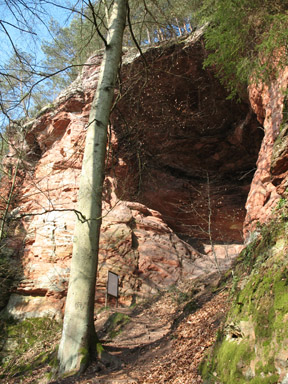
Geneviève rejects Golo. To get revenge, he accuses her of infidelity, which is an especially troubling charge, because she is pregnant at the time. Geneviève is sentenced to death. But the executioner pitied her and let her go. She and her son then stayed in a cave in the Ardennes, where a doe fed them.

Genovevahöhle in the Eifel region
(Genovevahöhle. Thanks source: de.wikipedia.org)

Genovevahöhle in the Eifel region
(Genovevahöhle. Thanks source: www.eifel.de)

Genovevahöhle in the Eifel region
(Genovevahöhle. Thanks source: geocaching.com)

Genovevahöhle in the Eifel region
(Genovevahöhle. Thanks source: geocaching.com)

Genovevahöhle in the Eifel region
(Genovevahöhle. Thanks source: gesounded.wordpress.com)


Adrian Ludwig Richter
Genoveva in der Waldeinsamkeit / Genoveva in the Forest Seclusion
Adrian Ludwig Richter Genoveva in der Waldeinsamkeit Genoveva in the Forest Seclusion
(Adrian Ludwig Richter: Genoveva in der Waldeinsamkeit / Genoveva in the Forest Seclusion, thanks source: commons.wikimedia.org)


Genevieve of Brabant. Genoveva von Brabant. Genovefa
(Thanks source: goethezeitportal.de)


Fraukirch Altar
Genevieve of Brabant. Genoveva von Brabant. Genovefa. Fraukirch Altar
(Fraukirch Altar. Genevieve, Genoveva, Genovefa Brabant. Thanks source: de.wikipedia.org)


Hübner Bürkner: Genoveva
Hübner Bürkner Genevieve Genoveva Genovefa Brabant
(Hübner Bürkner Genevieve Genoveva Genovefa Brabant. Thanks source: wikimedia.org)


Genoveva von Brabant in einer Höhle mit Früchten des Waldes
Genevieve Genovefa Genoveva von Brabant in einer Höhle mit Früchten des Waldes
( Genevieve Genoveva Genovefa Brabant. Genoveva von Brabant in einer Höhle mit Früchten des Waldes Thanks source: commons.wikimedia.org)


George Frederick Bensell: St. Genevieve of Brabant in the Forest
George Frederick Bensell: St. Genevieve of Brabant in the Forest. Genevieve Genoveva Genovefa Brabant
(George Frederick Bensell: St. Genevieve of Brabant in the Forest. Thanks source: americanart.si.edu)


(Genevieve Genoveva Genovefa Brabant. Thanks source: www.heiligen.net)


(Genevieve Genoveva Genovefa Brabant. Thanks source: www.heiligen.net)

Later she was found to be innocent. Her husband discovered them in the cave and restored her honor.


(Joseph Ritter von Führich. Graf Siegfried findet seine als tot beweinte Gemahlin Genoveva wieder. Thanks source: goethezeitportal.de)


Le retour de Genoveva von Brabant (Geneviève de Brabant) 1869

(Le retour de Genoveva von Brabant (Geneviève de Brabant) 1869. Thanks source: encyclopedie-universelle.com)


(Joseph Ritter von Führich. Graf Siegfried führt seine Gemahlin Genoveva und seinen Sohn Schmerzenreich in die Burg heim. Thanks source: goethezeitportal.de)
]

In the narrator's account of the magic lantern show, he describes seeing Golo galloping on horseback toward Geneviève's castle. She stands outside waiting for him. The person telling this story to the narrator, his great-aunt, apparently reads what seems to be Geneviève's speech to Golo, where perhaps she explains she will not indulge his love for her.
Golo stopped for a moment and listened sadly to the little speech read aloud by my great-aunt, which he seemed perfectly to understand, for he modified his attitude with a docility not devoid of a degree of majesty, so as to conform to the indications given in the text; then he rode away at the same jerky trot.

Golo s’arrêtait un instant pour écouter avec tristesse le boniment lu à haute voix par ma grand’tante et qu’il avait l’air de comprendre parfaitement, conformant son attitude avec une docilité qui n’excluait pas une certaine majesté, aux indications du texte; puis il s’éloignant du même pas saccadé.
The images of the story are projected on the wall, which mixes the real world surrounding the narrator with the fantasy projected into it. So Golo and his horse seem to ride over obstacles such as the doorknob, or become distorted in the folds of the window curtains.


From the C.K. Scott Moncrieff English translation:

Riding at a jerky trot, Golo, his mind filled with an infamous design, issued from the little three-cornered forest which dyed dark-green the slope of a convenient hill, and advanced by leaps and bounds towards the castle of poor Geneviève de Brabant. This castle was cut off short by a curved line which was in fact the circumference of one of the transparent ovals in the slides which were pushed into position through a slot in the lantern. It was only the wing of a castle, and in front of it stretched a moor on which Geneviève stood, lost in contemplation, wearing a blue girdle. The castle and the moor were yellow, but I could tell their colour without waiting to see them, for before the slides made their appearance the old-gold sonorous name of Brabant had given me an unmistakable clue. Golo stopped for a moment and listened sadly to the little speech read aloud by my great-aunt, which he seemed perfectly to understand, for he modified his attitude with a docility not devoid of a degree of majesty, so as to conform to the indications given in the text; then he rode away at the same jerky trot. And nothing could arrest his slow progress. If the lantern were moved I could still distinguish Golo’s horse advancing across the window-curtains, swelling out with their curves and diving into their folds. The body of Golo himself, being of the same supernatural substance as his steed’s, overcame all material obstacles — everything that seemed to bar his way — by taking each as it might be a skeleton and embodying it in himself: the door-handle, for instance, over which, adapting itself at once, would float invincibly his red cloak or his pale face, never losing its nobility or its melancholy, never shewing any sign of trouble at such a transubstantiation.


From the Original French:

Au pas saccadé de son cheval, Golo, plein d’un affreux dessein, sortait de la petite forêt triangulaire qui veloutait d’un vert sombre la pente d’une colline, et s’avançait en tressautant vers le château de la pauvre Geneviève de Brabant. Ce château était coupé selon une ligne courbe qui n’était autre que la limite d’un des ovales de verre ménagés dans le châssis qu’on glissait entre les coulisses de la lanterne. Ce n’était qu’un pan de château et il avait devant lui une lande où rêvait Geneviève qui portait une ceinture bleue. Le château et la lande étaient jaunes et je n’avais pas attendu de les voir pour connaître leur couleur car, avant les verres du châssis, la sonorité mordorée du nom de Brabant me l’avait montrée avec évidence. Golo s’arrêtait un instant pour écouter avec tristesse le boniment lu à haute voix par ma grand’tante et qu’il avait l’air de comprendre parfaitement, conformant son attitude avec une docilité qui n’excluait pas une certaine majesté, aux indications du texte; puis il s’éloignant du même pas saccadé. Et rien ne pouvait arrêter sa lente chevauchée. Si on bougeait la lanterne, je distinguais le cheval de Golo qui continuait à s’avancer sur les rideaux de la fenêtre, se bombant de leurs plis, descendant dans leurs fentes. Le corps de Golo lui-même, d’une essence aussi surnaturelle que celui de sa monture, s’arrangeait de tout obstacle matériel, de tout objet gênant qu’il rencontrait en le prenant comme ossature et en se le rendant intérieur, fût-ce le bouton de la porte sur lequel s’adaptait aussitôt et surnageait invinciblement sa robe rouge ou sa figure pâle toujours aussi noble et aussi mélancolique, mais qui ne laissait paraître aucun trouble de cette transvertébration.


From:
Proust, Marcel. Du coté chez swann. A la recherche du temps perdu. Tome I.
Available online at:
http://ebooks.adelaide.edu.au/p/proust/marcel/p96d/index.html

Proust, Marcel. Swan's Way. Vol. 1 of Remembrance of Things Past.Transl. C.K. Scott Moncrieff
Available online at:
http://ebooks.adelaide.edu.au/p/proust/marcel/p96s/index.html


Images from:

Adrian Ludwig Richter: Genoveva in der Waldeinsamkeit / Genoveva in the Forest Seclusion
1st instance
http://www.wga.hu/frames-e.html?/html/r/richtera/seclusio.html
2nd instance
http://commons.wikimedia.org/wiki/File:Adrian_Ludwig_Richter_013.jpg

Cover image:
http://www.goethezeitportal.de/index.php?id=3465

Fraukirch Altar
http://de.wikipedia.org/w/index.php?title=Datei:Fraukirch_Altar.jpg&filetimestamp=20050508220946

Hübner Bürkner: Genoveva
http://upload.wikimedia.org/wikipedia/commons/e/ec/H%C3%BCbner_B%C3%BCrkner_Genoveva.jpg


Genoveva von Brabant in einer Höhle mit Früchten des Waldes
http://commons.wikimedia.org/wiki/File:Genoveva_von_Brabant_in_einer_H%C3%B6hle.jpg

George Frederick Bensell: St. Genevieve of Brabant in the Forest
http://americanart.si.edu/collections/search/artwork/?id=1801

Halo image:
http://www.heiligen.net/heiligen/04/02/04-02-0760-genovefa_0.php

Black and white head and doe:
http://www.heiligen.net/heiligen/04/02/04-02-0760-genovefa_0.php?JPG=2

Joseph Ritter von Führich Images:
http://www.goethezeitportal.de/index.php?id=3465

Genovevahöhle
http://de.wikipedia.org/wiki/Datei:Genovevah%C3%B6hle.jpg
http://www.eifel.de/go/sehenswertes-detail/genovevahoehle.html
http://img.geocaching.com/cache/22b9555c-3392-4271-afca-cb64992a05d4.jpg
http://img.geocaching.com/cache/92766_300.jpg
http://gesounded.wordpress.com/2010/07/26/eifelsteig-pwned/


Le retour de Genoveva von Brabant (Geneviève de Brabant) 1869
http://www.encyclopedie-universelle.com/abeille1/abeille-histoire-hommes-civilisations-ruchers1b.html