17 Apr 2011

Deleuze Cinema Update: Aim of Ages. Buster Keaton. The Three Ages


by Corry Shores
[Search Blog Here. Index-tags are found on the bottom of the left column.]

[Central Entry Directory]
[Cinema Entry Directory]
[Filmmakers, Entry Directory]
[Buster Keaton, Entry Directory]

There is a new Deleuze Cinema Project entry. Click on the title below.


Deleuze Cinema Update: Dreaming of Dada. Buster Keaton. Sherlock Jr.

by Corry Shores
[Search Blog Here. Index-tags are found on the bottom of the left column.]

[Central Entry Directory]
[Cinema Entry Directory]
[Filmmakers, Entry Directory]
[Buster Keaton, Entry Directory]


There is a new Deleuze Cinema Project entry. Click on the title below.


Buster Keaton. Sherlock Jr.

Buster Keaton. Sherlock Jr.


16 Apr 2011

And Intense: Clifford Duffy's 'and'

posting by Corry Shores
[Search Blog Here. Index-tags are found on the bottom of the left column.]

[Central Entry Directory]
[Clifford Duffy Entry Directory]


A truly marvellous poem at Clifford Duffy's Fictions 4: and


Clifford Duffy. and


(Thanks very much, Clifford Duffy)

This poem should probably not be analyzed. I am unable to explain its magic. But I do not want to miss the opportunity to learn more about language by means of examining certain things in this poem.

The first thing I notice is the motion. I make gentle leaps from one line to the next, as if my eyes take flight and drop floatingly to the next line below. The gentleness I think comes from the phonetics. The sounds seem to reflect and allow us to move in a glide from one word or line to the next. Notice also the distribution, the space we feel as we sail between lines. Consider the melody it makes. For me, I hear the longer gap from the first to the second line as a somewhat profound drop in register. Now also consider the rhythm of the word stress. We might say it has a fairly consistent up-and-down flow to it. But notice also the speed changes. The lines toward the bottom are closer together, and so we read them in faster succession. For me, these rhythmic variations in speed also raise the pitch of the sound that the bottom three lines make. So going from lines three to four, I notice the most raising of pitch, for example, and these lines also happen to have the greatest speed of transition. Moving from line four to the final line five, our eyes need to move backwards, which slows the motion down a little, and like a plane slowing to land, the poem feels like it naturally slides gracefully to its ending stop.

In line four, there is an interesting temporalization, the extra space between 'ladies' and 'in care'. We might say we feel a tension in that gap, like a holding-back of language's saying. But is that so? What about the fact that all throughout, for the most part, up to that point, we felt a continuous flow? And yet here in the gap, the continuity is broken. But we still feel the inertia of the motion even after it breaks, like how when a car stops suddenly, we feel ourselves thrown forward even after the car fully halts. In other words, there is an intensity at work in that gap. In one way, our minds might aim to contract that gap by trying to bring the broken parts back together into the poem's flow, as if we could just forget the pause. But in another way, we feel the fullness of the intensities of that moment. So in the crack of that contraction is an enormous depth of poetic time. Then instead of thinking of this gap as having a tension created by an absence of text, we might instead think of it as an explosion of time and sense, coming from a singularity, namely, the contracted but profoundly deep crack in the flow.

Another remarkable part of my experience of this poem is the phonetic bifurcations. For example, in 'fluttering woof', I hear this conjointly as 'fluttering woof' and 'fluttering wolf', both somehow simultaneously, which is possible when we read it in our minds and have a split consciousness at that moment. Then there is a more orthographic and sense bifurcation in the final line. My eyes see both 'knight' with the 'k', but also in 'knight' is the word 'night', and I read it both ways simultaneously. This takes the interpretative machinery of our mind into two directions at once. These are also intensities. The text is intending to go different ways all at once, all in the same space or time, in a sense.

When language stands-out to us, whether because it is profoundly meaningful or aesthetically affective (or both), could this be largely on account of intensities such as the ones we analyzed here? If we think of our favorite line of poetry or our favorite part of a novel, can we attribute its power to its intensive forces?


Clifford Duffy. and. Fictions 4, dated 16-April-2011, captured here 17-April-2011.
http://fictions4.blogspot.com/2011/04/and.html


6 Apr 2011

Figure and Phenomena: Deleuze’s Anti-Gestaltist Perceptions


by Corry Shores
[Search Blog Here. Index-tags are found on the bottom of the left column.]

[Central Entry Directory]
[Corry Shores, Entry Directory]


[May I thank the sources of the images:
Joy A
all about Weybridge / Rachael Talibart
youtube clip / Komond
layersmagazine.com / Jacob Cass
Dark Roasted Blend
Brain Den
Credits given below the image and at the end.]


The following is from my presentation at the First Annual Graduate Conference at the Institute of Philosophy at the Catholic University of Leuven, April 2011.


Figure and Phenomena:
Deleuze’s Anti-Gestaltist Perceptions


Deleuze is often considered an anti-phenomenologist. Yet even so, he generated an original theory of phenomena. So rather than determining whether he was a phenomenologist or an anti-phenomenologist, we might instead attempt to formulate what a Deleuzean phenomenology would be. To do so, we will place it in contrast with Merleau-Ponty’s accounts. A phenomenon, for Deleuze, appears as the shock we feel when incompatible parts of our awareness are given together simultaneously and instantaneously. Merleau-Ponty's phenomena, however, are based more on continuities and organic integrations. Often he articulates his notions of phenomenal holism and integration by making use of Gestalt illustrations.

Müller-Lyer Illusion

Müller-Lyer optical illusion animation
(Animation above is my own, made with OpenOffice Draw and Unfreeze)

Let us consider for example a familiar illusion, to demonstrate how our perceptions cannot be reduced to their particular components. One part of our perception are the parallel lines of equal length; the other part are the angled lines on the ends. But when these parts are together, we no longer see these same individual elements. Instead, the parallel lines appear now with different lengths, on account of their integrated relations with the angled pieces. Our perceptions, then, are wholes that are greater than the mere sums of their component parts.


(Joy A's flickr. Thanks Joy A)

For Merleau-Ponty, our phenomenal parts integrate by means of our horizonal awareness. Consider if we view a red carpet. Each part of our perception looks its particular way on account of the other qualities and objects expressing themselves in that appearance, for example, the overlaying shadow that tinges the color or the illuminated portions that lighten its tone. We are not surprised when looking up to see the source of light and the objects that block it. The red’s particular shaded or lighted look refers our mind to things not explicit in what we directly perceive.


Or consider how a stream’s surface might reflect the brownish hue of an overlying bridge. When looking at the water, we are not directly aware of the bridge, but it is being implicitly spoken or announced by the stream’s color. The stream would appear differently to us were it not for its integrated relation with the bridge above it. And likewise, when looking up at the bridge, we see in its appearance the motion of the water, reflecting up upon it. Our minds have an awareness of these related phenomena, but they are not in the forefront of our attention. As implicit phenomena, they hover at the edges of our awareness.

This also applies to phenomena on our temporal horizon. Merleau-Ponty refers us to an early film experiment. See if you notice the subtle variations that a man’s face undergoes as he reacts to very different things appearing before him.

Seconds from Kuleshov Effect footage

(From youtube clip, thanks Komond)

Perhaps we saw hunger on his face after the soup, grieving after the dead child, and longing following the woman.


But in fact, the film footage for the face is the same each time. While the face is in our focus, the preceding image has not completely disappeared from our awareness and instead remains looming at the margin.

Photobucket

Our awareness retains the prior image, which speaks itself in the current one, by modifying how we perceive it. In this way, all our temporal horizons interlace to produce phenomena not reducible to any one moment of our awareness. They all must be taken together as making up a whole which is greater than the addition of the parts.

Rubin's Vase


Yet sometimes we will be surprised by what we notice, as if it were not implied in the horizon of our awareness. He points us to an optical illusion that is much like the figure-ground vase.

Photobucket
(Animation above is my own, made with OpenOffice Draw and Unfreeze; with use of the image from
layersmagazine.com / Jacob Cass)

When the vase is the figure standing-out in the foreground, then the spaces on the side become a mere void. But when the faces jump into our awareness, the vase then becomes the blank background. Merleau-Ponty says that in cases like this, the changes can be so drastic that we might find ourselves perceiving another world. Yet, this does not mean one moment of our awareness becomes completely incoherent with the rest.


He depicts a scene to illustrate. We happen upon a ship run aground on the beach. Behind it is a forest, and the ship’s mast blends-in with the trees, preventing us from initially noticing it as belonging to the ship. But there will come a moment when something does not seem right about one of the trees. Before even seeing the mast as distinct from the forest, we felt some sort of tension in the appearance, like how “a storm is imminent in storm clouds,” as he puts it. Even from the beginning we had a ‘vague expectation’ that there was something more to be understood in the appearance of the forest.

Surprises in our perceptual world, then, are not contradictions between horizons; rather, they result from us further investigating ambiguous details already given in the margins of our awareness.

We will now draw a sharp distinction with Deleuze. As we noted, phenomena for Deleuze are shocks or flashes produced by irreconcilable differences that are forced together in our perceptual experiences. An illustration can be seen in Fritz Lang’s Metropolis. The hero believes that his female inspiration is someone who could only exhibit pure goodness. But without his knowing, she is captured by a mad scientist, who then renders her likeness upon a deviant robot. When the hero sees her replica, it is conspiring with his own father, a heartless tyrant. The woman whom the hero recognizes is drastically different from the woman he is actually viewing in that same moment, even though he cannot help but equate the two.

Seconds from Fritz Lang's Metropolis,
showing the Deleuzean phenomenon


So two completely incompatible images are presented together simultaneously. The phenomenon here is neither the woman he recognizes nor the woman he now sees, but is rather the shock he feels from their impossible combination.


(Above uses image from
layersmagazine.com / Jacob Cass)


So in the vase illusion, we might first see the black space as a void background. But at some moment, our minds will tend toward seeing this emptiness also as a vase. Our experience is similar to the Metropolis hero’s disorientation: we will recognize what we see as a vase while seeing it also as a void, all within a split-second. The phenomena, then, would be neither the faces nor the vase, but rather the shocks we feel when the two are paradoxically given simultaneously.


So the integration of phenomenal horizons would not be of interest for a Deleuzean phenomenology. In fact, the less our horizons integrate, the more phenomenal our experience will be.


Another way Deleuze has us understand perceptions as being pure differences is by considering Leibniz’ micro-perceptions.

Photobucket
(Animation above is my own, made with OpenOffice Draw and Unfreeze)

They are the differential relations between perceptions that have diminished to the infinitely small. They have vanished, but the relation between them remains. To help us visualize this, Leibniz describes a geometrical figure with two triangles, constructed with the same line. As this line moves to the right, one triangle increases while the other decreases. Yet the sides of both triangles remain proportional, so the ratio of the larger one always indicates the ratio of the smaller one. This holds even as the smaller triangle’s sides diminish to the infinitely small. They have vanished, but their differential relation remains, still discernible in the larger triangle.


Our micro-perceptions are also like these differential relations between vanished terms.
For example, when we perceive green, we are really noticing the differential relations between infinitely small perceptions of blue and yellow. At their basis, all our perceptions are primarily these undetectable micro-perceptions.

So the perception of green is not merely the addition of yellow and blue, like when we mix paint. Green results not from their assimilation and bleeding into one another, but rather from their jarring up against each other. And neither the micro-perceptions of yellow nor those of blue have green on their horizon. The whole is not at all implied in the parts. And the whole field of green we see is not even just a sum of its differential parts, nor is it a whole greater than these parts. For, the green is not even a whole to begin with. It has its particular green appearance also due to its own differential relations with other perceptions.

Deleuze microperceptions yellow blue green differential perception animation
(Animation above is my own, made with Open Office Draw and Unfreeze.)

Consider this illusion. We seem to see four colors: two shades of green and two of red. But really there is just one red and one green.


(Thanks Brain Den)

They appear differently according to which neighboring color they are differentially relating to. So the appearance of the green in any given square is not just the sum of its yellow and blue differentials; the green is itself a differential as well.


In the parallel line illusion, then, it is not the integration of the parts which leads to the apparent disproportional size of the lines; rather, the phenomenon results from the differential relations in our eye movements. Perhaps, for example, the angles on the top-line make our eyes try to draw outward, all while those on the bottom cause our eyes to tend inward. The phenomena are not so much the resulting modified sizes as much as they are the shocks of difference between opposing tendencies in our eye-motions.
So a Deleuzean phenomenology would not make use of principles of integration and holism to explain our phenomenal experiences, not even the ones we have when seeing these Gestalt examples. Our question is: what is more phenomenologically interesting? Is it the way our perceptual parts all fall together nicely and blend with one another, or would it be the forces which arrest and hold our attention, and which make things stand-out and appear in the first place?


I would like to close by giving a better demonstration of Deleuzean phenomena, and for this I suggest the works of filmmaker Stan Brakhage. Deleuze refers to him when discussing the infinites of variation in our fields of perception. One thing Brakhage says he likes about film are its “sharp hard clarities of snapping individual frames.” In many later works, he hand-painted every frame individually. Each one could be a work of art on its own. But, is it only the pictures that we notice when watching his films? Or is there phenomenal content to the differences between the images, which are responsible for making each new frame stand-out in the first place?


First consider this simpler example from an earlier work. Moving one frame to the next, we change from black to red then return to black, all between other shifting imagery.

We will repeat this rapid transition here a few times, because it is easy to miss.

A couple seconds from Stan Brakhage's Meditations

(Thanks Stan Brakhage)

Is the phenomenon the red or the black, or is it not the shock we feel between the two? We might now consider how Brakhage uses this technique more subtly in his later painted films. Here perhaps he keeps us in a state of sustained phenomenal awareness, by means of the rapid succession of differences. So let’s close by viewing it in his Persian Series number 3.

Seconds from Stan Brakhage's Persian Series 3

(Thanks Stan Brakhage)


Red Carpet:
http://www.flickr.com/photos/21295189@N04/3028115809
(Joy A's flickr. Thanks Joy A)

Bridge:
http://www.allaboutweybridge.co.uk/aaw/weybridge/surrey/weybridge-photos/weybridge-wey-bridges.htm
(Thanks all about Weybridge. Thanks Rachael Talibart.)

Ship:
http://www.darkroastedblend.com/2007/12/ships-vs-big-waves.html
(Thanks Dark Roasted Blend)

Four color illusion:
http://brainden.com/visual-illusions.htm
(Thanks Brain Den)

Rubin's Vase
http://layersmagazine.com/negative-space.html
Thanks Jacob Cass

Kuleshov Effect footage
http://www.youtube.com/watch?v=grCPqoFwp5k
(Thanks Komond)


26 Mar 2011

Deleuze Cinema Update: Run Out and Touch Someone. Buster Keaton. The Cameraman

by Corry Shores
[Search Blog Here. Index-tags are found on the bottom of the left column.]

[Central Entry Directory]
[Cinema Entry Directory]
[Filmmakers, Entry Directory]
[Buster Keaton, Entry Directory]


There is a new Deleuze Cinema Project entry. Click on the title below.

Concrete Rules and Abstract Machines Link to Henry Somers-Hall's Deleuze and Merleau-Ponty: The Aesthetics of Difference.

,
.

.

by Corry Shores
[Search Blog Here. Index-tags are found on the bottom of the left column.]

[Central Entry Directory]
[Entry Directory of Blog Announcements]

'
A great link at concrete rules and abstract machines to a paper just recommended to me by a Deleuze/Merleau-Ponty/Bergson and Phenomenology scholar Judith Wambacq of Universiteit Gent. Her works can be seen here. It is an excellent paper, Henry Somers-Hall's Deleuze and Merleau-Ponty: The Aesthetics of Difference. Here is his faculty page, his publications, and here publication links on philpapers.
,
.
'
,

22 Mar 2011

Amazing New Clifford Duffy Innovations

posting by Corry Shores
[Search Blog Here. Index-tags are found on the bottom of the left column.]

[Central Entry Directory]
[Clifford Duffy Entry Directory]

See more of Clifford Duffy's beautiful innovations. Here is a gorgeous word from a stunning poem, remand:

o ,, n

And here a lovely phrase

at's time's at


See his painting too:


And certainly notice his interactive innovation for this poem. I cannot reproduce it on my blog, so see it here in the poem 'turf'


After the 'of', there is space for the eyes to read, until getting to his time-modulating double commas. We might not notice that there is a cloaked hyperlink, 'war' taking us to another wonderful poem (place your cursor near the last double comma and click). But when I first read it, I did not see it. Yet I felt something in that place where the word was. I felt the immediacy of time, as has been the case lately when I read many of Duffy's works; he has been producing new time experiences. So I wonder, what is our experience of this poem? Does it change how we experience the temporality in that space of the invisible war? Does Duffy create a far greater temporal intensity using this technique? That is my impression. Without knowing of the hidden war, I felt the force of time while my eyes moved over that place. But now knowing it is a link to another poetry-world, it feels like so much more is given birth in that instant my eyes are in that spot. Do you feel it too? In that blank space, another parallel language world is expressing itself implicitly. What separates these worlds is not space, because they intersect the same place. When we look in the mirror and see a person appearing many years older than we had in mind for ourselves, we feel the depth of these many years all in that instant. Time is not the passage from the past to the present, but the feeling of the forces at war between these images. Perhaps when our eyes see both language worlds in the same place, we do not have the feeling that space lies between them, but perhaps forces of time do; we might think, for example, that it will take time for us to go from this poetry world to the hyperlinked one. But we feel ourselves already in that other world, even before going there; we feel that other world implicitly in this sentence. So we feel the time between the two language worlds right there in an instant where we see just a small spaceless point in the motion of the poem. Our space-time warping into this other world is not actualized, it is implicit, we feel ourselves being thrown in that direction, like how a ball spinning on a chain always feels itself being thrown in a straight line away from its circular path.


As Duffy's poems show, language can generate 'lines of escape' or 'lines of flight'. By doing so, we feel ourselves fly-off to another meaning-world, all while remaining within the immediacy of our given experience. So perhaps one way language produces time is by creating these lines of flight to other language worlds, which compresses the time between them into our immediate temporal experience. Do we feel this in Duffy's poems? There are other reasons they create time, but is this at least one of them?

12 Mar 2011

RE: Sei zeMar kdow nsOnCap su leAllThr ough outTheYear‏

by Corry Shores
[Search Blog Here. Index-tags are found on the bottom of the left column.]

[Central Entry Directory]
[Logic & Semantics, Entry Directory]

[Deleuze Entry Directory]
[Other Entries in the Deleuze's Logic Series]

RE: Sei zeMar kdow nsOnCap su leAllThr ough outTheYear‏

Often, contraband messages get smuggled through our spam filters. Somehow the constructions communicate subversively, not in the sense of having subversive political messages or purposes, but subverting the codified efforts to block its flow. These bootlegged messages seem different than a secret code. We don't need a decoder to know the meaning. It just speaks to us in its devious way. It is stealth communication. The radars cannot read it, and it flies through the defenses. Our email boxes are not immune to these invasions, because language is immune to attempts at exhausting its meaning using mechanical methods. Language is a much more sophisticated machine. It can disassemble into a more heterogeneous and differential state. The message above seems incoherent. That is precisely its power. Its parts relate so differentially that the algorithms could not put them together into a whole coherent message.[1] But our eyes can. What might interest us is the self-differential process, how 'Seize Markdowns On Capsules All Throughout The Year' becomes 'Sei zeMar kdow nsOnCap su leAllThr ough outTheYear‏.' The parts that were combined do not usually fit together. The parts that were split would normally need to be touching. This is incoherence in two senses: the glue comes undone in some cases, and things that do not naturally glue together are forced into each other, despite their resistance to sticking together. We sometimes hear new slang terms from groups whose power is in the minority. They mostly use the same phonetics, often times the same words, perhaps in all cases the outer appearance of the slang term is something that fits in the language system of the majority power. But its meanings are not fully interpretable by those in the majority. Parents no matter the effort they invest often give up in exasperation trying to understand their teen children's lingo. Or people not accustomed to rap might be unable to discern any of its meanings, despite the rapper speaking entirely in that person's native language. These counterfeit words circulate through the normal currency, except unlike false money, bootlegged language is more valuable than the genuine marks. Slang terms have expressive power perhaps because they throw disruptions into the system, which they can do, because they are designed to pass freely within that system. When we hear a slang term we don't know, it seems like it is from a foreign language, but we know it is not from some language of a different part of the world. Slang is language originating among the parts of our system and circulating freely throughout the regimented ranks of all the other words, as if its subversive meaning wears an invisibility cloak.

[1] A new mechanical method could be devised to discern it, first by only placing spaces before capital letters. But the point is that the algorithms are created only after the invention of the new deformations, in a delayed response to them, hence at first the contraband messages will often get through the defense machinery.

As Time Breathes

posting by Corry Shores
[Search Blog Here. Index-tags are found on the bottom of the left column.]

[Central Entry Directory]
[Clifford Duffy Entry Directory]


Another beautiful time creation, Clifford Duffy's 'As' at The Fictions of Deleuze and Guattari. Here is a small piece. I feel language breathing time:


Blue as a river . Dark as a night. So the cloud . Bulk blue sky ask the anagram word. Of the
name . So the plateau rivers delivers its own self. Along the rink dark as the skater's legs,


and the ring between the sky and ocean ~ and lips over hips and the word as its vessel


ties fingers over thighs . and the ~


http://fictionsofdeleuzeandguattari.blogspot.com/2011/03/as.html


2 Mar 2011

The Still of Time: A-Temporal Phenomena in the Duration of Deleuze’s Bergson


by Corry Shores
[Search Blog Here. Index-tags are found on the bottom of the left column.]

[Central Entry Directory]
[Corry Shores, Entry Directory]


[May I thank the sources of the images:
eyefetch
diagonalthoughts.com
marinagraham
Credits given below the image and at the end.]


The following is from my presentation at the Bergson and his Postmodern and Immanent Legacies conference.


The Still of Time:
A-Temporal Phenomena in the Duration of Deleuze’s Bergson


Deleuze is often considered an anti-phenomenologist. Yet my sense is that his critique of phenomenology is more of a constructive critique. Deleuze is not against the project of studying phenomenal appearances; he merely does so on the basis of different principles and methods. Namely, Deleuze seems interested mostly in the phenomenality of phenomena. Phenomenologists, however, often turn their attention to how phenomenal appearances become constituted throughout the flow of our internal time consciousness. But for Deleuze, a phenomenon is a flash. It could appear instantaneously. What we will explore is the possibility that a Deleuzean phenomenology need not appeal to a flow of time consciousness in order to account for the production of phenomena.

This endeavor is inspired by an article that phenomenologist Michael Kelly wrote, where he defends Husserl’s time consciousness against Deleuzean-Bergsonists. These critics charge that Husserl’s theory of internal time cannot “accommodate time’s fundamental characteristic, namely its passage.” . Yet, Kelly shows that Husserl’s later writings on temporality are immune to this critique.

We might note how Deleuze famously said of his Bergsonism book that it is a classic instance of his buggering technique. He writes, “I imagined myself getting onto the back of an author, and giving him a child, which would be his and which would at the same time be a monster. It is very important that it should be his child, because the author actually had to say everything that I made him say. But it also had to be a monster because it was necessary to go through all kinds of decenterings, slips, break ins, secret emissions, which I really enjoyed.”

So what we will explore is the possibility that one such conceptual offspring is a surprising interpretation of Bergson’s duration: for Deleuze, duration’s fundamental characteristic is not its flowing passage. Perhaps we might characterize duration by employing terms with more of an a-temporal connotation, like instantaneous, simultaneous, and eternal. But these provisional characterizations should really only serve to avert our attention away from time’s flow in order to focus more on time in its absolute immediacy.

To do this, let’s first examine Bergson’s expanding circuit diagram.


Bergson uses it to illustrate the way that the past is always contemporaneous with the present. He first has us consider what he calls an ‘after image’. They are always a part of our perception.


We look at some object, then abruptly avert our gaze to another place. For a split-second, the image of the initial object will carry-into and overlay-upon the new scene we see. The prior object remains in our field of perception, even though it is actually no longer there. Instead, it is virtually there.


The virtual past image inserts itself so thoroughly into the new actual image that “we are no longer able to discern what is perception and what is memory.” Perhaps this is why fast moving objects leave a blurry trail behind them.

According to Bergson, just while the perceived image is sent to our brain, the most recent image in our memory has already arrived-upon and overlaid our current perception, with both moving lightning fast in a continuous circuit.


But just as soon as we see something, it will already begin to appear differently to us, because we move our eyes or notice something new in what we see. Like before, the new image and its predecessor circulate immediately. Yet the even older image has not gone away; it too re-imposes itself on the present perception, but in a somewhat less vivid way. Nonetheless, this enriches the object with another layer in its appearance.


With each additional moment, another new inner circuit pushes-out the former ones.
So we see, then, that the past and present are perpetually crystallized together. “In truth,” writes Bergson, “every perception is already memory. Practically we perceive only the past, the pure present being the invisible progress of the past gnawing into the future.”


Yet even though all of our past is always interposed in the present in an implicit way, sometimes what we see causes one recollection to stand-out more explicitly among the rest. Often we observe something in our daily life that causes certain prior memories to flare-out before our “mind’s eye.” And sometimes our flashbacks can be so vivid that they drown-out the actual things we see. We then begin to feel as though we are reliving that past experience.

Deleuze illustrates these recollection-circuits with the cinematic flashbacks in Marcel Carné’s movie The Daybreak (Le jour se lève).

The film follows events happening from sundown to dawn. During this short period, a murderer flashes back into his past. Whenever we return to the present, we hear a heavy doom-filled bass and drum beat. It gives us the feeling we are moving inevitably toward a fatal end. So during the flashbacks, the past is so vibrant that it completely covers-over the actual present things standing before him in his room. As viewers, we only see what he is remembering, and not the events still carrying-on in the present while he dreams. But because upon returning we hear that fatal march toward the end, we are reminded that even while reminiscing, we never escaped the current doomed situation.


Now consider if we were to memorize a series of spoken lines for a play. Each time we practice it, we create a new individual memory. When it comes time to perform, we just start with the first word, and the rest seem to follow automatically, without our needing to recall any single rehearsal. All the previous times were contracted into that present moment of automatic habitual bodily performance. But after the show, someone might ask us about how we memorized the lines. Then we could relax and daydream about those moments, seeing them in their vivid detail.

Bergson illustrates this with his famous cone diagram. As new things enter our memory, they add to a cone.


If we are acting automatically, like when performing something we rehearsed, then we are down closer to the S point.

Being near this tip does not mean our memories have gone away. Rather, they are all contracted into our physical actions, like how a performance expresses physically all our memories of past recitals. When instead we daydream about the past, the images expand-out in our minds, as during a flashback. In these moments, we reside at a higher layer of the cone. Always we are varying somewhere between automatic action and dreamful reflection, so we might be at any of the many possible layers of expansion or contraction of our memory.

Photobucket

So during flashback scenes, the character’s memory leaps-up to a higher level. But during an action scene where he acts automatically, his memory is contracted into the present moment, down at the cone’s tip. We are always changing level, varying ‘melodically’ between our intense physical engagement in the present moment and our drifting somewhere in dream-land.

So the larger circuits are more distant memories, and the higher cone levels are increased degrees of expansion on one part of those memories.

The cone levels and the circuits are not equivalent, but we might place them in correspondence by noting that when moving to a distant circuit, we are also expanding our memories. In these slides we might correlate the movement-into-flashback with the expansions in the diagrams.

What we notice are the simultaneity of the layers. At any one moment, our consciousness is expressing, implicitly or explicitly, all our past actions and memories. We do not need time to flow in order for it to fully present itself in its immediacy. When the hero sees a memento and flashes back to an event taking place a couple months prior, he does not feel two months of time in their continuous passage. Instead, he experiences two months time in a sudden flash. So the simultaneity of the distant past with the active present becomes immediately evident to him. It is not an extent of time that he undergoes in this flash, but rather time in the form of an intensity.

To further illustrate, Deleuze discusses flashback movies made by Joseph Mankiewicz. In these films, flashbacks are the product of bifurcations. There are two dimensions to these bifurcations or forkings. The first sort we will consider is the forking as a break in a linear progress, as described by Prigogine and Stengers.

Photobucket

They describe how for certain chemical reactions, changes in one variable can be correlated to the variations of others, but then one variable will reach a point when its path is indeterminable. It could increase or decrease, but this outcome is always left to chance.


The other sort of bifurcation we find in Borges’ story ‘The Garden of Forking Paths.’ It describes a Chinese monk’s unfinished manuscripts for a novel with this same title. It went unpublished because it was incomprehensible. The chapters did not proceed just sequentially. A following chapter would be like an alternate version of the same prior one.

The Garden, then, forks-not through space but rather through time. Characters in stories normally must choose between diverging paths. In the Garden, however, the character, “chooses— simultaneously—all of them. He creates, in this way, diverse futures, diverse times which themselves also proliferate and fork.”

There is one remarkable scene in Mankiewicz’ Barefoot Contessa, which showcases both senses of bifurcation. The soon-to-be Contessa quite abruptly switches companions, taking her down a drastically different path. But this scene was remembered by two different people, each in their own way and with their own slight variations. We will place both scenes side-by-side, listening just to the audio from one.


We notice that sudden instant of the slap, that crack in the flow of time, when the next moment is completely undetermined, entirely discontinuous with the present, that moment which is truly phenomenal, that pure, intense, dramatic moment outside the flow of time.

Now, the Contessa’s forking is the reason each of these people recalled the event. We see the relation between bifurcation and flashback shown even more vividly in Mankiewicz’ A Letter to Three Wives. In this story, a woman writes a letter to three wives saying she ran off with one of their husbands, but she does not specify which one. This is a forking in their lives, and it causes them to recall prior forkings in the past that foreshadowed the current situation. In one wife’s recollection, we see her discover a possible reason her husband might have left with the other woman. Her face makes a certain expression that is almost identical with her current one, as if in her past she was already flashing forward to the future. And likewise, events in the present unfold where she gets news that seems to confirm her suspicions, and she makes that same facial expression again, linking all three moments together.


So when something happens in our lives that takes us down a diverging unexpected path, we on the one hand might flash back to another forking in the past that only implicitly hinted at the current bifurcation; yet on the other hand, we are already living the present moment as a memory given in advance of its future recollection, only we don’t know yet what future forkings will bring out the present moment’s implicit significance. In the instant of the flashback, past, present, and future are all simultaneous and immediate to our consciousness, as if we are always in a way standing outside of time’s flow and experiencing events from the perspective of eternity.


We noted at the beginning how phenomenology requires time to pass in order for phenomena to appear. This in a way gives the present moment a sort of thickness. It swells out from the present, fading into the past like a comet tail, as Husserl puts it.

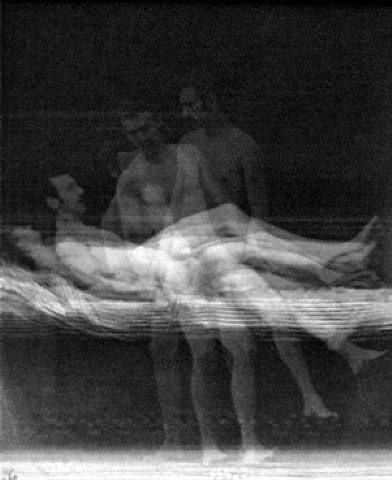
And we are only able to constitute a phenomenal object by means of associative similarities that present themselves and synthesize across a span of flowing time. But for Deleuze, we need not think that appearances show themselves through time in its flowing. The phenomenon of motion, for example, might just be the diminishing vibrancy of layers of after images all showing in one instant of perception.

Deleuzean Bergsonist Depth of Time

(Thanks eyefetch)


(Thanks diagonalthoughts.com)


(Thanks marinagraham)

If ever we feel time, we feel it as a difference or a gap, like when peering in the mirror and seeing someone who looks older than we thought we were. Abruptly-noticed signs of age make us feel the depth of many years all in that sudden instant when they flash before us. Instead of an extensive thickness of time, we might think of an intensive depth of time. Each moment in our lives has the depth of all time, here and now immediately. A Deleuzean phenomenological time need not flow, and perhaps should not flow. If the flow is based on associating similarities bridging one moment to the next, then more flow would mean less difference from moment to moment, and thus less standing out, less appearing, less phenomenality.


Image credits:
http://www.marinagraham.co.uk/files/IMG_355.jpg

http://www.diagonalthoughts.com/wp-content/uploads/2008/12/idris-khan.jpg

http://www.eyefetch.com/image.aspx?ID=1193241