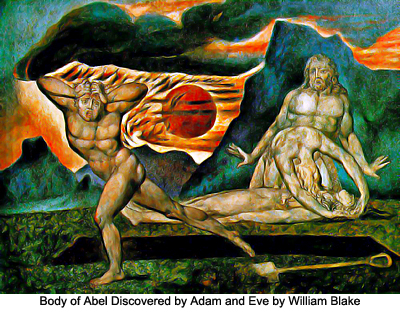
[The image was obtained gratefully from here.]
Becoming Blameless
Friedrich Nietzsche
The Will to Power
§ 765
(Jan.-Fall 1888)
"Redemption from all guilt"
Some are born into wealth and privilege, others into poverty and disability. Those who become bad, sick, or criminal claim that they are the result of "a long suppression of the weak by the strong." They make the ruling class responsible for their base characters. They did not choose their low position. The powerful forced it upon them.
These days, people call this attitude "the pessimism of indignation." From this perspective, history was guided by men responsible for their actions, and hence guilty of bequeathing our current "unjust" society. In this way, they "judge history, to divest it of its fatality, to discover responsibility behind it, guilty men in it." (400bc)
But the underprivileged are rebelling from their conditions, and they need some enemy to attack. So they seek-out some scapegoat in order not to direct their rage back upon themselves. Some, like Russian atheists, blame God. Others blame the social order, the Jews, the nobility "or those who have turned out well in any way."
In short, the pessimism of indignation invents responsibility in order to create a pleasant feeling for itself — revenge — "Sweeter than honey" old Homer called it. (400d)
*
The reason we tolerate the lowly's thirst for revenge on the strong is because it is a Christian value.
Christians believe we have an immortal soul. It comes from somewhere otherworldly. It descends into earthly flesh, but is not changed through this union. It does not matter to such a soul when in history it is born, and into which family and social strata.
With this idea, the individual is made transcendent; as a result, he can attribute a senseless importance to himself. (401b)
Christianity places the individual above everything else. For, it invites individuals to judge the state, society, historical laws, their bodies and so forth from the standpoint of their eternal souls. In this way, they "enforce eternal rights against everything temporal and conditioned," placing them beyond becoming.
What speaks here is something beyond becoming, something unchanging throughout history, something immortal, something divine: a soul! (401 bc boldface mine)
Christianity holds an even crazier idea: all souls are equal before God. On account of this delusion, humans first declared equal rights on a religious basis, and then later on a moral basis. Eventually this pessimism of indignation became an accepted idea in politics and society.
*
People often attribute responsibility to agents in the world. Whatever they try to understand, they taint with the idea that moral individuals are responsible for the things that happen. But this results from the instinct of revenge.
This instinct of revenge has so mastered mankind in the course of millennia that the whole of metaphysics, psychology, conception of history, but above all morality, is impregnated with it. As far as man has thought, he has introduced the bacillus of revenge into things. He has made even God ill with it. (401d)
But really, nothing is to blame for anything. There are competing forces, and the stronger win by necessity. Things change. This is not because someone does something wrong, and punishment restores balance. At every moment, the forces in the world have the right to fight. This is the justice of becoming. And outcomes are largely decided by blind chance, like a child god who rolls the dice. So every moment is innocent. That means we too are always innocent. Whenever we express our strength, it is just because it is necessary. So too when we express our weakness. We really were weak. It could not have been otherwise. But by affirming this fact of life, that all actions are innocent, we have already made a step towards greater strength. But that is not what the vengeful man seeks. he has deprived existence in general of its innocence; namely, by tracing back every state of being thus and thus to a will, an intention, a responsible act. (emphasis mine)
Many espouse the idea that an individual has a will that chooses between moral and immoral actions. They propagate this idea so that they may punish and take revenge against those who are stronger than them. Priests, for example, taught that men had a free will. This created God's right to take revenge on us. This falsehood has predominated psychological theories.
Europe today seems to have followed this path of resentment, revenge, and the pessimism of indignation. But we others "are trying with all our might to withdraw, banish, and extinguish the concepts of guilt and punishment from the world" so to "purify psychology, morality, history, nature, social institutions and sanctions, and even God of this filth." (402b)
We others, who desire to restore innocence to becoming, would like to be the missionaries of a cleaner idea: that no one has given man his qualities, neither God, nor society, nor his parents and ancestors, nor he himself — that no one is to blame for him. (402c, boldface mine)
Thus no one is responsible for anybody else's position in life.
And hence also, we did not result because something intended us to happen. We exist in this cosmos by a roll of the dice.
We are not the result of an eternal intention, a will, a wish.
There is no place, no purpose, no meaning, on which we can shift the responsibility for our being, for our being thus and thus. (402d)
This is impossible, because no one can take a stance outside the instant of becoming and judge the whole of things. There are five reasons for this. The first one is that
nothing exists besides the whole. (403a)
Hence no one can stand outside the whole of things to judge it.
So no one and nothing can be judged absolutely:
this is a tremendous restorative; this constitutes the innocence of all existence. (403a)
Nietzsche, Friedrich. The Will to Power. Ed. Walter Kaufmann. Transl Walter Kaufmann and R.J. Hollingdale. New York: Random House Vintage Books, 1967.
Image obtained gratefully from:


.jpeg)